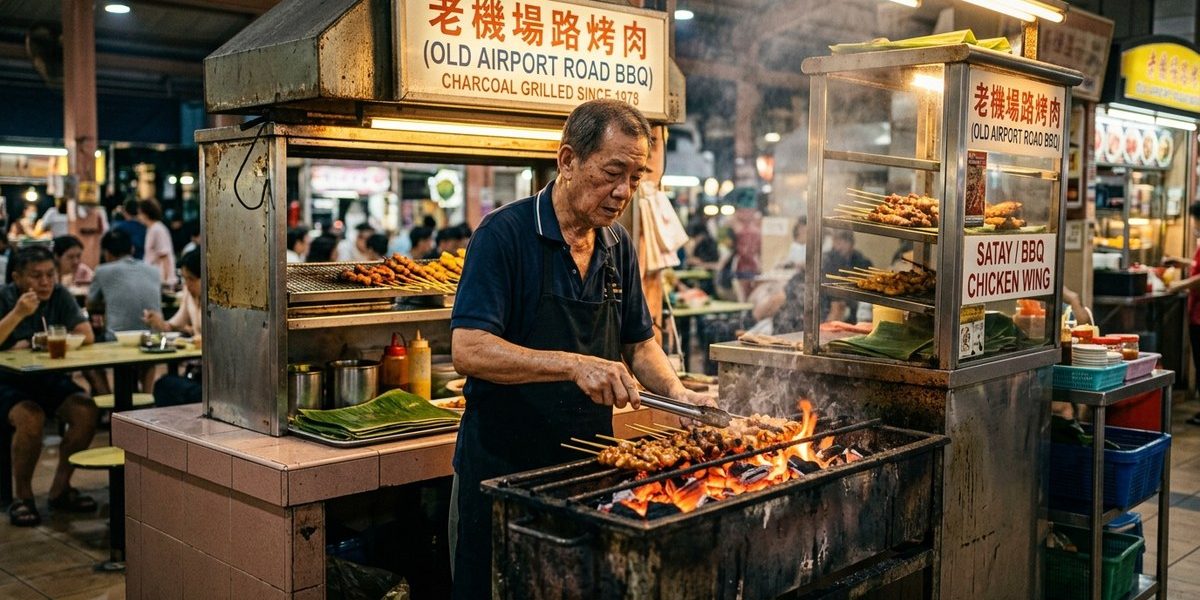
At Old Airport Road Food Centre, a distinct plume of smoke rises from one corner. It is not the usual steam from a wok or the haze from a fryer. It is the unmistakable scent of charcoal, mingling with the aroma of caramelised meat. This smoke tells a story of tradition, patience, and flavour that electric grills cannot replicate. In a city where efficiency often rules, Tong Kee Charcoal BBQ stubbornly sticks to an ancient method. And for the countless regulars who queue here, that stubbornness is exactly why they keep coming back.
Tong Kee Charcoal BBQ at Old Airport Road remains one of the last hawker stalls in Singapore to use real charcoal for barbecuing meat. The method is labour intensive but yields a deep, smoky flavour that gas or electric grills cannot match. Understanding why they stick to charcoal helps you appreciate every bite. If you have not tried it, make a trip soon. This is heritage food worth preserving.
The Charcoal Tradition at Tong Kee
Step closer to the stall and you see it. A simple wire grill sits over a bed of glowing embers. The chef, with a fan in one hand, coaxes the fire to the perfect heat. Pieces of chicken wings, pork belly, and satay skewers sizzle as the fat drips onto the charcoal below. The smoke curls upward, infusing the meat with a fragrance that is both primal and comforting.
Tong Kee has been operating at Old Airport Road Food Centre for decades. While many neighbours have upgraded to gas grills or electric ovens, this stall remains faithful to charcoal. The reason is not mere nostalgia. It is about flavour control. Charcoal burns at a higher temperature than gas, and it radiates infrared heat that sears the meat quickly, locking in juices. That initial blast of heat creates a crisp, caramelised exterior while keeping the inside tender and moist.
In Singapore’s humid climate, charcoal also helps reduce moisture in the cooking environment, which prevents the meat from steaming instead of grilling. The result is a dry, smoky finish that pairs beautifully with the stall’s signature sweet and savoury marinade.
Why Charcoal Matters for Flavour and Texture
The difference between charcoal and other heat sources is not subtle. Anyone who has eaten grilled food knows that charcoal adds something extra. That something is a combination of chemical reactions and aromatic compounds.
When fat drips onto hot charcoal, it vaporises and creates smoke. That smoke contains compounds like guaiacol and syringol, which give grilled meat its characteristic smoky taste. Gas grills cannot produce the same effect because the fat drips onto metal bars or burners, not onto red hot coals. Electric grills are even further removed from this process.
Tong Kee’s marinade also plays a role. The stall uses a blend of soy sauce, honey, garlic, and spices that caramelises beautifully under charcoal heat. The sugars in the marinade develop a deep brown crust, while the smoke adds layers of complexity. Each bite carries a hint of the fire, a taste of the kiln.
For food enthusiasts in Singapore, this is the real deal. No shortcuts, no artificial smoke flavourings. Just meat, fire, and time.
The Challenges of Cooking with Charcoal
Using charcoal is not easy. It requires skill, patience, and physical effort. Here are four challenges that Tong Kee’s chefs face every day:
-
Maintaining a consistent temperature. Charcoal does not burn evenly. The chef must constantly adjust the airflow by fanning or shifting the coals. One moment the fire is too hot and burns the meat; the next it is too low and the meat stews in its own fat. Experienced hands learn to read the embers and move the meat accordingly.
-
Longer cooking time. Unlike a gas grill that heats up in seconds, charcoal takes 20 to 30 minutes to reach the right temperature. The entire process, from lighting the coals to serving a batch of chicken wings, can take over an hour during peak hours. This limits how many portions the stall can produce, which explains the queues.
-
Managing smoke and heat. The stall is not air conditioned. The chef works in a hot, smoky environment for hours. It is physically demanding work that many younger hawkers are reluctant to take on. This is one reason why charcoal grilling is becoming rare.
-
Higher cost and sourcing difficulty. Good quality charcoal, like the lump charcoal Tong Kee prefers, is not cheap. It burns hotter and produces less ash than briquettes, but it is harder to find consistently. The stall must plan ahead and ensure a steady supply.
Despite these challenges, Tong Kee persists. The dedication shows in every bite.
Charcoal vs Gas: A Side by Side Comparison
To understand why Tong Kee still chooses charcoal, it helps to compare the two methods directly.
| Aspect | Charcoal | Gas |
|---|---|---|
| Flavour | Deep smoky flavour from fat dripping on coals | Cleaner taste; less pronounced smoke |
| Heat intensity | High, with infrared radiation for searing | Moderate; can struggle to achieve high sear |
| Temperature control | Requires manual adjustment; skill dependent | Easy to control with knobs |
| Cooking time | Longer preheat and cook time | Quick to heat and cook |
| Labour | High: fanning, turning, cleaning ash | Low: just turn the knob |
| Operating cost | Charcoal is expensive; needs frequent replacement | Cheaper per hour of use |
| Authenticity | Traditional; respected by purists | Modern; less romantic appeal |
| Consistency | Varies with each batch of charcoal | Highly consistent |
For a hawker stall aiming for speed and volume, gas makes sense. For a stall like Tong Kee, which prides itself on old school flavour, charcoal is irreplaceable.
How Tong Kee Achieves That Smoky Taste
The process behind the grill is straightforward but requires attention to detail. Here are the key steps that make Tong Kee’s barbecue stand out:
- Marination overnight. Meat is marinated in a house blend of soy sauce, honey, garlic, and secret spices. The long marination allows the flavours to penetrate deep into the meat.
- Choice of charcoal. The stall uses high quality lump charcoal, not briquettes. Lump charcoal lights faster, burns hotter, and imparts a cleaner smoke.
- Careful fire management. The chef fans the coals to achieve a medium high heat. Too hot and the marinade burns; too low and the meat dries out.
- Grilling in batches. Only a few skewers or pieces are cooked at a time to ensure even cooking. Each piece is turned multiple times to develop an even crust.
- Resting the meat. After grilling, the meat rests for a minute or two. This allows the juices to redistribute, keeping the meat succulent.
Each chicken wing or satay skewer leaves the grill with a glossy, charred coating. The smell alone draws people from across the food centre.
Expert Advice from the Hawker Behind the Grill
We spoke to the stall owner, Uncle Lim, about his commitment to charcoal. He has been running Tong Kee for over 20 years.
“Many people ask me why I don’t switch to gas. I tell them: charcoal is like old friend. You need to understand it, respect it. Gas is faster, but it cannot give you that smokiness. My customers come here for that taste. If I change, they will know. I will not do that to them.”
Uncle Lim’s words reflect a broader truth about Singapore’s hawker culture. The best stalls are often the ones that resist change, not because they are stubborn, but because they know what works. In a world of convenience, Tong Kee’s charcoal fire is a quiet act of rebellion.
For more stories about hawkers who stick to tradition, read about why Tian Tian Hainanese Chicken Rice still has queues after 30 years or meet the 78-year-old uncle behind Chinatown’s best char kway teow.
Visiting Tong Kee: What to Order and When to Go
If you plan to try Tong Kee Charcoal BBQ, here is what you need to know.
Location: Old Airport Road Food Centre, stall 01-10. It is in the central section of the hawker centre, near the drink stalls.
Opening hours: Typically 11:00 am to 9:00 pm, but they close when sold out. Weekends are busiest, so arrive before noon if you want a shorter queue.
Must order items:
– Charcoal grilled chicken wings. They are the signature. The skin is crisp, the meat juicy.
– Pork belly skewers. Fatty and caramelised, with a smoky edge.
– Satay (chicken or beef) served with peanut sauce and ketupat. The peanut sauce is house made, thick, and slightly spicy.
Pro tip: bring your own tissues to chope a table before you queue. The centre gets packed during lunch and dinner hours.
If you are new to Old Airport Road Food Centre, you might also want to check out our ultimate guide to recently renovated hawker centres and their must try new tenants to see what else is available.
Preserving the Charcoal Flame for Future Generations
Tong Kee Charcoal BBQ is more than a stall. It is a living example of how Singapore’s hawker heritage can survive in a modern city. Every time Uncle Lim fans the coals, he is keeping a dying trade alive. Charcoal grilling is disappearing from hawker centres, replaced by cleaner, faster methods. But the flavour it produces is irreplaceable.
As food enthusiasts, we have a role to play. By visiting stalls like Tong Kee, we support the hawkers who choose tradition over convenience. We vote with our wallets. Every queue we join is a signal that heritage matters.
The next time you are at Old Airport Road, follow the smoke. Let the charcoal aroma guide you to a stall that still cooks the old way. Order a plate of chicken wings, sit down, and taste the fire. You will understand why some things are worth keeping.
For more stories about the hawkers keeping Singapore’s food heritage alive, check out three generations behind the wok: Singapore’s oldest family-run hawker stalls and the vanishing art of traditional kueh-making: elderly hawkers keeping Peranakan sweets alive.