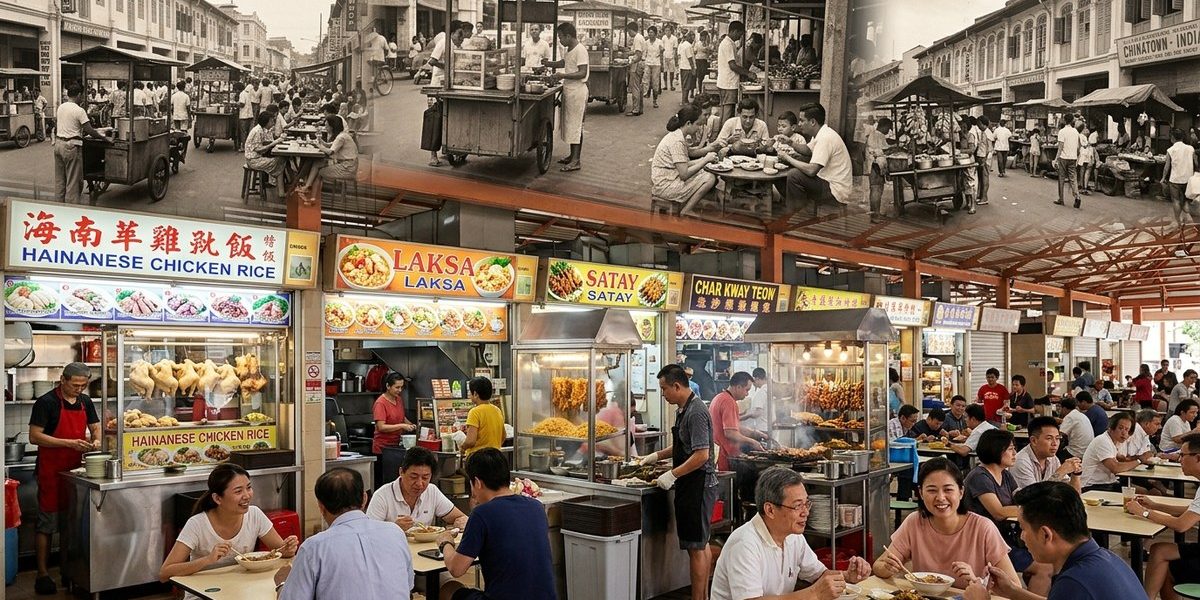
The whirring of extraction fans, the clatter of metal spoons against woks, the bright fluorescent lights that illuminate row after row of stalls. This is the modern hawker centre you know. Now picture its predecessor: a smoky five foot way, a pushcart balanced on uneven pavement, a hawker sweating over a charcoal stove beside an open drain. That world existed just sixty years ago. Then the government stepped in with a sweeping plan. The 1960s hawker relocation Singapore programme did not just clean up the streets. It permanently rewired how we eat, how we gather, and how we define local food.
The 1960s hawker relocation Singapore programme moved thousands of street vendors into purpose-built centres. It solved public health and traffic problems but also preserved recipes and created the communal dining spaces we love today. Understanding this history helps you appreciate why some stalls still taste like the old days and why queuing for chicken rice is a national habit.
The Chaotic Pre-1960s Street Hawker Scene
In the 1950s and early 1960s, Singapore's streets were alive with food peddlers. They sold Hokkien mee from pushcarts, satay from bamboo poles, and roti prata from makeshift tents. But this vibrancy came at a cost. Many hawkers operated without licenses. They used water from drains and disposed of oil into monsoon canals. Traffic jams formed around popular carts. Residents complained of noise, pests, and fires. The colonial government had tried to regulate them before, but enforcement was weak. By the time Singapore gained self governance in 1959, an estimated 25,000 illegal hawkers roamed the island.
In 1965, newly independent Singapore faced a different challenge. The city state needed order, cleanliness, and efficiency. Street hawkers, beloved as they were, clashed with these goals. The government saw them as a public health risk and an obstacle to urban modernisation. But it also recognised their value. They provided affordable meals for low income workers and immigrants. A complete ban would cause backlash.
The Government's Decision to Relocate
The answer was not to eliminate hawkers but to move them. The 1960s hawker relocation Singapore programme aimed to license, register, and house street vendors in government built hawker centres. This was a massive logistical undertaking. Officials conducted surveys, designed stalls, and negotiated with vendor associations.
Why Relocation Was Necessary
- Public health: Street hawking had no sanitation standards. Diarrhoea and food poisoning were common.
- Traffic congestion: Carts blocked roads and caused accidents.
- Urban redevelopment: Many hawker areas were targeted for new housing estates and roads.
- National image: Lee Kuan Yew's government wanted Singapore to look modern and orderly.
The programme was not universally popular. Some hawkers resisted. They feared high rents, loss of regular customers, and unfamiliar rules. But the government offered incentives like low rent and training.
How the 1960s Hawker Relocation Programme Worked
The process unfolded over several years. Here are the key steps:
-
Registration and licensing - The Ministry of Health conducted a census of all hawkers. Each received a temporary license. This allowed officials to know exactly who was operating and where.
-
Construction of hawker centres - The Housing and Development Board and the Urban Renewal Authority built the first purpose built centres. Early examples include the original Whampoa Food Centre and the relocated Albert Street hawkers at what is now Tekka Centre.
-
Allocation of stalls - Licensed hawkers were assigned spaces based on their type of food. The goal was to replicate the variety of street life under one roof. Vendors who had operated in the same area for years were given priority.
-
Enforcement against illegal hawking - Once centres opened, unlicensed street vending was strictly prohibited. By the early 1970s, most roadside hawkers had moved indoors.
The government also established fixed rent structures and common utilities like shared sinks and rubbish disposal. This was revolutionary for its time.
The Human Impact: Stories from Hawkers
Not everyone adapted easily. Many older hawkers found the transition painful. They missed the freedom of the street. Some stalls lost their loyal customer base when they relocated to a new estate. Others struggled with the rent, though it was low by today's standards.
"I used to push my cart from Chinatown to Geylang every morning. When they opened the new centre in Toa Payoh, they gave me a stall. I was angry at first. The place was empty. But slowly people came. I am still here 40 years later. My son takes over next year."
Uncle Lim, retired Hokkien mee hawker (interviewed in 2020)
Stories like Uncle Lim's are common. The relocation forced change, but it also stabilised the trade. Many family recipes survived because they were handed down within a fixed, permanent space. You can still taste that continuity at stalls like the one featured in Meet the 78-Year-Old Uncle Behind Chinatown's Best Char Kway Teow. His story mirrors the generation that made the move.
The Lasting Legacy on Singapore's Food Landscape
The 1960s hawker relocation Singapore programme left behind a food system that is now the envy of the world. Consider these outcomes:
- Hygiene standards improved dramatically. The first hawker centres introduced running water, proper drainage, and regular inspections.
- Food variety consolidated. Instead of a single cart selling one dish, a centre offers dozens of cuisines under one roof.
- Community spaces were born. Hawker centres became the neutral ground for all races and classes.
- Heritage preservation happened accidentally. Because stalls stayed in one place, recipes were passed down without disruption.
The famous stall Why Tian Tian Hainanese Chicken Rice Still Has Queues After 30 Years is a product of this stability. Without the relocation, it might have remained a nameless pushcart.
Comparing Old and New: A Table
| Aspect | Street Vending (pre 1960s) | Hawker Centre (post 1960s) |
|---|---|---|
| Hygiene | Open drains, shared utensils | Running water, individual stalls, cleaning standards |
| Variety | One dish per cart | Multiple cuisines in one centre |
| Operating cost | Low (no rent) | Low rent but utilities |
| Location | Along roads, five foot ways | Designated sheltered buildings |
| Regulation | Minimal or none | Licensed, regular health checks |
| Customer base | Passers by, regulars | Local estate residents, wider public |
The table shows the trade offs. Costs went up slightly, but the gains in safety and convenience were enormous.
Challenges and Adaptations
The programme was not perfect. Some hawkers were pushed out because they could not afford the rent or did not qualify for a license. Others found their new location was too far from their old customers. The food scene lost some itinerant specialties like mobile rojak carts and night soil noodles (yes, that was a real thing). But overall, the relocation succeeded in its primary goal: to modernise street eating.
In later decades, the government built more centres. Today, there are over 110 hawker centres across Singapore. Many are now heritage listed structures. The 1960s scheme essentially created the template we still use.
If you want to see a direct link to that era, visit a centre built in the 1970s, such as the one described in The Ultimate Guide to Tiong Bahru Market: Where Heritage Meets Hawker Excellence. The layout, the tiles, the metal fans. They all echo the original design.
Why This History Matters for Today's Hawker Hunters
Understanding the 1960s hawker relocation Singapore programme helps you read the foodscape differently. When you order a plate of char kway teow at a gleaming new centre, you are tasting a lineage that began on a pushcart. The relocation did not kill the hawker spirit. It gave it a roof.
It also explains why some stalls are tucked away in older estates rather than tourist hubs. Those hawkers were the original settlers of the 1960s move. Their families have been cooking in the same spot for three or four generations.
For the aspiring food hunter, this history is a cheat code. The best stalls are often those that can trace their roots to a pre relocation pushcart. They carry the flavour of an era when hawking was a survival trade, not a commerce class.
What You Can Do Next
Your next hawker meal can be a tribute to that history. Before you eat, ask the stall owner how long they have been there. They might say "since 1972." Or "my father started in 1966." That date is a clue. It tells you they were part of the relocation wave.
Visit a neighbourhood centre like those in Toa Payoh, Ang Mo Kio, or Queenstown. These were the first to receive relocated hawkers. Bring your friends and share a table. That act of communal dining is exactly what the planners of the 1960s wanted to preserve.
And if you crave a taste of the past, try the stall we profiled in Five Generations of Bak Chor Mee: Inside Tai Hwa Pork Noodle's Michelin Success. Their story is a direct thread from the pushcart era.
The 1960s hawker relocation did not just clean up Singapore. It saved our food culture from extinction. The next time you queue under a bright fluorescent light, remember you are standing in a line that began sixty years ago, on a hot street corner, with a man pushing a cart and a dream.