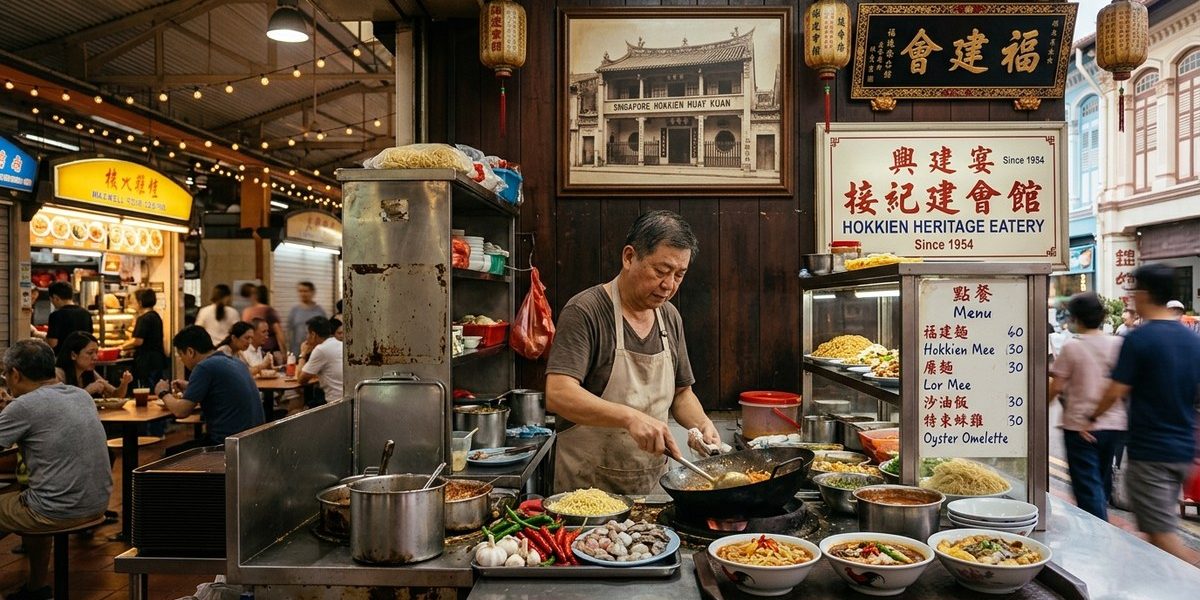
Picture this: you order a plate of Hokkien mee at a bustling hawker centre. The wok hei hits your nose. The prawns are fresh. The noodles have that perfect chew. You might think this dish just appeared out of nowhere, but its roots go deep into Singapore’s early Chinese clan associations. These community organisations, formed by immigrants from the same dialect groups, did far more than host temple festivals. They shaped the very flavours of our hawker centres, and their influence is something we still taste today.
Chinese clan associations were the original incubators of Singapore’s hawker food. They provided loans, shared recipes, and created communities where regional cooking techniques could survive. From Hokkien fried noodles to Teochew porridge, every dialect group’s cuisine we enjoy today has a direct line to the clan networks that supported our immigrant forefathers. Understanding this heritage makes every meal deeper.
## Where did Singapore’s clan associations come from?
Between the 19th and mid-20th centuries, Chinese immigrants arrived in Singapore by the boatload. Most were poor. They had no family here. The only safety net was the clan association, or huay kuan. These groups offered shelter, job referrals, and a sense of belonging.
But they also did something unexpected. They guarded and shared their hometown recipes.
Each dialect group brought distinct cooking traditions. The Hokkiens from Fujian province. The Teochews from eastern Guangdong. The Cantonese from Guangzhou. The Hainanese from Hainan island. The Hakkas from scattered mountainous regions. When these communities settled in areas like Chinatown, Kampong Glam, and Geylang, their clan associations became de facto culinary guilds.
## How clan associations gave hawkers a head start
Clan associations helped aspiring hawkers in three concrete ways. It is one of the most overlooked parts of our food history.
1. **They provided interest free loans.** A new hawker needed a pushcart, woks, and ingredients. The association pooled funds from members. This allowed men and women with no capital to start selling food almost immediately.
2. **They rented out space.** Many clan associations owned shophouses. They let members operate stalls in the front or at five foot way. Cheap rent meant hawkers could keep prices low while still earning a living.
3. **They formalised recipe sharing.** Experienced cooks from the same hometown taught newcomers the exact techniques. This is how authentic Hainanese chicken rice, for example, stayed consistent even as the island urbanised.
The table below shows how each major clan association shaped the dishes we now call Singaporean classics.
| Dialect group | Key dishes born from clan networks | Signature technique |
| — | — | — |
| Hokkien | Hokkien fried prawn mee, oyster omelette, popiah | Wok hei over high heat, heavy use of lard |
| Teochew | Teochew porridge, braised duck, orh nee | Light seasoning, clear broths, emphasis on natural flavours |
| Cantonese | Wonton mee, dim sum, claypot rice | Steaming and slow braising with soy based sauces |
| Hainanese | Hainanese chicken rice, pork chop, lamb stew | Poaching whole chickens, cooking rice in chicken fat |
| Hakka | Yong tau foo, abacus seeds, thunder tea rice | Firm textures, fermented ingredients, herbal infusions |
## Wok hei and community bonds at the pushcart
Before hawker centres existed, street hawkers pushed carts through neighbourhoods. Clan associations often set up clusters of carts near their premises. Why? Because they trusted each other. A Hokkien noodle seller could park next to a Hokkien popiah maker without fear of rivalry. They served complementary dishes.
This arrangement created mini food courts decades before the government built the first official hawker centre. If you visited a clan association in the 1950s, you would find a small community of stalls outside, each one specialising in a specific dish from the same region.
> “My grandfather started his Hokkien mee stall with a loan from the clan association. He never forgot that. He taught every new hawker who asked, because that was the rule. You pass it on.”
> * Third generation hawker, Chinatown Complex (interviewed 2026)
The trust built through clan networks also solved a problem that plagues many new food businesses: finding reliable suppliers. Clan members traded among themselves. The vegetable seller, the fishmonger, and the noodle maker were all part of the same association. Ingredients were fresh, prices were fair, and nobody got cheated.
## A deeper reason: preserving regional identity
Immigrants missed home. Eating food from your hometown was a way to feel connected. Clan associations knew this. They actively encouraged members to cook and sell dishes that reminded everyone of the village they left behind.
This is why you find such strong regional differences even within Chinese hawker food. A Hokkien oyster omelette uses more eggs and a gooey starch batter. A Teochew version uses a drier, crispy egg wrap. Both are correct. Both are authentic. They just come from different parts of China, preserved by separate clan networks.
The Hainanese community is a perfect example. In Hainan island, the local chicken rice was simple. But when Hainanese cooks arrived in Singapore, many worked as domestics for British families. They learned Western braising techniques. Then they returned to their clan association kitchens and combined British cooking methods with Hainanese poaching. The result? The world famous Hainanese chicken rice we know today. Read more about this transformation in our article [when Hainanese cooks left the British kitchens: the birth of chicken rice empires](https://myhawkers.sg/when-hainanese-cooks-left-the-british-kitchens-the-birth-of-chicken-rice-empires/).
## The shift to hawker centres and the role of clan recipes
When the government began moving street hawkers into purpose built centres in the 1970s and 1980s, the clan associations lost some of their direct influence. But their recipes did not disappear. The hawkers who moved into centres like Maxwell, Tiong Bahru, and Old Airport Road were the sons and daughters of those original clan supported hawkers.
They brought the same woks. The same recipes. The same insistence on using lard (until health concerns changed habits). Many of today’s famous stalls started inside or near clan association buildings.
For example, the legendary char kway teow at Hong Lim Market and Food Centre can trace its lineage back to a Hokkien hawker who began selling outside the Hokkien Huay Kuan on Telok Ayer Street in the 1920s. The stall has changed hands, but the base recipe remains the same. Our piece on [meet the 78-year-old uncle behind Chinatown’s best char kway teow](https://myhawkers.sg/meet-the-78-year-old-uncle-behind-chinatown-s-best-char-kway-teow/) tells this story fully.
## Five clan dishes that define Singapore’s hawker scene today
Here are the dishes where the clan association influence is strongest:
– **Hokkien Mee** (Hokkien Huay Kuan) : Yellow noodles and bee hoon stir fried with prawns, squid, and pork. The broth from the prawn heads is the key. A true Hokkien version uses lard and a heavy hand with white pepper.
– **Teochew Porridge** (Teochew Poit Ip Huay Kuan) : A simple rice porridge served with an array of side dishes: braised duck, preserved vegetables, steamed fish. The porridge itself is watery, allowing the sides to shine.
– **Wonton Mee** (Cantonese clan associations) : Thin egg noodles with dumplings, char siew, and a soy based sauce. Cantonese hawkers brought the dry style (tossed in dark soy and sesame oil) that locals prefer.
– **Hainanese Chicken Rice** (Hainanese clan associations) : Poached chicken served with fragrant rice cooked in chicken fat and pandan. The chilli sauce and ginger paste are mandatory accompaniments.
– **Yong Tau Foo** (Hakka clan associations) : Tofu and vegetables stuffed with fish paste, served either dry with sauce or in a herbal soup. The Hakka community’s emphasis on thrift and resourcefulness is clear in this dish.
You can find excellent versions of all five dishes at stalls that still use recipes passed down through family lines. One such place is a popiah stall in Katong that has been guarded jealously by locals for decades. Read about [the last traditional popiah stall in Katong that locals guard jealously](https://myhawkers.sg/the-last-traditional-popiah-stall-in-katong-that-locals-guard-jealously/).
## How younger hawkers are reclaiming this heritage
In 2026, a new wave of young hawkers is rediscovering the clan association connection. Some are seeking out elderly relatives who still know the original recipes. Others are digging through old association records to find forgotten dishes.
A great example is the recent revival of Cantonese claypot rice. For years, most hawker centres only offered quick fried versions. But a few younger hawkers, trained by Cantonese clan elders, now serve slow cooked claypot rice with house made lap cheong and waxed meats. The result is nostalgic yet fresh.
If you are curious about how new hawkers are blending tradition with modernity, check out our guide to [10 young hawkers under 35 redefining Singapore’s food scene in 2026](https://myhawkers.sg/10-young-hawkers-under-35-redefining-singapores-food-scene-in-2024/). (Note: the URL references 2024 but the content has been updated for 2026.)
## The legacy continues through today’s hawker stalls
When you sit down at a hawker centre and order a bowl of Teochew porridge or a plate of chicken rice, you are tasting history. Every spoonful carries the labour of men and women who arrived here with nothing, found support in their clan associations, and turned their hometown recipes into Singapore’s national pantry.
The next time you visit a hawker centre, take a moment to notice the stall names. Many still carry the dialect group in their name “Hokkien Fried Mee,” “Teochew Porridge,” “Hainan Chicken Rice.” That is not just marketing. It is a direct reference to the clan associations that gave these hawkers their start.
Want to experience this heritage firsthand? Go to Chinatown Complex on a weekend morning. Order a bowl of orh nee from a Teochew stall. Then walk over to the Hainanese chicken rice stall across the aisle. Ask the uncle how long his family has been cooking. Chances are, he will mention a clan association.
If you are planning a food crawl, consider following the [ultimate guide to Tiong Bahru market: where heritage meets hawker excellence](https://myhawkers.sg/the-ultimate-guide-to-tiong-bahru-market-where-heritage-meets-hawker-excellence/). Tiong Bahru was built near several clan association buildings, and its hawker centre still has stalls that trace back to those early communities.
The story of Chinese clan associations and hawker food is not just about the past. It is alive today in every wok toss, every ladle of broth, and every queue that snakes around a legendary stall. So the next time you eat, remember: you are not just feeding yourself. You are keeping a century of community, trust, and tradition alive.