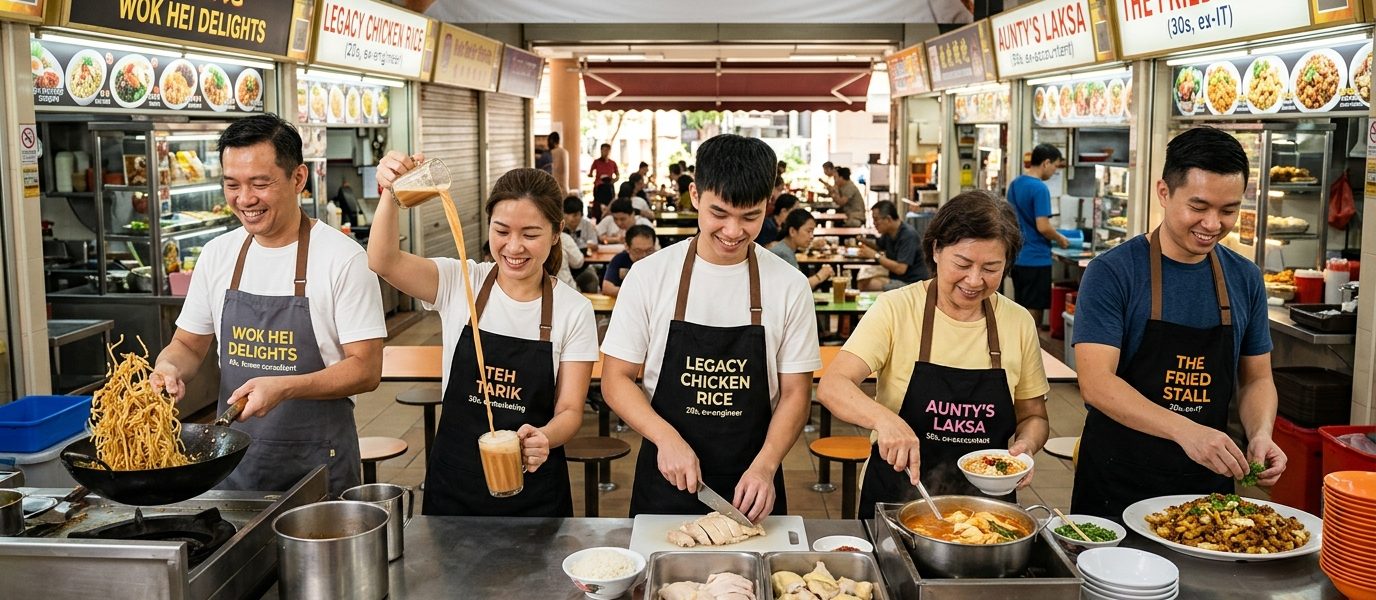
The smell of wok hei at 6am beats the scent of office coffee any day. At least that’s what former banker Marcus Tan believes as he flips char kway teow at his Bedok hawker stall, trading his suit for an apron three years ago.
Switching from corporate work to running a hawker stall demands honest financial planning, culinary skills, and mental preparation for physical labour. Success stories show that former professionals bring business acumen to traditional trades, but the transition requires at least six months of training, S$50,000 to S$100,000 in capital, and acceptance of drastically different working conditions. The reward is autonomy, direct customer relationships, and preserving Singapore’s food heritage.
Why professionals are choosing hawker stalls over boardrooms
The corporate job to hawker stall career switch isn’t just a trend. It’s a response to burnout, a search for meaning, and sometimes a return to family roots.
Sarah Lim spent 12 years climbing the marketing ladder at a multinational firm. Her weekends disappeared into email chains. Her passion for food became her only outlet.
“I was earning good money but felt empty,” she says. “My grandmother’s laksa recipe kept calling me back.”
Today, Sarah runs a laksa stall at Tiong Bahru Market. She wakes at 4am to prepare her spice paste. The work is harder physically, but mentally lighter.
The numbers tell part of the story. NEA reported that between 2019 and 2023, roughly 15% of new hawker stall applicants came from white-collar backgrounds. That’s up from just 8% in the previous five years.
These career switchers bring fresh perspectives to traditional trades. They understand branding, customer service systems, and digital marketing in ways that older hawkers might not.
But romanticising the switch is dangerous. The reality involves standing for 10 hours, managing thin profit margins, and accepting that your income might drop by half or more initially.
What the transition actually costs you
Let’s talk money first because that’s where most people stumble.
Initial capital requirements
| Expense Category | Estimated Cost (SGD) | Notes |
|---|---|---|
| Stall rental deposit | 3,000 to 8,000 | Varies by location and hawker centre |
| Equipment and setup | 20,000 to 50,000 | Woks, fridges, prep tables, exhaust systems |
| Licensing and permits | 1,500 to 3,000 | Food hygiene courses, NEA licenses |
| Initial ingredient stock | 3,000 to 5,000 | First month’s supply |
| Working capital buffer | 15,000 to 30,000 | Cover losses during learning phase |
| Total | 42,500 to 96,000 | Conservative estimate |
Daniel Wong left his IT project management role with S$80,000 in savings. He thought it would be enough.
“I burned through S$60,000 in the first eight months,” he admits. “Equipment broke down. I wasted ingredients learning proper portions. My initial menu was too ambitious.”
His chicken rice stall at Ang Mo Kio finally turned profitable in month nine. Now he clears S$4,500 monthly after expenses, compared to his previous S$7,200 corporate salary.
The income drop is real. Most successful hawker switchers report earning 30% to 50% less in their first two years.
But the calculation isn’t purely financial. Daniel now finishes work by 3pm most days. He sees his kids after school. His stress levels plummeted.
Time investment before opening day
You can’t just rent a stall and start cooking. The learning curve is steep.
- Complete mandatory food safety certification through SFA-approved providers (1 to 2 days, around S$200).
- Apprentice with an experienced hawker for at least 3 to 6 months to learn dish fundamentals, timing, and workflow.
- Test your recipes extensively on friends, family, and honest critics who’ll tell you when your char siew is too sweet.
- Understand supplier networks and negotiate pricing on ingredients, which can make or break your margins.
- Build physical stamina because standing for 8 to 12 hours daily while managing heat and speed is brutal.
Rachel Goh, a former HR manager, spent five months training under a bak chor mee master before opening her own stall.
“I thought I could cook because I hosted dinner parties,” she laughs. “Cooking for 200 customers daily is completely different. The speed, the consistency, the muscle memory needed… it’s another world.”
She also underestimated the physical toll. Rachel lost 8kg in her first three months from the sheer activity and heat.
Skills from corporate life that actually transfer
Not everything from your office career becomes useless. Some abilities translate surprisingly well.
Process optimization matters enormously. Former engineers and project managers excel at streamlining prep work, reducing waste, and improving service speed.
Marcus, the ex-banker, applied his analytical skills to track ingredient costs daily. He identified that switching suppliers for bean sprouts saved him S$180 monthly. Small gains compound.
Customer service training from corporate roles helps too. Understanding complaint resolution, reading customer moods, and building rapport creates loyal regulars faster.
Marketing and branding knowledge gives career switchers an edge. They create Instagram-worthy presentation, use social media effectively, and understand how to differentiate their stalls.
“My corporate background taught me to see patterns in data. I track which dishes sell best on rainy days versus sunny ones, adjust my prep accordingly, and reduce waste by 40% compared to when I started.” – Daniel Wong, chicken rice hawker
But don’t assume business school prepares you for everything. Hawker culture has its own unwritten rules about supplier relationships, neighbouring stall etiquette, and customer expectations that only experience teaches.
The hardest adjustments nobody warns you about
The physical demands surprise everyone. Corporate workers aren’t conditioned for the repetitive strain, heat exposure, and constant standing.
Sarah developed plantar fasciitis in month two. She now wears compression socks and proper kitchen shoes, but the pain took six months to fully resolve.
The social dynamics shift dramatically too. You go from team meetings and office politics to working largely alone or with one assistant. Some people love the independence. Others feel isolated.
“I missed the camaraderie,” admits Rachel. “In HR, I was surrounded by people all day. At the stall, it’s just me and the wok until the lunch rush hits.”
The loss of corporate benefits stings. No more annual leave, medical insurance, or CPF contributions from an employer. You’re suddenly responsible for your own retirement planning and health coverage.
Common mistakes career switchers make:
- Choosing trendy dishes over proven classics because they want to be “different”
- Underpricing to compete, then realising margins don’t cover costs
- Overcomplicating menus instead of mastering two or three signature items
- Ignoring the importance of location and foot traffic patterns
- Expecting instant success and giving up after a slow first quarter
The emotional adjustment is real too. Going from a respected professional title to “the new hawker” requires ego management.
Marcus remembers his first week clearly. A customer complained loudly that his char kway teow wasn’t as good as the previous stall holder’s. In banking, he managed million-dollar portfolios. Now he was being publicly criticised over S$5 noodles.
“You have to develop thick skin fast,” he says. “But you also have to listen. That customer was right. My wok hei wasn’t strong enough yet.”
How to test the waters before burning bridges
Don’t quit your job tomorrow. Smart switchers test their concept first.
Weekend markets and pop-up opportunities let you validate your recipes and gauge customer response without full commitment. Several career switchers started at neighbourhood markets before securing permanent stalls.
Take unpaid leave to apprentice if your company allows it. Three months of intensive training beats jumping in blind.
Calculate your real break-even point. Track every expense during your testing phase. If your food cost exceeds 35% of selling price, your pricing is probably wrong.
Build a financial runway of at least 12 months of living expenses before making the switch. Most successful transitions involved people who could afford to earn nothing for six months while learning.
Talk to other career switchers honestly. The hawker community is surprisingly open. Visit stalls during off-peak hours and ask owners about their experience. Most will share their journey.
Consider starting with simpler dishes. Chicken rice has fewer variables than laksa. Mastering one dish thoroughly beats offering a mediocre menu of ten items.
What makes some switchers succeed while others quit
The difference between those who make it and those who return to corporate life often comes down to three factors.
Realistic expectations top the list. People who expected hawker life to be easier than office work usually quit within a year. Those who anticipated hard physical labour and lower income but valued the tradeoffs stayed.
Genuine passion for the specific dish matters more than general interest in food. You’ll make the same dish hundreds of times weekly. If you don’t love it deeply, the repetition kills motivation.
Financial cushion and family support prove critical. Every successful switcher I spoke to had either substantial savings or a spouse with stable income. The ones who struggled financially gave up faster, regardless of cooking skill.
Daniel’s wife kept her teaching job for the first two years. That stability let him weather the learning curve without panic.
“I could focus on improving my chicken rice instead of worrying about next month’s rent,” he explains. “That mental space was priceless.”
The ability to accept feedback and iterate constantly separates survivors from quitters too. Corporate culture often rewards confidence and decisiveness. Hawker culture rewards humility and continuous improvement.
Rachel changed her bak chor mee recipe 23 times in her first year based on customer feedback. She tracked comments in a notebook, tested variations, and gradually refined her formula.
“In HR, I was the expert giving advice,” she notes. “As a hawker, I became a student again. That mindset shift was hard but necessary.”
Building your reputation from zero
You don’t have a corporate brand behind you anymore. Your reputation is purely your own work.
Consistency matters more than occasional brilliance. Customers return when they know exactly what they’re getting every single time.
Marcus obsesses over this. His char kway teow tastes identical whether you order at 11am or 1pm. He pre-portions ingredients, times his wok heat precisely, and refuses to rush even during peak hours.
“In banking, I could have good days and bad days. Here, every plate has to be perfect,” he says.
Word of mouth remains the most powerful marketing for hawkers. One regular customer who brings friends weekly is worth more than any Instagram post.
But social media helps, especially for younger customers. Sarah posts her laksa prep process on Instagram stories. It’s not polished content, just honest behind-the-scenes glimpses. Her follower count is modest, but engagement is high.
She also participates in hawker festivals and food trails, which expose her stall to new audiences. The young hawkers movement creates opportunities for career switchers to connect and collaborate.
Location still trumps everything though. A mediocre stall in a high-traffic hawker centre will outlast an excellent stall in a quiet neighbourhood. Choose your location carefully.
The unexpected rewards beyond income
Money isn’t why most switchers stay. The intangible benefits keep them going.
Direct customer relationships provide satisfaction that corporate work rarely offers. When a regular tells you their day feels incomplete without your chicken rice, it hits differently than a performance review.
Creative autonomy is real. You decide your menu, your hours, your suppliers. No committees, no approvals, no corporate bureaucracy.
“I answer to my customers and myself,” Sarah says. “That freedom is worth the pay cut.”
The connection to heritage and culture resonates deeply for many. They’re not just cooking food. They’re preserving techniques, recipes, and traditions that might otherwise disappear.
Several switchers mentioned improved mental health despite harder physical work. The simplicity of the work, the clear goals, and the immediate feedback loop reduce anxiety.
Daniel puts it simply: “I sleep better now. In IT, I’d wake up at 3am worrying about project deadlines. Now I wake at 3am to prep chicken. It’s earlier, but I’m not anxious.”
The sense of community within hawker centres surprises many too. Neighbouring stall holders share ingredients, cover for each other during emergencies, and celebrate each other’s successes.
This communal aspect contrasts sharply with competitive corporate environments where colleagues are often rivals.
When the switch might be wrong for you
Not everyone should make this transition. Some warning signs suggest you might be better off staying corporate.
If you’re running from problems rather than toward something specific, hawker life won’t solve your issues. The work is too hard to sustain without genuine pull toward it.
If you need external validation and status markers, the ego hit might be too much. Nobody at the hawker centre cares about your previous job title.
If you have low physical stamina or chronic health issues that standing work would aggravate, reconsider. The physical toll is real and cumulative.
If your financial situation is already tight, the risk might be too high. This transition works best from a position of financial stability, not desperation.
If you’re hoping to get rich, wrong industry. Successful hawkers make decent livings, but few become wealthy. This is about lifestyle and passion, not maximising income.
And if you can’t handle direct criticism from strangers about your work, the customer-facing nature of hawker work will destroy you. People are blunt about food.
Making the switch work for you
Start planning at least 12 months before you quit. Use that time to save aggressively, train on weekends, and test your concept.
Find a mentor in the specific dish you want to master. Offer to work for free on weekends. Most established hawkers respect genuine interest and will teach willing students.
Study the business side as thoroughly as the cooking. Understand ingredient sourcing, pricing strategies, and the licensing process. The NEA website provides detailed requirements.
Visit different hawker centres at various times to understand foot traffic patterns, customer demographics, and competition levels.
Build your physical fitness before starting. The work is genuinely demanding. Regular exercise and strength training help prevent injuries.
Create a detailed financial plan that accounts for worst-case scenarios. What if you earn nothing for six months? What if equipment breaks down? What if you get sick?
Talk to your family honestly about the lifestyle changes. Your hours will be different. Your income will likely drop. Your stress will shift from mental to physical. Everyone needs to be on board.
Consider starting part-time if possible. Some hawker centres allow shared stalls or weekend-only operations. This lets you build skills and customers while maintaining some corporate income.
The path forward for career switchers
The corporate job to hawker stall career switch isn’t for everyone. It’s physically harder, financially riskier, and socially different than office work.
But for those with genuine passion, adequate preparation, and realistic expectations, it offers rewards that corporate life can’t match.
The satisfaction of mastering a craft, serving your community, and building something entirely your own draws people despite the challenges.
Singapore’s hawker culture benefits from these switchers too. They bring professionalism, innovation, and energy that helps preserve and evolve our food heritage.
If you’re seriously considering this path, start small. Test your recipes. Talk to current hawkers. Calculate your real costs. Build your skills gradually.
The best career switches happen when preparation meets passion. Give yourself time to develop both before taking the leap.
Your corporate skills won’t go to waste. They’ll just get applied in a completely different context, one that smells like wok hei and sounds like sizzling noodles instead of keyboard clicks and meeting room chatter.