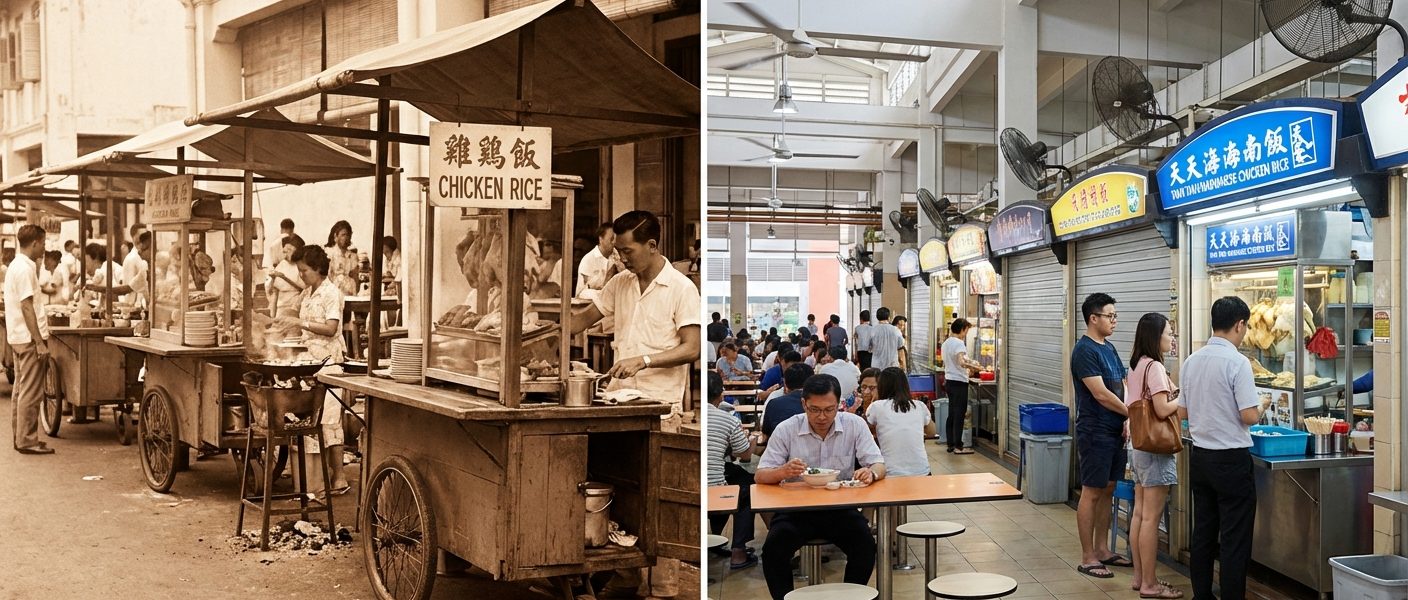
Singapore’s hawker centres didn’t appear overnight. They’re the result of decades of careful planning, cultural negotiation, and a government determined to clean up the streets without destroying the soul of local food culture. What started as thousands of unlicensed pushcart vendors clogging five-foot ways became one of the most celebrated food systems in the world.
The history of Singapore hawker centres spans from the 1800s street vendor chaos through post-independence relocation programmes to today’s UNESCO-recognised heritage. Between 1971 and 1986, the government built over 140 centres, moving 20,000 hawkers indoors whilst preserving affordable meals and cultural identity. This transformation balanced public health, urban planning, and food heritage in ways no other city has replicated.
The messy origins nobody talks about
Walk through any Singapore street in the 1950s and you’d encounter a sensory overload. Hawkers lined every available space. They blocked drains, created traffic jams, and turned pavements into makeshift kitchens.
Hygiene was a nightmare. Food sat uncovered in tropical heat. Flies swarmed openly. Waste water ran into monsoon drains. Cholera and typhoid outbreaks were regular occurrences.
But here’s the thing: these street vendors fed the working class. A bowl of noodles cost 20 cents. Families depended on hawker meals because cooking at home in cramped shophouses wasn’t always practical.
The colonial government tried licensing schemes as early as the 1880s. They failed. Enforcement was weak. Demand was too high. By independence in 1965, Singapore had roughly 24,000 registered hawkers and countless more operating illegally.
Why the government couldn’t just ban street hawking
Post-independence leaders faced a dilemma. Street hawkers were a public health risk, yes. But they were also employers, entrepreneurs, and guardians of cultural food traditions.
Banning them outright would trigger social unrest. Many hawkers were recent immigrants with no other income source. Their customers were equally dependent on affordable street food.
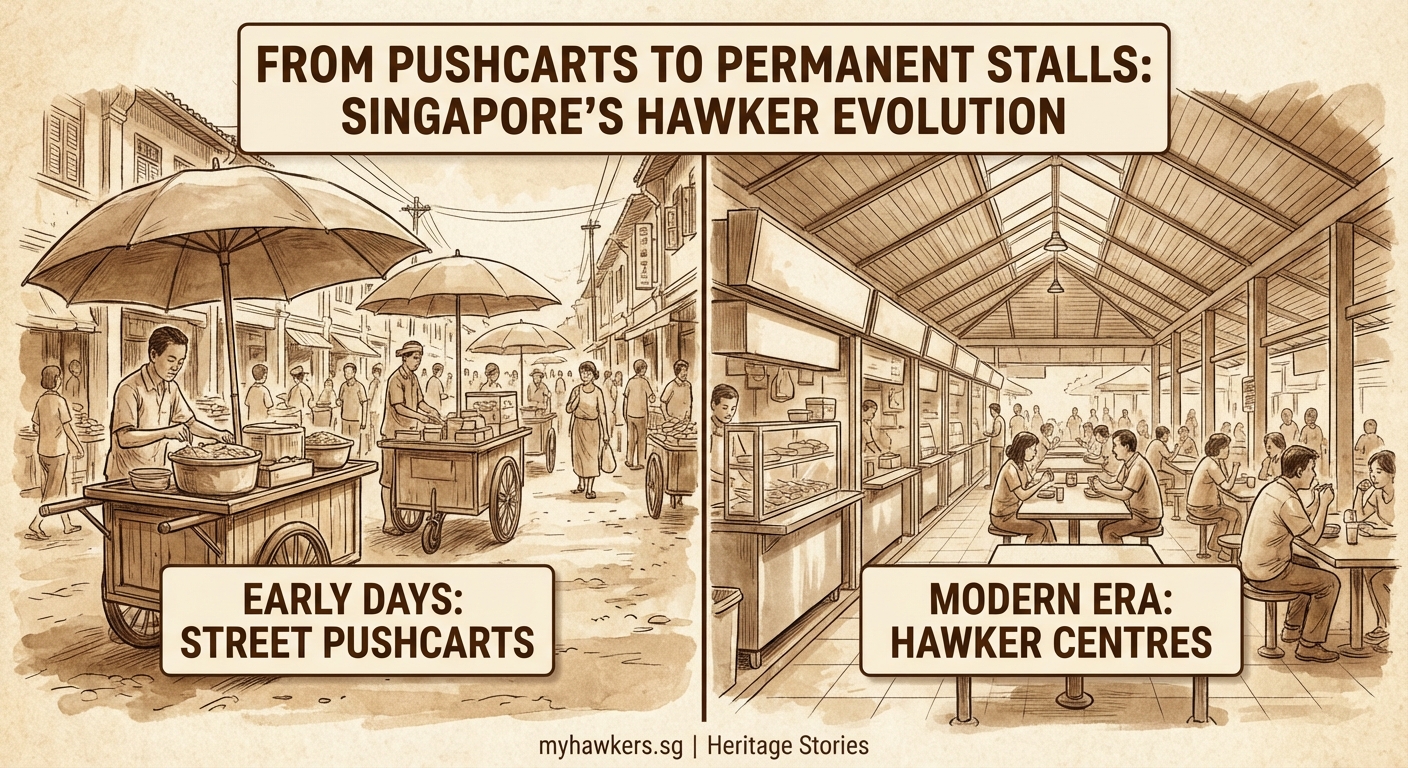
The solution wasn’t elimination. It was relocation.
Between 1968 and 1985, the government launched a systematic resettlement programme. The goal was ambitious: move every single street hawker into permanent, purpose-built centres.
Here’s how they did it:
- Identify high-density hawker zones through street surveys and licensing records
- Build hawker centres near HDB estates and transport hubs to guarantee foot traffic
- Offer existing hawkers first priority for stalls at subsidised rents
- Enforce strict deadlines for street clearance with penalties for non-compliance
- Provide basic infrastructure like running water, electricity, and waste disposal systems
The first purpose-built hawker centre opened in 1971 at Bedok. By 1986, the government had constructed over 140 centres island-wide.
What made hawker centres different from kopitiams
People often confuse hawker centres with kopitiams. They’re not the same.
Kopitiams are privately run coffee shops where independent stall operators rent space. The kopitiam owner controls rental terms and operating hours.
Hawker centres are government-managed facilities. The National Environment Agency (NEA) or town councils oversee them. Stall rents are regulated. Hygiene standards are enforced through regular inspections.
This structure kept meals affordable. A plate of chicken rice that cost 50 cents in 1975 still costs around $3 to $4 today. That’s remarkable considering inflation.
| Feature | Street Hawking (Pre-1970s) | Hawker Centres (1970s onwards) |
|---|---|---|
| Location | Five-foot ways, street corners | Permanent government facilities |
| Hygiene oversight | Minimal enforcement | Regular NEA inspections |
| Infrastructure | None (portable stoves, buckets) | Running water, electricity, waste systems |
| Rent structure | Illegal or informal payments | Regulated monthly fees |
| Operating hours | Flexible, often till late | Fixed centre hours |
The cultural resistance nobody expected
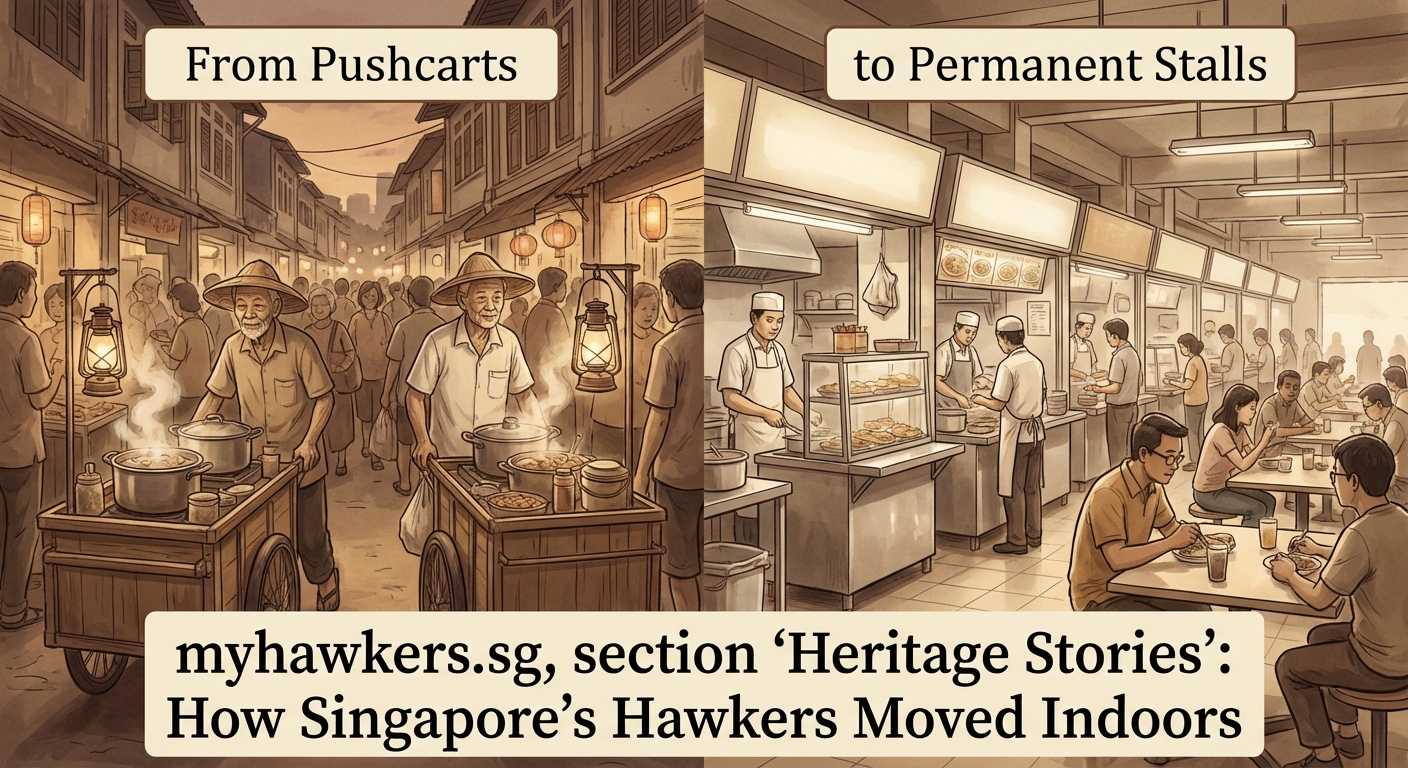
Not every hawker welcomed relocation. Moving indoors meant losing flexibility. Street hawkers could pack up and leave if business was slow. They could follow crowds to festivals or construction sites.
Hawker centres locked them into fixed locations. Stall rents were low but non-negotiable. Operating hours became standardised.
Some hawkers worried about losing their customer base. Would regulars follow them to a new centre across town? Would tourists find them in a suburban HDB estate?
The government addressed these concerns through strategic planning. Centres were built near existing markets and transport nodes. The ultimate guide to Tiong Bahru Market shows how one of the earliest centres became a heritage icon by preserving its neighbourhood roots.
Subsidies helped too. The government kept rental rates artificially low. By the 1980s, a hawker stall cost around $200 per month. That’s less than a quarter of what private kopitiam spaces charged.
How the second generation changed everything
By the 1990s, a new challenge emerged. First-generation hawkers were ageing. Their children, many university-educated, weren’t interested in 12-hour days over a hot wok.
Hawker culture faced extinction through generational attrition.
The government responded with modernisation efforts. Air-conditioned hawker centres started appearing in the 2000s. These weren’t just about comfort. They signalled that hawking could be a dignified, sustainable career.
Programmes like the Hawkers Development Programme offered grants for stall improvements. The Incubation Stall Programme gave aspiring hawkers subsidised spaces to test concepts.
Some heritage stalls thrived across generations. Tian Tian Hainanese Chicken Rice became a global brand whilst staying rooted in Maxwell Food Centre. Tai Hwa Pork Noodle earned a Michelin star without abandoning traditional methods.
“The hawker centre system works because it balanced affordability with sustainability. Customers get cheap meals. Hawkers get stable income. The government maintains public health standards. It’s a three-way social contract that most cities can’t replicate.” – Dr. Lily Kong, former Vice President, Singapore Management University
The UNESCO recognition that validated everything
In December 2020, Singapore’s hawker culture received UNESCO Intangible Cultural Heritage status. This wasn’t just symbolic. It validated the government’s 50-year effort to preserve food traditions whilst modernising infrastructure.
The inscription highlighted several unique aspects:
- Community dining spaces that transcend race and class
- Affordable meals that remain accessible across income levels
- Intergenerational knowledge transfer in cooking techniques
- Urban planning that prioritises cultural heritage alongside hygiene
Maxwell Food Centre became a case study in heritage tourism. Tourists queue for hours at stalls that have operated since the 1970s. Yet locals still eat there daily because prices stay reasonable.
What other cities get wrong when copying Singapore
Countries from Malaysia to Taiwan have studied Singapore’s hawker model. Most implementations fail because they miss critical details.
Mistake 1: Treating hawker centres as pure real estate
Private developers build “hawker-style” food courts with market-rate rents. Stall operators pass costs to customers. A $3 meal becomes $8. The affordability pillar collapses.
Mistake 2: Ignoring enforcement
Building centres is easy. Maintaining hygiene standards requires constant inspection. Singapore conducts unannounced checks. Stalls receive grades (A, B, C, D). Repeat offenders lose licences.
Mistake 3: Forgetting the social contract
Hawker centres work because all stakeholders sacrifice something. Customers accept basic facilities. Hawkers accept regulated hours. The government subsidises infrastructure. Remove any element and the system breaks.
Hidden neighbourhood gems prove that hawker culture thrives outside tourist zones. These centres survive because they serve daily needs, not Instagram moments.
The challenges facing hawker centres today
Rising costs threaten the model. Ingredient prices have surged. Rental increases, though controlled, still happen. Manpower shortages force some hawkers to reduce operating days.
Younger hawkers face different pressures. They’re tech-savvy but lack traditional cooking skills. Some experiment with fusion concepts that alienate older customers. Others struggle with the physical demands of hawker work.
The government continues adapting. Recent initiatives include:
- Centralised dishwashing services to reduce hawker workload
- Tray return systems to address cleanliness complaints
- Digital payment infrastructure for cashless transactions
- Apprenticeship schemes pairing young cooks with veteran hawkers
Lau Pa Sat demonstrates how heritage centres balance tourism and local needs. The satay street activation draws crowds whilst daytime operations serve office workers.
Why timing mattered more than policy
Singapore’s hawker transformation succeeded partly due to historical timing. The relocation programme coincided with rapid economic growth. The government had resources to build centres. Hawkers had customers with rising incomes.
Attempting the same transition today would be harder. Land costs have skyrocketed. Construction timelines stretch longer. Public expectations for amenities are higher.
The 1970s and 1980s offered a unique window. Singapore was urbanising fast but hadn’t yet become prohibitively expensive. HDB estates needed community amenities. Hawker centres filled that gap perfectly.
Morning hawker centres show how centres adapted to neighbourhood rhythms. Some open at 5am for construction workers. Others cater to late-night crowds. This flexibility within structure defines Singapore’s approach.
Where hawker heritage goes from here
The next decade will test whether hawker culture can survive without its founding generation. Many veteran hawkers are in their 70s and 80s. Some operate past midnight because they’ve done it for 40 years.
Innovation offers one path forward. Viral fusion creations attract younger customers whilst respecting traditional flavours. These experiments keep hawker food relevant without abandoning its roots.
Documentation matters too. Oral history projects record recipes and techniques before they disappear. Stalls known only to locals often hold the most authentic knowledge. Preserving this requires active effort, not passive nostalgia.
The legacy written in laksa and char kway teow
The history of Singapore hawker centres isn’t just about food or urban planning. It’s about a government that chose preservation over convenience. It’s about hawkers who adapted without losing their craft. It’s about customers who valued affordability and authenticity over air conditioning and aesthetics.
This balance remains fragile. Every stall closure, every rent increase, every hawker who retires without a successor threatens the ecosystem. But the foundation built over 50 years is stronger than most people realise. Hawker centres survived economic recessions, generational shifts, and changing tastes. They’ll likely survive whatever comes next, as long as we remember why they matter in the first place.
Next time you sit down at a hawker centre, look around. The uncle flipping char kway teow learned from his father. The auntie ladling curry inherited her recipe from her grandmother. The centre itself stands where street vendors once fought for pavement space. You’re not just eating a meal. You’re participating in living history.