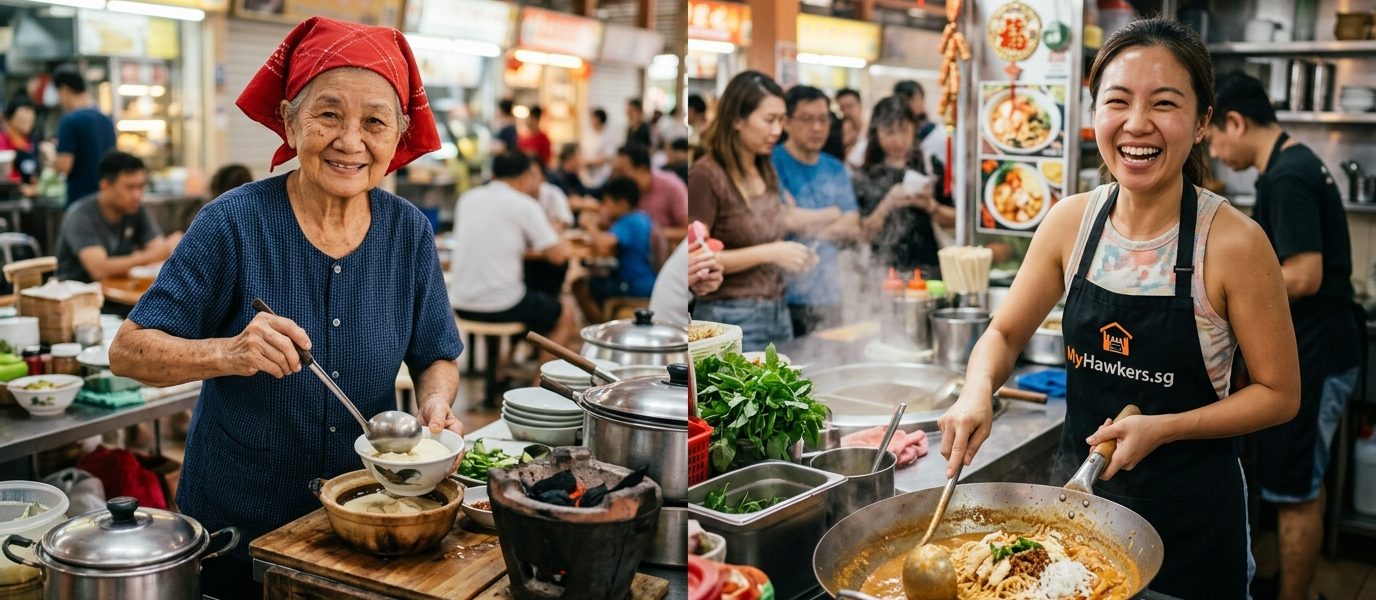
Walk through Chinatown today and you might spot an elderly woman in a distinctive red headscarf. She represents one of Singapore’s most resilient yet overlooked communities. The Samsui women arrived from Guangdong’s Sanshui county in the early 1900s, carrying nothing but determination and an unbreakable work ethic. They hauled bricks, mixed cement, and literally built the foundations of modern Singapore. Their legacy extends far beyond construction sites. These women shaped our food culture, influenced hawker traditions, and demonstrated that strength has no gender.
Samsui women were Chinese immigrant labourers from Sanshui county who worked in Singapore’s construction industry from the 1920s to 1940s. Recognisable by their iconic red headscarves, they performed backbreaking manual labour, remained largely unmarried, and sent money home to support families in China. Their contributions laid the physical and cultural foundations of modern Singapore, influencing everything from urban development to hawker food traditions.
Who Were the Samsui Women
The term “Samsui” refers to Sanshui, a county in Guangdong province known for its poverty and limited opportunities. Women from this region began migrating to Nanyang (Southeast Asia) in the 1920s. Unlike other Chinese immigrants who came with families, Samsui women travelled alone or in small groups.
They sought work in Singapore’s booming construction industry. The British colonial government was rapidly expanding infrastructure. Buildings, roads, and bridges needed workers willing to do physically demanding labour. Samsui women filled this gap.
Their signature red headscarf served multiple purposes. It protected them from the sun and construction debris. The colour symbolised good fortune in Chinese culture. Most importantly, it became their identity marker. Locals could spot a Samsui woman from across a construction site.
These women typically remained unmarried. Some had taken vows of celibacy. Others simply prioritised economic survival over family life. They lived in communal housing, sharing cramped quarters with fellow workers. Every cent saved went back to relatives in China.
The Daily Life of Construction Workers
Samsui women woke before dawn. Their workday started at 6am and often lasted until 6pm. Some sites required even longer hours.
The work was brutal. They carried bricks on wooden poles balanced across their shoulders. Each load weighed up to 50 kilograms. They climbed rickety bamboo scaffolding without safety equipment. Falls were common. Injuries went largely untreated.
Lunch breaks lasted 30 minutes. Women ate simple meals of rice with preserved vegetables. Some brought cold tea in recycled bottles. Meat was a luxury reserved for special occasions.
Their wages were meagre. In the 1930s, a Samsui woman earned about 30 to 50 cents per day. Male workers doing similar jobs received double that amount. Despite the pay gap, they never complained. The money still exceeded what they could earn back home.
After work, they returned to cramped shophouses in areas like Chinatown and Balestier. Multiple women shared single rooms. They cooked communal dinners, mended clothes, and prepared for the next day. Sundays offered the only respite. Some attended temple. Others simply rested their aching bodies.
Building Singapore’s Physical Landscape
Samsui women worked on nearly every major construction project in pre-independence Singapore. They helped build Raffles Hotel, the National Museum, and countless shophouses that still stand today.
The iconic red-brick buildings scattered across the island bear their fingerprints. Each brick they carried, each bag of cement they mixed, contributed to Singapore’s transformation from colonial outpost to modern city.
Their contribution extended beyond famous landmarks. They constructed the infrastructure that made daily life possible. Water pipes, drainage systems, and roads all required manual labour. Samsui women provided that labour without recognition or fanfare.
The 1950s marked their peak presence. Estimates suggest between 1,000 to 2,000 Samsui women worked in Singapore during this period. After 1949, when the Communist Party restricted emigration from China, new arrivals stopped coming. The existing community aged without replacement.
By the 1970s, mechanisation replaced manual labour on construction sites. Cranes lifted loads that once required human shoulders. Concrete mixers eliminated the need for hand-mixing cement. The Samsui women’s skills became obsolete.
From Construction Sites to Hawker Stalls
As construction work declined, some Samsui women transitioned to other industries. A significant number entered the food service sector. Their work ethic and resilience translated well to hawker culture.
Some opened their own stalls. Others worked as assistants in established kitchens. They brought the same dedication to food preparation that they once applied to construction work. Long hours, physical demands, and modest pay felt familiar.
The connection between Samsui women and hawker culture runs deeper than employment patterns. Both communities embodied similar values. Hard work. Frugality. Community support. A willingness to start from nothing and build something lasting.
Traditional Cantonese dishes served at hawker centres across the island reflect cooking methods Samsui women would have used. Simple preparations. Maximum flavour from minimal ingredients. Nothing wasted.
Their influence appears in the operational philosophy of many veteran hawkers. Wake early. Prep meticulously. Serve consistently. Save diligently. These principles mirror the Samsui approach to life.
Recognising Their Cultural Impact
Singapore has slowly begun acknowledging the Samsui women’s contributions. The National Museum features exhibits documenting their lives. Local theatre productions have dramatised their stories. Academic researchers now study their social and economic impact.
The red headscarf has become an icon of Singapore’s immigrant heritage. It appears in historical displays, cultural festivals, and educational materials. School textbooks mention Samsui women when discussing nation-building.
Yet recognition came late. Most Samsui women lived and died without public acknowledgment. They never sought fame or gratitude. Their satisfaction came from survival and the ability to support families back home.
The last generation of Samsui women are now in their 80s and 90s. Few remain physically able to share their stories. Oral history projects have recorded some testimonies. These recordings provide invaluable insights into their experiences, challenges, and perspectives.
“We didn’t think about whether the work was hard. We just did it. There was no choice. If you wanted to eat, you had to work.” – Anonymous Samsui woman, oral history interview, 1990s
Understanding Their Social Structure
Samsui women created tight-knit communities based on mutual support. They operated informal savings clubs where members contributed monthly amounts. When someone faced an emergency or needed to send money home, they could access pooled funds.
These networks extended beyond financial assistance. Experienced workers mentored newcomers. They taught them job skills, helped them find housing, and warned them about unscrupulous employers. The community protected its own.
Many Samsui women maintained connections with their home villages through letters and remittances. They sent money regularly, often sacrificing their own comfort to support relatives. Some never returned to China, dying in Singapore without seeing their homeland again.
Their living arrangements reflected both practicality and cultural values. Shared housing reduced costs while maintaining respectability. Unmarried women living alone would have faced social stigma. Group living provided safety, companionship, and economic efficiency.
Religious practices offered spiritual comfort. Many Samsui women were Buddhist or followed traditional Chinese folk religions. They visited temples on rest days, made offerings, and participated in festivals. These rituals connected them to their cultural roots while adapting to life in Singapore.
Comparing Samsui Women to Other Immigrant Groups
Singapore’s development involved multiple immigrant communities. Understanding how Samsui women differed from other groups provides context for their unique contributions.
| Aspect | Samsui Women | Hainanese Men | Indian Labourers |
|---|---|---|---|
| Primary Industry | Construction | Domestic service, food | Rubber plantations, public works |
| Gender Composition | Almost entirely female | Predominantly male | Predominantly male |
| Marital Status | Mostly unmarried | Mixed | Often married with families |
| Cultural Identity Marker | Red headscarf | Culinary skills | Religious practices |
| Post-Work Transition | Hawker stalls, retirement | Hawker food businesses | Various industries |
| Legacy Visibility | Moderate (growing) | High (chicken rice culture) | Moderate (Little India) |
The Hainanese community, for example, transitioned from domestic work in British households to establishing iconic food businesses. Their culinary legacy remains highly visible today, from legendary chicken rice stalls to coffee shops across the island.
Samsui women’s contributions were less visible but equally foundational. They built the physical structures that house hawker centres and food stalls. Their work ethic influenced subsequent generations of workers, including those in the food industry.
Lessons from the Samsui Experience
The Samsui women’s story offers several insights relevant to modern Singapore.
Resilience through adversity. These women faced discrimination, physical hardship, and social isolation. They persevered without complaint. Their example reminds us that determination can overcome enormous obstacles.
The power of community support. Samsui women survived through mutual aid. They shared resources, knowledge, and emotional support. Their informal networks functioned more effectively than many formal institutions.
Gender and labour inequality. Despite performing the same work as men, Samsui women earned half the wages. This disparity reflected broader social attitudes about women’s capabilities and worth. Their experience highlights ongoing conversations about workplace equality.
Immigration and identity. Samsui women maintained strong connections to their homeland while adapting to Singapore. They never fully assimilated, yet they contributed immensely to their adopted home. Their experience reflects the complex nature of immigrant identity.
Unrecognised labour. For decades, Samsui women’s contributions went unacknowledged. They built landmarks that others claimed credit for. Their story reminds us to recognise all workers who build our society, not just those in prominent positions.
How to Learn More About Samsui Women Today
Several resources allow you to deepen your understanding of Samsui women and their legacy.
-
Visit the National Museum of Singapore. The permanent galleries include sections on immigrant communities, featuring Samsui women’s stories and artifacts.
-
Attend cultural performances. Local theatre companies occasionally stage productions about Samsui women. These dramatisations bring their experiences to life through storytelling and performance.
-
Read oral history collections. The National Archives has recorded interviews with surviving Samsui women. These testimonies provide firsthand accounts of their lives and work.
-
Take heritage walks. Several organisations offer guided tours through areas where Samsui women lived and worked. These walks point out buildings they constructed and neighbourhoods they inhabited.
-
Support documentation projects. Various cultural groups continue researching and documenting Samsui history. Contributing to these efforts helps preserve their legacy for future generations.
Common Misconceptions About Samsui Women
Misconception: All Samsui women were construction workers.
Reality: While most worked in construction, some found employment in other industries. A minority worked as domestic helpers, factory workers, or in agriculture. The red headscarf became associated with construction because that’s where they were most visible.
Misconception: They chose celibacy for religious reasons.
Reality: Economic necessity drove most decisions to remain unmarried. Marriage and children would have made it impossible to work and save money. Some did take religious vows, but practical considerations mattered more for most women.
Misconception: Samsui women were uneducated.
Reality: Formal education was limited, but they possessed significant practical knowledge. They learned construction skills, managed finances, and navigated complex social systems. Their intelligence manifested differently than academic achievement.
Misconception: They all returned to China eventually.
Reality: Many Samsui women spent their entire lives in Singapore. Some lost contact with families in China. Others had no one left to return to. Singapore became their permanent home, even if they never fully considered themselves Singaporean.
The Connection Between Samsui Women and Modern Hawker Culture
The relationship between Samsui women and hawker culture extends beyond individual career transitions. Both represent grassroots entrepreneurship born from necessity.
Samsui women demonstrated that success doesn’t require formal credentials or capital. It requires work ethic, resilience, and community support. These same qualities define successful hawker businesses.
The communal living arrangements Samsui women created mirror the hawker centre model. Multiple vendors operate independently yet share common spaces and resources. Competition coexists with cooperation. Individual success benefits the collective.
Their frugality and efficiency influenced food preparation methods. Samsui women knew how to stretch resources without compromising quality. This skill translated directly to hawker cooking, where profit margins depend on minimising waste while maximising flavour.
Some heritage hawker centres occupy buildings that Samsui women helped construct. The physical spaces they built now house the food culture they influenced. This connection creates a tangible link between past and present.
Preserving the Samsui Legacy for Future Generations
As the last Samsui women pass away, preserving their legacy becomes increasingly urgent. Several initiatives aim to ensure their stories survive.
Documentation projects record oral histories before they’re lost forever. Researchers interview surviving Samsui women and their descendants. These recordings capture not just facts but also emotions, perspectives, and personal experiences.
Educational programmes introduce younger Singaporeans to Samsui history. School curricula now include lessons about immigrant communities and their contributions. Students learn that nation-building involved countless unnamed workers, not just prominent leaders.
Public art installations commemorate Samsui women. Sculptures, murals, and monuments appear in areas where they lived and worked. These physical markers ensure their presence remains visible in the urban landscape.
Cultural festivals celebrate their heritage. Events featuring traditional Cantonese culture, food, and performances honour Samsui women’s roots. These celebrations keep their memory alive while educating the public.
Museums continue expanding their collections. Artifacts like red headscarves, work tools, and personal belongings provide tangible connections to the past. Future generations can see and touch objects that Samsui women used daily.
Why Their Story Matters Now
Singapore’s rapid development sometimes obscures the human cost of progress. Gleaming skyscrapers and efficient infrastructure didn’t appear magically. People built them, often at great personal sacrifice.
Samsui women represent the countless workers whose labour made modern Singapore possible. Recognising their contributions means acknowledging that development requires more than visionary leadership. It requires people willing to do difficult, dangerous work for modest compensation.
Their story also challenges assumptions about gender and capability. Samsui women performed physically demanding labour that many assumed only men could handle. They proved that determination and skill matter more than gender stereotypes.
For contemporary discussions about foreign workers, the Samsui experience offers historical perspective. Singapore has always relied on immigrant labour. The Samsui women were early foreign workers who contributed immensely without seeking permanent residency or citizenship. Their experience informs current debates about immigration policy and worker rights.
Their legacy connects to ongoing conversations about preserving hawker culture. Understanding how immigrant communities influenced food traditions helps explain why hawker centres matter culturally, not just economically. The diverse food offerings at places like Maxwell Food Centre reflect generations of immigrant contributions, including those of Samsui women.
Where You Can Still Find Traces of Their Presence
Physical remnants of Samsui culture exist throughout Singapore if you know where to look.
Chinatown shophouses. Many buildings in the Chinatown Conservation Area were constructed with Samsui labour. The red-brick facades and sturdy construction reflect their craftsmanship.
Balestier Road. This area housed a significant Samsui community. Some of the older shophouses served as their communal residences. Walking these streets means following paths they travelled daily.
Construction sites near heritage buildings. When restoration work occurs on pre-1960s structures, you’re seeing buildings that Samsui women likely helped construct. Their labour is literally embedded in the walls.
Older hawker centres. Some veteran hawkers remember working alongside Samsui women or learning from them. Conversations with long-time stallholders sometimes reveal these connections.
Temples in Chinatown. Several temples that Samsui women frequented still operate. These spaces provided spiritual comfort and community gathering points. Visiting them offers a sense of their religious practices.
The Red Headscarf as Cultural Symbol
The distinctive red headscarf transcended its practical origins to become a cultural icon. Understanding its significance helps appreciate Samsui identity.
The fabric was inexpensive cotton, easily replaced when worn out. Women folded it into a specific shape that covered the head and neck while allowing freedom of movement. The technique was passed down from experienced workers to newcomers.
Red symbolised good fortune in Chinese culture, but practicality mattered more. The bright colour made workers visible on construction sites, reducing accident risks. It also hid dirt and dust better than lighter colours.
The headscarf created instant recognition. Employers knew that a woman in a red headscarf would work hard and reliably. This reputation benefited the entire community. One woman’s strong performance reflected well on all Samsui workers.
Today, the red headscarf appears in museums, cultural performances, and historical displays. It has become shorthand for the entire Samsui experience. Seeing that splash of red immediately evokes their story.
Honouring the Women Who Built Our Nation
The Samsui women never asked for recognition. They simply worked, saved, and supported their families. Their humility makes honouring them both important and challenging.
Grand monuments might feel inappropriate for people who lived such modest lives. Instead, the most meaningful tributes come through remembering their values and applying them today.
When you visit a hawker centre, consider the immigrant workers who built both the physical structure and the food culture. When you see older buildings, think about the hands that laid each brick. When you hear stories about resilience and determination, remember the Samsui women who embodied these qualities daily.
Their legacy lives on not in statues or plaques but in the physical and cultural foundation of Singapore. Every time you walk down a street they helped build or eat at a hawker stall that reflects their work ethic, you’re experiencing their contribution.
Share their story with others. Educate younger generations about the people who built Singapore before independence, before prosperity, before recognition. Ensure that the red headscarf remains a symbol of strength, resilience, and the power of ordinary people to achieve extraordinary things.
The Samsui women asked for nothing except the opportunity to work and survive. They received little during their lifetimes. The least we can do now is remember them, honour their contributions, and ensure their story becomes part of how we understand ourselves as Singaporeans.