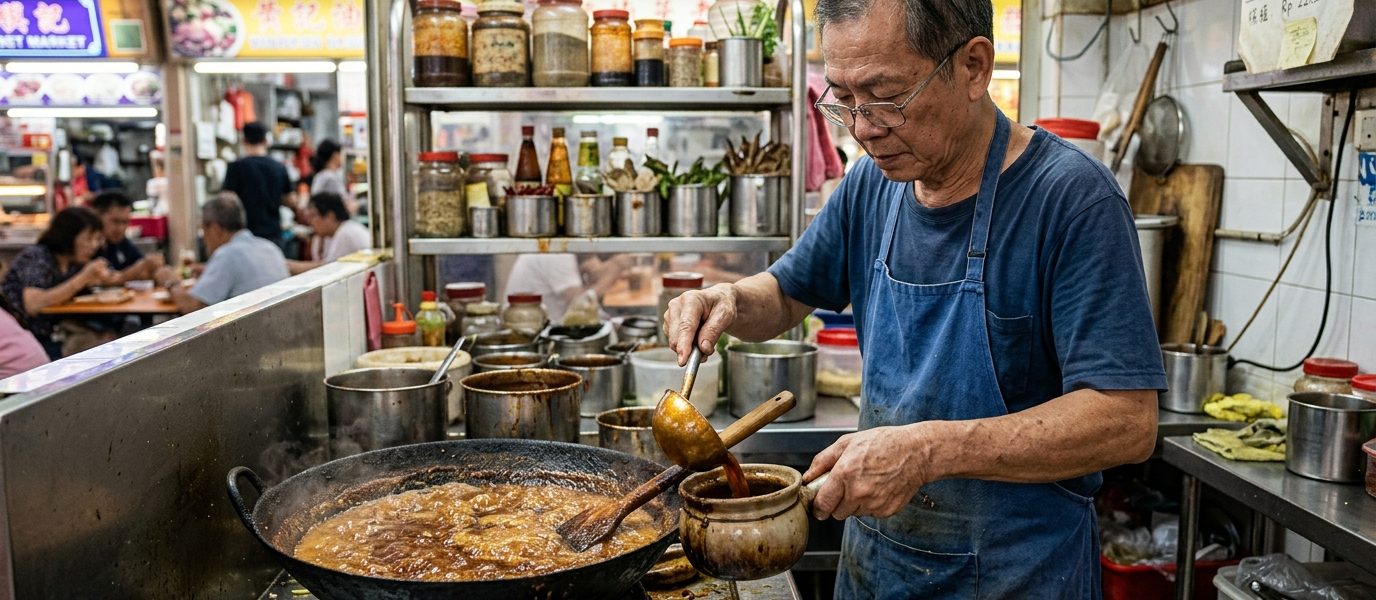
Walk into any heritage hawker centre and you’ll notice something curious. Some uncles and aunties arrive before dawn, not just to prep ingredients, but to mix their secret sauces alone. No assistants. No onlookers. Just them, their wok, and a recipe that’s survived decades.
These aren’t just cooking formulas. They’re edible inheritance.
Singapore hawker secret recipes represent decades of trial, error, and cultural fusion. Heritage hawkers protect their signature sauces and cooking methods through selective knowledge transfer, often revealing full formulas only to chosen successors. These recipes aren’t just business assets but living documentation of immigrant histories, regional adaptations, and family resilience that shaped Singapore’s food landscape.
What makes a hawker recipe truly secret
Not every recipe qualifies as a guarded secret. Plenty of hawkers happily share their general cooking methods. The real secrets lie in specific ratios, timing sequences, and ingredient sources that create unmistakable flavours.
A chicken rice uncle might tell you he uses ginger and pandan in his rice. That’s common knowledge. What he won’t tell you is the exact gram measurement of each, the precise moment he adds the chicken fat, or which specific farm supplies his ginger. These micro-details separate good chicken rice from the kind people queue 45 minutes for.
The secrecy isn’t about being difficult. It’s about survival. Many heritage stalls built their reputations on a single dish perfected over 30, 40, sometimes 50 years. That recipe is their competitive edge in an increasingly crowded hawker landscape.
“My father told me the chilli recipe three times. Each time, he changed one small thing to test if I was paying attention. Only on the third time did he give me the real one.” – Third-generation satay seller, Lau Pa Sat
The anatomy of a protected formula
Heritage hawkers typically guard three elements with particular intensity.
Sauce compositions top the list. The chilli sauce at a Hainanese chicken rice stall might contain 12 ingredients, but the magic lives in their proportions. Too much lime juice and it’s sour. Not enough fermented soybean and it lacks depth. These ratios took years to calibrate.
Marination timings come next. A char kway teow master knows exactly how long to marinate lap cheong before slicing. A satay seller has precise windows for different meat cuts. These timings account for humidity, meat temperature, and even seasonal variations.
Cooking sequences matter more than most people realise. When you add dark soy sauce to fried noodles changes everything. Add it too early and it burns. Too late and it doesn’t caramelise properly. The meet the 78-year-old uncle behind Chinatown’s best char kway teow demonstrates this principle perfectly.
| Recipe Element | Why It’s Protected | Common Cover Story |
|---|---|---|
| Exact spice ratios | Defines signature taste profile | “Just add to taste lah” |
| Ingredient sources | Quality and consistency vary wildly | “Any supplier can” |
| Cooking temperatures | Affects texture and flavour development | “Medium heat lor” |
| Resting periods | Allows flavours to develop properly | “Just let it sit a while” |
| Tool specifications | Wok age, burner type affect results | “Any wok also can” |
How recipes pass between generations
The transfer of singapore hawker secret recipes follows patterns that would make anthropologists take notes.
Most heritage hawkers use a staged revelation approach. Children or chosen apprentices learn the basic recipe first. They might work with it for years, thinking they know everything. Only later, sometimes decades later, do they learn the crucial adjustments that make the dish truly special.
This isn’t cruelty. It’s quality control. The staged approach ensures the successor has developed enough experience to understand why certain steps matter. A 20-year-old might know the recipe intellectually, but a 40-year-old who’s cooked it 10,000 times understands it in their bones.
Some families use deliberate misinformation as a teaching tool. They’ll give apprentices a 90% accurate recipe and watch how they problem-solve when the results aren’t quite right. The ability to identify what’s missing demonstrates readiness for the complete formula.
The trust threshold
- Apprentice learns basic cooking techniques and stall operations
- They’re taught the “public version” of signature recipes
- After proving commitment (usually 3-5 years), they receive first-level adjustments
- Upon demonstrating consistency and understanding, they learn source-specific details
- Final formula transfer happens only when succession is confirmed
Physical demonstration matters more than written recipes. Many heritage hawkers never wrote their formulas down. They teach through repetition, correction, and muscle memory. A laksa uncle might make you stir the rempah 50 times before he’s satisfied you understand the right consistency.
The five generations of bak chor mee inside Tai Hwa pork noodle’s Michelin success shows how this knowledge transfer can preserve quality across a century.
Why some recipes die with their creators
Not every heritage recipe survives. Walk through older hawker centres and you’ll hear stories of legendary stalls that closed because no one learned the formula.
Sometimes children choose different careers. A hawker who spent 40 years perfecting their curry puff filling might have kids who became accountants and engineers. No judgment there, but the recipe often dies with retirement.
Other times, the hawker themselves decides against passing it down. They’ve seen too many former apprentices open competing stalls nearby. Or they’ve watched children treat the family recipe casually, without the reverence it deserves. Rather than see it diluted or misused, they let it end.
Health issues can interrupt transfers mid-process. A stroke might take a hawker before they’ve revealed everything. A sudden heart attack leaves gaps in the knowledge chain. These aren’t dramatic secrets taken to graves, just practical information lost to bad timing.
- Successor lacks genuine interest or commitment to hawker life
- Family disputes over who deserves to inherit the recipe
- Recipe depends on ingredients no longer available in Singapore
- Cooking method requires equipment or techniques now banned
- Hawker believes the recipe won’t survive modern food safety regulations
The hidden neighbourhood gems with 7 underrated hawker centres locals swear by features several stalls facing this succession challenge.
The economics of recipe protection
Heritage hawkers protect their formulas because they’re literally valuable. A proven recipe that draws consistent crowds represents decades of unpaid research and development.
Consider the math. A hawker might have tested 200 different chilli sauce variations over 15 years before landing on their signature blend. That’s thousands of hours of experimentation, ingredient costs, and customer feedback. The final recipe embodies all that investment.
When competitors copy a signature dish, they skip all that development work. They reverse-engineer the final product without paying the tuition of failure. This is why hawkers get protective when former employees open similar stalls selling nearly identical dishes.
Some heritage recipes also depend on relationships built over decades. A particular spice supplier who sources premium quality. A vegetable farmer who grows specific varieties. These connections aren’t easily replicated, making the complete recipe package even more valuable.
Recipe value factors:
– Years of development and refinement invested
– Established customer base and reputation
– Unique supplier relationships and ingredient access
– Cultural and historical significance
– Potential franchise or licensing opportunities
Modern challenges to traditional secrecy
The internet age complicates recipe protection. Food bloggers photograph everything. YouTube channels film cooking processes. TikTok videos go viral showing “secret” techniques.
Some heritage hawkers have adapted by becoming more open about general methods while guarding specific details. They’ll demonstrate their cooking on camera but keep certain steps vague. “Season to taste” becomes code for “I’m not telling you the exact measurements.”
Others have embraced documentation as preservation. They’ve written down recipes, not for publication, but as insurance against memory loss or sudden health issues. These written formulas stay locked away, insurance policies against the unexpected.
The from pushcarts to permanent stalls showing how Singapore’s hawkers moved indoors documents how hawkers have always adapted to changing circumstances.
Younger generation hawkers sometimes take different approaches. They’re more willing to share recipes publicly, betting that execution matters more than formulas. They figure even with the recipe, most people won’t match their speed, consistency, or ingredient quality.
What home cooks can learn from hawker secrecy
You don’t need to guard your rendang recipe like state secrets, but hawker approaches to recipe development offer useful lessons.
Document your successes. When you nail a dish, write down exactly what you did. Not just ingredients, but brands, temperatures, timings, and even weather conditions. Your future self will thank you.
Test incrementally. Hawkers don’t change five variables at once. They adjust one element, test it for weeks, then move to the next. This methodical approach identifies what actually improves the dish.
Respect ingredient quality. Heritage hawkers know that premium ingredients often make the difference. The cheapest soy sauce won’t give you the same results as the brand a hawker’s been using for 30 years.
Build supplier relationships. Find butchers, fishmongers, and grocers who understand what you’re trying to achieve. These relationships improve your ingredient access and knowledge.
The why Tian Tian Hainanese chicken rice still has queues after 30 years demonstrates how consistency and quality compound over time.
The cultural weight of recipe inheritance
These secret formulas carry more than flavour profiles. They’re edible archives of immigration stories, cultural adaptation, and family resilience.
A Teochew porridge recipe might trace back to a great-grandfather who arrived in Singapore with nothing but cooking skills. The specific way of preparing fish reflects techniques from a Chinese coastal village most family members have never seen.
A Hainanese chicken rice formula might encode the moment when Hainanese cooks left the British kitchens and birthed chicken rice empires, adapting their employers’ cooking methods for local tastes and ingredients.
Each protected recipe is a time capsule. The ingredients available in 1960s Singapore. The cooking equipment of that era. The taste preferences of customers from different dialect groups. All this history lives in the formula.
When a heritage recipe dies, we lose more than a dish. We lose a direct connection to a specific moment in Singapore’s development, preserved in edible form.
Where to taste these guarded traditions
Experiencing singapore hawker secret recipes means visiting the stalls where they’re still practiced daily.
Maxwell Food Centre remains the top tourist hawker destination in 2024 partly because it concentrates several heritage stalls with protected recipes. The chicken rice, the rojak, the congee – each represents decades of refinement.
Tiong Bahru Market, where heritage meets hawker excellence, houses multiple family-run stalls where recipes have passed through three or four generations. The morning crowds there aren’t just hungry, they’re participating in living food history.
Early morning visits to the best morning hawker centres by region often reward you with heritage stalls at their freshest, when the uncles and aunties are still personally overseeing every dish.
Some protected recipes only reveal themselves to regular customers. The char kway teow uncle who adds extra lap cheong for familiar faces. The laksa auntie who adjusts spice levels based on what she remembers you ordered last time. These personalised touches are part of the secret recipe ecosystem too.
Why these secrets matter beyond nostalgia
Recipe protection isn’t about being precious or elitist. It’s about maintaining standards in an environment that constantly pressures hawkers to cut corners, speed up service, and reduce costs.
A heritage hawker who guards their recipe is also guarding the time it takes to make it properly. The expensive ingredients that can’t be substituted. The techniques that don’t scale to mass production. These “secrets” protect quality as much as competitive advantage.
When we lose these recipes, we lose proof that food can be both affordable and exceptional. That a $5 plate of noodles can represent mastery. That street food can be art.
The protected formulas at heritage stalls set benchmarks. They show what’s possible when someone dedicates their life to perfecting a single dish. They remind us that excellence doesn’t require fancy equipment or expensive real estate, just knowledge, skill, and commitment.
The recipes that shaped a nation’s palate
Singapore’s food reputation rests substantially on these guarded formulas. The international recognition, the food tourism, the pride Singaporeans feel in their hawker culture – all of it traces back to individual hawkers who refused to compromise their recipes.
The Hokkien mee rivalry that’s divided Singaporeans for decades exists because different hawkers protected different interpretations of the same dish. Their secrecy preserved regional variations that might otherwise have homogenised.
These protected recipes also influenced how subsequent generations cook. A young hawker learning char kway teow today is learning from masters who learned from masters, creating an unbroken chain of knowledge transfer. Even when they innovate, they’re building on foundations laid by those secret formulas.
The recipes themselves evolve subtly over time. A third-generation hawker might adjust their grandfather’s formula for modern ingredients or changed customer preferences. But the core principles, the fundamental ratios that make the dish work, those remain protected and passed down.
Tasting history, one plate at a time
Next time you’re at a heritage hawker stall, consider what you’re really eating. That plate of char kway teow or bowl of bak chor mee represents someone’s life work. The sauce you’re tasting might be a formula refined over 40 years, known completely by perhaps two or three people on earth.
The uncle who won’t tell you his exact recipe isn’t being difficult. He’s protecting something irreplaceable, something that took decades to create and could disappear in a generation. He’s guarding not just a business asset, but a piece of Singapore’s edible heritage.
These secret recipes remind us that some knowledge can’t be Googled. Some skills can’t be learned from YouTube. Some traditions require direct transmission from master to apprentice, repeated practice, and genuine commitment.
So eat well. Eat often. Support the heritage stalls while they’re still around. Because every time a hawker retires without passing down their secret recipe, we lose something we can never get back. And Singapore’s food story becomes a little less rich, a little less connected to the immigrant dreams and family sacrifices that created it.