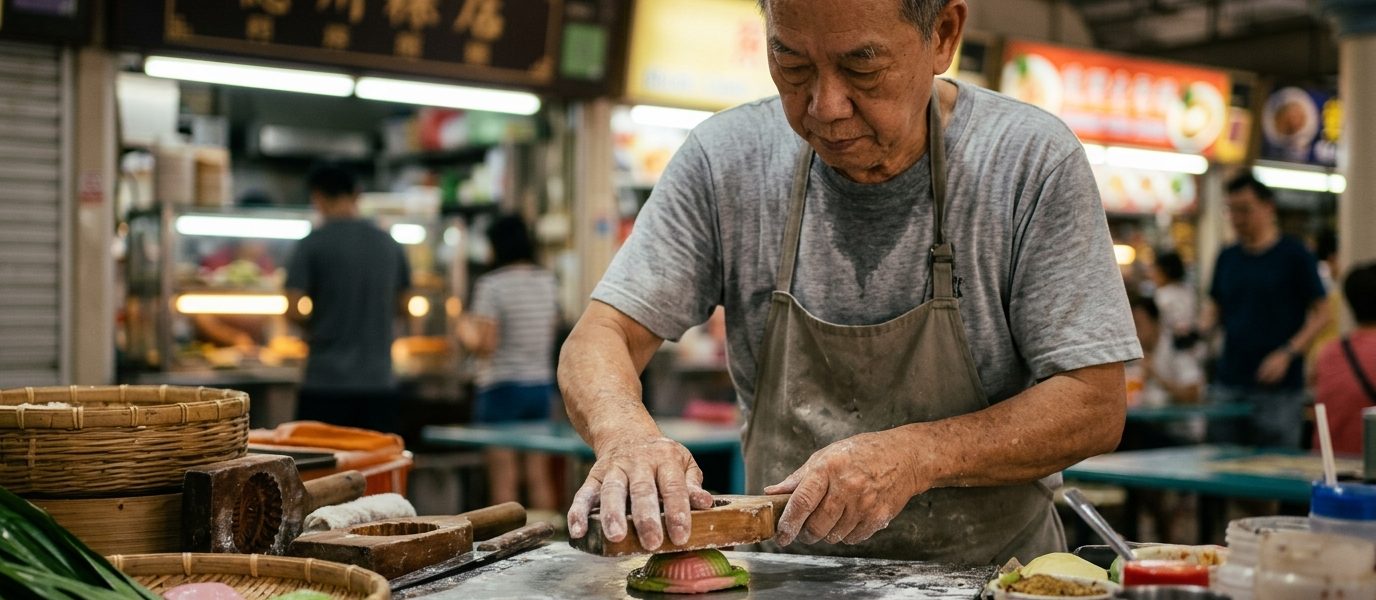
The smell of charcoal smoke used to fill every hawker centre in Singapore. Now, you can count the stalls using traditional methods on one hand. The old uncles and aunties who spent decades perfecting their craft are retiring, and most of their children have chosen office jobs over wok hei. What we’re losing isn’t just food. It’s an entire way of life that shaped our national identity.
Singapore’s hawker heritage is disappearing as veteran hawkers retire without successors. Five traditional trades face extinction: hand-pulled noodles, charcoal-grilled satay, traditional kaya toast, handmade popiah skin, and clay pot rice. These skills take years to master, and only a handful of stalls still practise them. Visit these remaining craftspeople now before their recipes and techniques vanish forever from our food landscape.
The Craft Behind Hand-Pulled Noodles
Walk past most noodle stalls today and you’ll see packets of factory-made noodles stacked in the fridge. But there’s one technique that machines still can’t replicate properly: hand-pulled lamian.
The process looks deceptively simple. A ball of dough gets stretched, folded, and pulled repeatedly until it transforms into dozens of thin, springy strands. But master hawkers will tell you it takes at least three years to get the tension right.
Mr Liang at Tiong Bahru Market is one of fewer than ten hawkers in Singapore still pulling noodles by hand every morning. He starts at 5am, making enough for the day’s service. Each batch takes 20 minutes of continuous pulling and folding. His shoulders ache, but he refuses to switch to pre-made noodles.
The texture difference is obvious. Hand-pulled noodles have irregular thickness that creates varied bite. They absorb soup differently. They spring back when you chew them. Factory noodles just can’t match that.
“When I retire, this skill dies with me. My son is a banker. He’s never going to wake up at 5am to pull noodles for $5 a bowl.” – Mr Liang, lamian hawker
Why Charcoal Grilling Is Almost Extinct
Most satay stalls switched to gas decades ago. It’s cleaner, faster, and doesn’t require someone to tend the fire constantly. But talk to anyone over 50 and they’ll tell you satay doesn’t taste the same anymore.
Charcoal creates uneven heat. That’s actually what makes it superior. The hot spots char the meat while cooler areas let it cook through slowly. Gas flames are too uniform. They dry out the meat before it develops that smoky crust.
Only three satay stalls in Singapore still use charcoal exclusively. They’re all run by hawkers in their 70s. None have apprentices learning the trade.
Here’s what makes charcoal grilling so labour-intensive:
- Start the charcoal fire 90 minutes before service begins
- Wait for flames to die down and coals to turn white
- Constantly adjust skewer positions based on heat zones
- Add fresh charcoal throughout service to maintain temperature
- Clean ash and residue after every session
The process requires constant attention. You can’t leave the grill to take orders or prepare other items. Most hawkers can’t afford to hire dedicated grill masters anymore.
| Grilling Method | Setup Time | Temperature Control | Labour Required | Flavour Profile |
|---|---|---|---|---|
| Charcoal | 90 minutes | Manual adjustment every 5-10 minutes | Full-time grill master needed | Smoky, complex, varied char |
| Gas | 10 minutes | Dial adjustment as needed | Can multitask | Clean, uniform, less depth |
| Electric | 5 minutes | Thermostat controlled | Minimal supervision | Flat, one-dimensional |
The hawkers who still use charcoal do it knowing they’re losing money. But they can’t bring themselves to compromise on taste.
Traditional Kaya Toast Is Vanishing Too
You might think kaya toast is everywhere. And you’d be right, if you’re counting the chain cafes using factory-made kaya and pre-sliced bread. But traditional kaya toast is a completely different animal.
Real kaya takes eight hours to make. You can’t rush the process. The coconut milk, eggs, and gula melaka need to cook slowly over low heat, with constant stirring to prevent curdling. Most modern stalls buy their kaya pre-made in tubs.
The bread matters just as much. Traditional kaya toast uses thick-cut bread grilled over charcoal, not popped in a toaster. The charcoal gives it a smoky edge that balances the kaya’s sweetness.
Mrs Tan at her hidden neighbourhood stall still makes everything from scratch. She’s 68 and starts cooking kaya at midnight so it’s ready for the breakfast crowd. She grills each slice of bread individually over charcoal.
Her children have office jobs. When she retires, the stall closes for good.
The difference between traditional and modern kaya toast:
- Kaya texture: Homemade is grainy with visible egg strands; factory-made is smooth and uniform
- Bread thickness: Traditional uses 2cm slices; modern uses thin pre-sliced bread
- Grilling method: Charcoal creates uneven char; toasters give even browning
- Butter application: Traditional uses cold butter that doesn’t fully melt; modern uses soft butter
- Serving temperature: Traditional serves immediately off the grill; modern can sit for minutes
The Art of Handmade Popiah Skin
Every popiah stall has those thin, translucent crepes. But almost none make them by hand anymore. The skill is nearly extinct.
Making popiah skin by hand requires a specific wrist motion that takes years to perfect. You slap a ball of wet dough onto a hot griddle in a circular motion, leaving behind a paper-thin layer. The whole action takes maybe two seconds. Too slow and the skin becomes thick. Too fast and you get holes.
Mr Wong learned from his father, who learned from his grandfather. He’s the last in his family line willing to continue. He makes about 500 skins every morning, each one individually slapped onto the griddle.
Machine-made skins are thicker and less delicate. They tear easily when you roll them. They don’t have that slight chew that hand-made skins develop.
The problem isn’t just the physical skill. It’s the economics. Mr Wong spends three hours making skins that cost him the same as buying factory-made ones. He does it purely for quality, not profit.
He tried teaching his nephew. The young man quit after two weeks. His wrists hurt too much, and he couldn’t see the point when machines could do the job.
Clay Pot Rice Cooked the Old Way
Most “clay pot rice” stalls now use metal pots or rice cookers. Real clay pot rice requires individual clay pots over charcoal or gas flames. Each pot cooks one portion at a time. It’s impossibly inefficient by modern standards.
The clay pot creates a unique texture. The rice at the bottom gets crispy and slightly burnt. The middle stays fluffy. The top absorbs the sauce from whatever toppings you’ve added. You can’t replicate this in a rice cooker.
Mrs Lee at her stall cooks each clay pot individually. During peak hours, she has 20 pots going simultaneously, each at a different stage of cooking. She knows by sound and smell when each pot is ready. No timers. No temperature gauges. Just decades of experience.
Each pot takes 20 minutes to cook. That means during lunch rush, she can only serve about 15 customers per hour. The stall next to hers using rice cookers serves 50.
She’s 72. She’s already had two wrist surgeries from lifting heavy clay pots for 40 years. Her children have told her to retire, but she keeps going because she knows once she stops, that’s it. No one else will continue.
How to Support These Dying Trades
Visiting these stalls isn’t just about eating good food. It’s about keeping these skills alive for a few more years.
Here’s what actually helps:
- Visit during off-peak hours so hawkers have time to chat and share their stories
- Bring younger family members so they understand what’s being lost
- Pay the asking price without complaining (these dishes are already underpriced)
- Share photos and locations on social media to spread awareness
- Buy extra portions to freeze if the stall sells items that keep well
Don’t just take photos and leave. Talk to the hawkers. Ask about their techniques. Show genuine interest in their craft. Many of them feel invisible, like their life’s work doesn’t matter anymore.
Some practical tips for finding these traditional stalls:
- Visit older hawker centres built before 1990
- Look for stalls with elderly hawkers working alone or with one assistant
- Check for visible charcoal grills or clay pots (not hidden in the back)
- Ask around at morning hawker centres where traditional breakfast trades still survive
- Follow heritage food groups on social media that document these stalls
What Happens When These Trades Disappear
Some people say it’s just nostalgia. That food evolves and we should accept change. But what we’re losing isn’t just about taste. It’s about craftsmanship that took generations to develop.
These hawkers represent an unbroken chain of knowledge stretching back decades. Their techniques were refined through thousands of hours of practice. Once they retire, all that accumulated wisdom vanishes.
We’ll still have hawker centres. We’ll still have cheap food. But it will be a flatter, more uniform version of what came before. The rough edges that made our food culture unique will be smoothed away.
The younger generation of hawkers focuses on efficiency and scalability. They need to, given rising costs and labour shortages. But something essential gets lost in that optimization.
You can already see it happening. Dishes that used to vary wildly from stall to stall now taste remarkably similar. Everyone uses the same suppliers, the same pre-made ingredients, the same shortcuts.
Preserving Heritage Before It’s Gone
The government has programmes to document hawker trades and encourage younger people to apprentice with master hawkers. Some have succeeded. Most haven’t.
The fundamental problem isn’t lack of interest. It’s economics. A young person can’t survive on hawker wages in modern Singapore. Even if they love the craft, they can’t afford to continue it.
Some traditional hawkers have found creative solutions. They’ve partnered with restaurants to offer premium versions of their dishes at higher prices. They’ve started teaching classes. They’ve written cookbooks.
But these solutions don’t scale. For every success story, there are ten hawkers who quietly retire and close their stalls forever.
The clock is ticking. Most of the hawkers mentioned in this article will retire within the next five years. Some might last ten years if their health holds. But that’s it. After that, these dying hawker trades Singapore has left will exist only in photos and memories.
Tasting History While You Still Can
Every bowl of hand-pulled noodles, every stick of charcoal-grilled satay, every piece of traditional kaya toast you eat now is a small act of preservation. You’re keeping these trades economically viable for a little bit longer. You’re showing these elderly hawkers that their skills still matter.
More importantly, you’re creating your own memories of what authentic hawker food tastes like. Someday you’ll want to tell younger people about it. You’ll want to explain why Singapore’s food culture was special. Those experiences you’re having now will be your proof.
The stalls are still there. The hawkers are still cooking. But they won’t be forever. Make the trip. Try the food. Have the conversation. Do it soon, before these skills become nothing more than museum exhibits and historical footnotes.