“`markdown
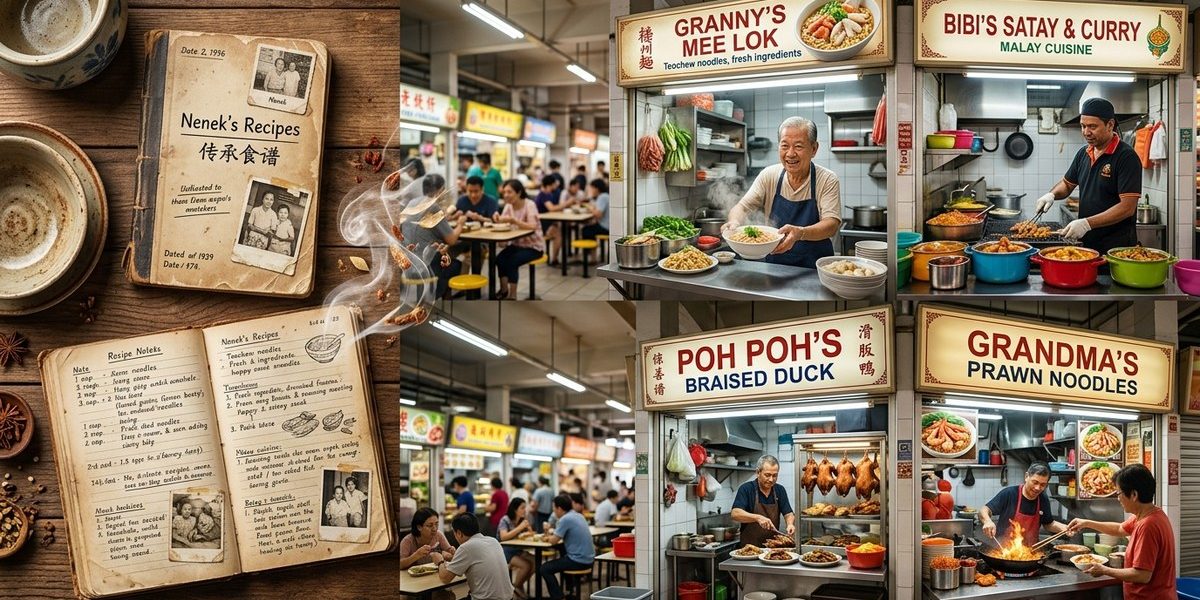
In Singapore, the best recipes are never written down. They are passed through memory, measured by feel, and sealed with love. That is why the new wave of hawker stalls opening in 2026 feels so special. These are not just businesses. They are living archives of grandmothers’ cooking. Young hawkers are pulling old notebooks out of kitchen drawers, dusting off yellowed pages with handwriting that slants to the right, and deciding to turn those family secrets into real food stalls. The result? A surge of authentic, grandmother-inspired dishes that remind us why hawker culture is worth preserving.
Across Singapore, a new generation of hawkers is turning handwritten recipe books into real food stalls. These entrepreneurs draw on their grandmothers’ spice blends, braising methods, and secret sauces. The result is a nostalgic yet fresh taste of home. From old-school laksa to forgotten kueh, each stall carries a family story. Read on to meet four new hawker stalls that honour grandmothers’ recipes and are already winning loyal customers.
Why Grandmother Recipes Matter More Than Ever
Grandmothers hold the DNA of Singapore’s food heritage. Their hands know the exact heat needed for a wok, the precise amount of belacan to wake up a sambal, and the patience to slow cook a broth until it turns cloudy with flavour. When a hawker stall uses a grandmother’s recipe, you taste something deeper than technique. You taste a childhood memory, a Sunday afternoon in a kampong kitchen, or a festive gathering where the whole family helped pound rempah.
These recipes are also vanishing. Many elderly hawkers are retiring, and younger generations often lack the time or interest to learn. That makes the current movement of new hawker stalls so important. They are actively documenting and reviving recipes that might otherwise disappear. Our piece on uncovering Singapore’s heritage hawker recipes passed down through generations explores this in more detail. But today, we focus on the specific stories behind four stalls that have turned grandmothers’ recipes into reality.
From Recipe Books to Reality: A 3-Step Process
Bringing a family recipe to a hawker stall is not as simple as photocopying a page. It takes testing, capital, and emotional courage. Here is a look at how these hawkers did it.
-
Digging up the original source. Most grandmothers never used exact measurements. They used words like “a thumb of ginger” or “enough oil to coat the wok.” The first step for these hawkers was to sit with their grandmothers (or their mothers who learned from them) and write down every detail. They recorded not just ingredients but also the order of adding them, the resting times, and the visual cues.
-
Scaling for a commercial kitchen. A home recipe that serves six people does not automatically work for 100 portions. The hawkers had to test, adjust ratios, and sometimes simplify steps without losing the soul. One stall owner told us she spent three months perfecting her rempah paste because the industrial blender produced a different texture from her grandmother’s mortar and pestle.
-
Training the younger generation. Even after the recipe is locked, the hawker must teach it to their team (or themselves) with the same patience their grandmother once showed them. This ensures the flavour stays consistent even when the original matriarch is no longer in the kitchen.
The Four New Hawker Stalls Carrying Grandmothers’ Legacies
Each of these stalls opened in 2026 and has already built a following. They share one trait: every dish begins with a handwritten recipe from a grandmother.
1. Nenek’s Laksa at Bedok South Market
Ahmad bin Ismail, 34, quit his IT job to revive his late grandmother’s laksa recipe. She was a well-known cook in her kampong in the 1970s. Her laksa features a rich, coconut-based gravy with a hint of dried shrimp and a spice paste that includes 12 ingredients. The stall uses thick beehoon soaked in the gravy for ten seconds before serving a method Ahmad learned by watching his grandmother.
2. Ah Ma’s Hokkien Mee at Toa Payoh Lorong 1
Michelle Tan, 29, grew up eating her grandmother’s version of Hokkien mee. Unlike the heavy, prawn-heavy styles you find elsewhere, Ah Ma’s version relies on a clear, pork-based stock simmered for four hours. Michelle braised the egg noodles she uses in a secret soy sauce mixture that came from her grandmother’s recipe book. The stall also serves a crispy lard garnish that is made fresh every hour.
3. Grandma Ng’s Chicken Rice at Tiong Bahru Market
Jason Ng, 41, spent two years convincing his 78-year-old grandmother to share her chicken rice recipe. She finally agreed when he promised to name the stall after her. Her method involves massaging the chicken with salt and ginger before poaching, and using a mixture of chicken fat and sesame oil for the rice. The stall has already been featured in why Tian Tian Hainanese chicken rice still has queues after 30 years for comparison, but locals say Ng’s version has a more complex ginger kick.
4. Mummy’s Kitchen at Geylang Serai Market
Siti Rahmah, 27, learned her grandmother’s curry puff recipe from a tattered notebook. Her grandmother used a special technique: she added a pinch of sugar to the dough to make it extra flaky, and her filling included potato, egg, and a secret blend of five spices. Siti now makes over 300 curry puffs a day and sells out by noon.
Techniques and Mistakes: A Quick Table
| Technique | Grandmother’s Approach | Common Mistake in Modern Versions |
|---|---|---|
| Rempah paste | Use mortar and pestle, grind in batches | Over-blending in food processor, making it watery |
| Chicken poaching | Gently simmer, never boil; use ice bath for skin snap | Boiling aggressively, skipping ice bath |
| Laksa gravy | Toast dried shrimp before blending | Adding raw shrimp paste, missing depth |
| Hokkien mee stock | Simmer pork bones with white peppercorns for 4 hours | Cutting corners with stock cubes |
These small details make all the difference. The grandmothers knew that texture and aroma are just as important as taste. Modern hawker stalls that skip these steps end up with bland, one-dimensional food.
The Challenges of Preserving Authenticity
Running a hawker stall based on a grandmother’s recipe is not without obstacles. Here are the main hurdles these new hawkers face:
- Consistency is hard. A grandmother might say “add a bit more lard if it looks dry.” But in a busy stall, every portion must taste the same. Hawkers must train their hands to replicate the instinct.
- Ingredient sourcing. Some traditional ingredients, like old strain of coconut milk or specific types of dried fish, are becoming expensive or hard to find. One stall uses fresh grated coconut instead of packaged coconut cream to stay true to the recipe.
- Time pressure. Grandmothers cooked for their families at a relaxed pace. A hawker stall must serve 100 orders during lunch rush. Balancing speed with quality is a constant struggle.
- Resistance to change. Some customers expect a modern fusion twist. But these hawkers are committed to the original version. They believe that heritage should be respected, not reinvented.
Advice from a hawker: “The most important thing is to trust your taste. My grandmother never used measuring cups. She taught me to taste and adjust. That is the real secret. If the sambal tastes flat, add a pinch of salt. If the broth lacks body, let it simmer another 30 minutes. You cannot rush flavour.” — Michelle Tan, Ah Ma’s Hokkien Mee
How to Support These New Grandma-Inspired Hawkers
Visiting these stalls is the best way to keep the recipes alive. Each bowl or plate you buy is a vote for heritage. But you can do more:
- Bring friends and family. Share the story behind the food. When they taste the love, they will come back.
- Leave reviews online. Mention the grandmother inspiration. It helps other food enthusiasts discover these hidden gems.
- Ask questions. If the hawker is not too busy, ask about the recipe. Most are happy to talk about their grandmother’s cooking. It keeps the memory alive for them too.
- Follow the stalls on social media. Many post behind-the-scenes clips of them cooking with their grandmothers or adjusting recipes. Support them with likes and shares.
The Legacy Lives On in Every Bowl
These four hawker stalls are proof that grandmothers’ recipes have a future. They are not stuck in the past. They are adapted, scaled, and served with pride to a new generation of diners. The young hawkers behind them are not just running a business. They are preserving a piece of Singapore’s soul.
So next time you queue at a hawker centre, look for the stall that has a handwritten sign or a family photo on the counter. That might be the one that started with a grandmother’s recipe book. Order a portion, taste slowly, and think about the hands that wrote those instructions decades ago. You are not just eating lunch. You are honouring a legacy.
If you want to read more about family-run hawker traditions, check out our article on three generations behind the wok: Singapore’s oldest family-run hawker stalls. And for more hidden gems, our guide to 10 hawker stalls only locals know about (and how to find them) is a great next step.
The grandmothers may not be in the kitchen anymore, but their recipes are still feeding Singapore. One stall at a time.