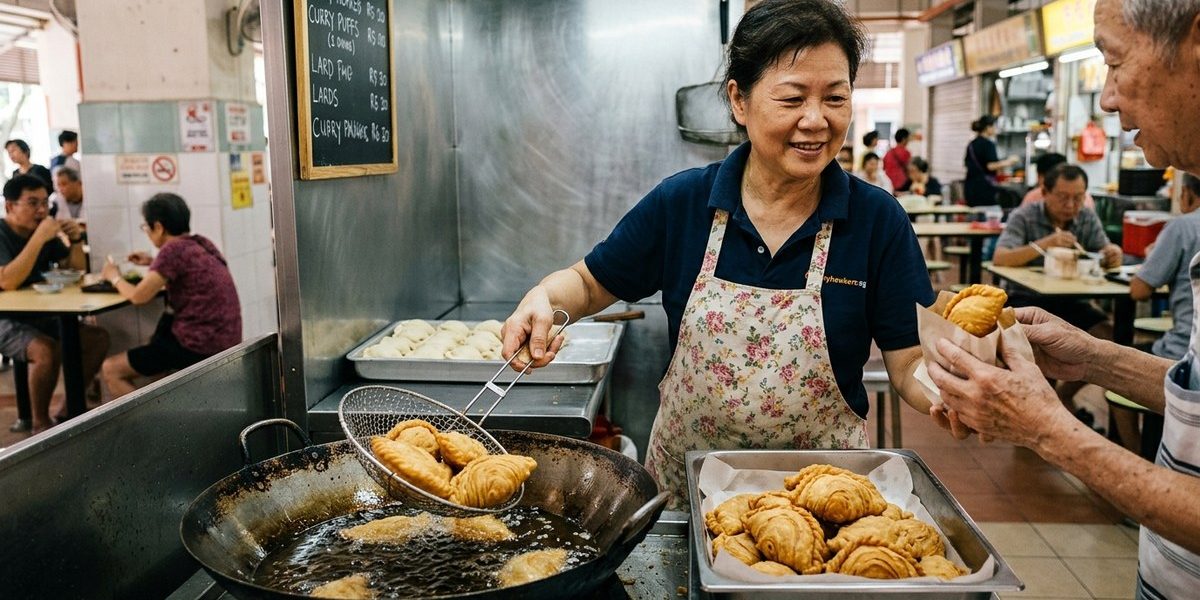
The best curry puffs Singapore uses lard for that impossibly flaky, fragrant crust that no shortening can mimic. We tracked down the Tiong Bahru stall that keeps this tradition alive, plus five other hawkers doing it right. If you want the real deal, forget the bakeries – these are the stalls regulars queue for.
You bite into a curry puff and the crust shatters. Golden flakes scatter across your shirt. The filling, rich with potato and chicken, is just slightly oily. That, right there, is the taste of lard. And in 2026, it is getting harder to find.
Curry puffs are a Singapore icon. But somewhere along the way, many stalls swapped lard for vegetable shortening or margarine. It saves cost, extends shelf life, and keeps the crust looking uniform. But it kills the soul. The best curry puffs Singapore still come from hawkers who refuse to compromise. They know that a proper puff needs animal fat.
We visited the stall at Tiong Bahru Market that has built a cult following around this old school method. The queues snake before lunch. Regulars swear it is the best in Singapore. Let us break down why, and where else you can find the same devotion.
What makes a curry puff worth queuing for
A great curry puff is not complicated. It is a pastry filled with curried potato, chicken, and sometimes egg. But the difference between average and legendary comes down to three things.
First, the crust must be laminated. That means layers of dough folded around fat, then rolled and folded again. When it hits hot oil, the water in the fat turns to steam, forcing the layers apart. Lard creates the thinnest, crispiest layers because of its high melting point and unique fat crystal structure.
Second, the filling must taste like someone spent time on it. Not just curry powder and boiled potatoes. The best stalls cook the filling down until it is thick, almost jammy, with bits of chicken that are still tender. They use fresh rempah – ground shallots, garlic, ginger, and spices.
Third, the frying temperature must be right. Too low and the puff absorbs oil and becomes greasy. Too high and the outside burns before the inside cooks. A master hawker can tell by the sound and the bubbles.
Let us look at how the stalls at the top of the game approach each of these.
The Tiong Bahru stall that keeps the lard tradition alive
We already wrote about this spot in detail on our main article, but here is the short version. The stall uses rendered pork lard for both the pastry and the deep frying. The result is a puff that is almost translucent when held up to the light. It shatters on the first bite.
The uncle behind the stall learned the technique from his father, who ran a pushcart in the 1970s. Back then, lard was the standard. But as health concerns grew and ingredient costs rose, most stalls switched. He refused. “My customers expect the real thing,” he told us. “If I change, they will know.”
One regular we spoke to said he drives from Pasir Ris every Saturday morning just to buy twenty puffs for the week. “Freeze them,” he said. “Reheat in a toaster oven. Still better than anything else.”
Where else to find lard fried curry puffs in Singapore
Tiong Bahru is not the only game in town. Other hawkers still hold the line. Here are five more stalls where lard is not a dirty word.
- Old School Puff at Hong Lim Food Centre – Their pastry uses a blend of lard and butter. The filling has a hint of lemongrass.
- Kampong Chai Chee Curry Puff – A tiny stall in Bedok that fries in fresh lard every morning. They sell out by 1pm.
- Geylang Serai Market’s hidden gem – Look for the stall with a handwritten sign saying “Fried in Pure Lard”. No name, just the promise.
- Tiong Bahru Yi Dian Xin – Different from the famous one, this stall does a sambal version with lard in the pastry.
- Joo Chiat’s traditional puff maker – A third generation hawker who still uses a family recipe from the 1960s.
Each of these stalls has something unique. But they all share one thing: they refuse to change the fat.
How to spot a stall that uses real lard
You do not need to ask. Here are the signs.
| Telltale sign | What it means |
|---|---|
| Irregular, bubbly surface | Lard creates uneven blisters during frying. Shortening gives a smooth, uniform crust. |
| Rich golden brown colour | Lard browns deeper because of its natural sugars and proteins. |
| Aroma of roasted pork fat | The stall itself will smell like a kitchen from your grandmother’s house. |
| Crust shatters into fine shards | Laminated lard pastry breaks into hundreds of tiny flakes. |
| Slightly greasy fingers (but not wet) | Lard leaves a light sheen, not a slick. |
If you see a curry puff that looks too perfect, be suspicious. The real thing is a little ugly. That is how you know it is handmade.
Why lard matters more than you think
“Lard is not just about flavour. It is about texture. Vegetable shortening gives you a stiff, dry crust. Lard gives you tenderness. It is the difference between a puff you eat and a puff you experience.” – A third generation hawker who asked to remain anonymous.
The science backs this up. Lard has a higher smoke point than butter, so it can handle the high heat of deep frying without burning. It also contains less water than butter, which means less steam escapes during frying, keeping the crust crisp for longer. And the unique fatty acid profile means it does not leave a waxy coating on your tongue the way shortening does.
For the best curry puffs Singapore, this is not nostalgia. It is technique.
How to eat a curry puff like a local
There is a proper way. Do not just bite in.
- Wait for it to cool for about two minutes. The filling can be volcanic.
- Hold it with both hands, thumbs on the top ridge.
- Bite off a small corner to let steam escape.
- Tilt the puff so the filling does not drip onto your pants.
- Eat the rest in three or four bites, catching the falling flakes.
If you are eating at a hawker centre, order a kopi O kosong to go with it. The bitterness cuts through the richness.
The best curry puffs Singapore for different cravings
Not every great puff is lard fried. Some stalls use other fats but still produce excellent results. Here is a breakdown by what you want.
For the traditionalist: The Tiong Bahru lard puff. No contest.
For a spicy kick: Look for stalls that add extra chilli to the rempah. The one at Old Airport Road has a version with bird’s eye chilli.
For a breakfast puff: Some stalls open early and fry fresh batches from 6am. The one at Chinatown Complex does a killer morning run.
For a sweet variation: A few hawkers now do yam filled puffs with lard in the crust. They taste like a savoury dessert.
For halal options: Most Malay stalls use vegetable oil, but some use ghee for a similar richness. The stall at Geylang Serai Market, mentioned earlier, is halal certified and uses ghee blended with vegetable oil.
Common mistakes when hunting for curry puffs
Even seasoned food hunters make these errors.
- Assuming all lard is the same. Some stalls reuse oil too many times, which gives a stale taste. Watch how dark the oil looks.
- Going too late. The best puffs sell out by lunch. If you arrive at 3pm, you are getting leftovers or reheated ones.
- Judging by appearance only. A perfectly round, uniform puff is probably machine made and mass produced. Look for uneven shapes.
- Not asking about the filling. Some stalls use pre made curry paste from a factory. Ask if they grind their own spices. The good ones will tell you proudly.
Where the curry puff fits in Singapore’s hawker story
Curry puffs are not a native dish. They came with Peranakan and Eurasian cooks who adapted Portuguese pasties with local spices. Over time, they became a hawker staple. But as hawker culture modernises, the old ways are fading. Lard is expensive. Young hawkers do not want to deal with the smell and the mess. It is easier to buy frozen puffs and fry them on demand.
That is why stalls that still do it by hand, with real lard, are worth protecting. They are not just selling food. They are preserving a technique that goes back generations. When you buy one, you are voting for that future.
For more stories about the hawkers keeping heritage alive, read about the last traditional popiah stall in Katong that locals guard jealously or how a former banker built Tiong Bahru’s most talked about lor mee stall. The same devotion applies.
Your curry puff checklist for this weekend
Before you head out, here is a quick rundown.
- Prioritise stalls that fry to order. They taste best within five minutes of leaving the oil.
- Bring cash. Many old school stalls are cash only.
- Go early. Aim for 10am to 11am for the freshest batch.
- Buy extra. They freeze well. Reheat in a toaster oven at 180 degrees for eight minutes.
- Talk to the hawker. Ask about their fat. Most will be happy to explain if they take pride in their work.
The future of the curry puff in Singapore
In 2026, we are seeing a small resurgence. Younger hawkers who trained under the old masters are opening their own stalls. Some are experimenting with fillings curry chicken, even crab. But they still use lard in the pastry. That is the baseline.
The key is to support these stalls while they are still around. Once they close, the knowledge goes with them. No recipe book can teach the feel of the dough when the lard is at the right temperature. That is something you learn by doing, over years.
So next time you crave a snack, skip the convenience store puff. Head to a hawker centre. Find a stall with a queue. Watch the auntie fold each puff by hand. And when you bite into that shattering, fragrant, golden crust, you will understand why the best curry puffs Singapore are worth the search.
Now go get yourself one. Your kopi is waiting.