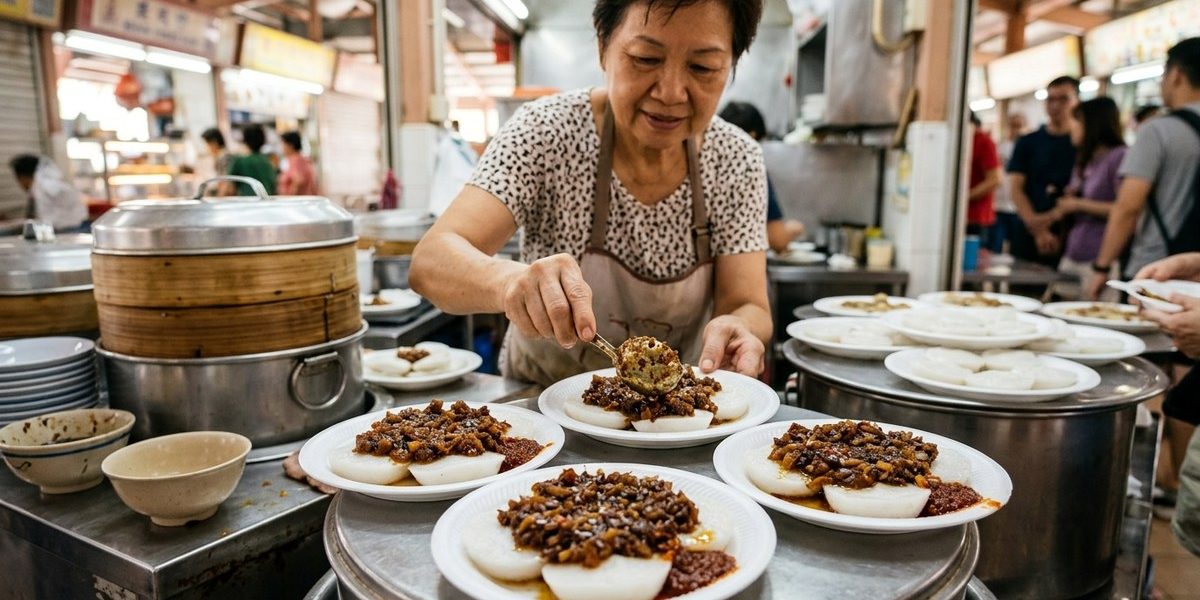
The morning air in Bedok carries a familiar scent. It drifts from a small stall that has been serving the same dish for fifty years. Steam rises from bamboo baskets. The smell of freshly grated radish and rice flour mixes with the chatter of aunties and uncles catching up over breakfast. This is the story of a chwee kueh stall that has become more than just a place to eat. It is a living piece of Singapore’s hawker heritage, a testament to hard work, and a reminder that the best food is often the simplest.
This Bedok chwee kueh stall has survived five decades, two hawker centre relocations, and a global pandemic. The secret is not a fancy spice. It is a stubborn commitment to making everything from scratch daily. The chwee kueh are steamed in small batches, the chai poh (preserved radish) is sourced from the same supplier since 1976, and the chilli sauce is ground fresh every morning. Consistency, not gimmicks, built this legacy.
The Humble Beginnings of a Bedok Institution
Back in the mid 1970s, Bedok was a different place. It was a growing estate, a new town for young families moving out of the city centre. Hawkers were still mostly operating from pushcarts and temporary sheds. That was when Mr. Tan, a Teochew immigrant with a strong back and a simple recipe, started selling chwee kueh from a small cart near the old Bedok market.
He woke up at 3am every day. He ground the rice flour by hand. He grated the chai poh. He steamed the kueh in small batches. There was no shortcut. There was no premix. There was just a man and his craft.
The cart had a loyal following within a year. Residents from nearby HDB blocks would walk over in their slippers, holding their own containers. Mr. Tan would fill the containers with four or five pieces, drizzle the sweet savoury chye poh, and add a spoonful of his homemade chilli. That was breakfast.
From Pushcart to Permanent Stall
In the 1980s, the government began moving hawkers into proper hawker centres. This was part of the larger effort to clean up the streets and provide better hygiene standards. Mr. Tan was one of the first hawkers in Bedok to get a permanent stall.
The move was not easy. He had to adapt to a fixed rental. He had to deal with new regulations. But the customers followed him. The queue that formed at his pushcart simply shifted to his new stall.
This is a pattern we see across many heritage stalls. The ones that survive the relocation are the ones that never compromise on quality. For a deeper look at how other hawkers made this transition, read our piece on how Singapore’s hawkers moved indoors.
The Secret Ingredient That Keeps Customers Coming Back
What is the secret ingredient? It is not a rare spice imported from a faraway land. It is not a family recipe locked in a vault. It is something much simpler and much harder to maintain.
The secret is consistency.
Mr. Tan’s son, who now runs the stall, puts it plainly. “We do not change anything. Not the brand of rice flour. Not the type of chai poh. Not even the size of the steamer trays.”
Here is what they do differently:
- They use only first grade rice flour. No cheaper alternatives.
- The chai poh is soaked for exactly two hours to remove excess salt.
- The chilli is made from a specific type of bird’s eye chilli grown in Johor.
- They steam no more than 20 pieces at a time. No stacking. No shortcuts.
This level of attention is rare. Most stalls today use premix batter or frozen chwee kueh. This stall does not.
A Step by Step Look at the Process
Many people think chwee kueh is easy to make. It is not. The difference between a good piece and a great piece is in the details.
- Prepare the batter. The rice flour is mixed with water and a small amount of salt. The consistency must be just right. Too watery, the kueh becomes hard. Too thick, it becomes rubbery.
- Prepare the chai poh. The preserved radish is washed, soaked, and then stir fried with a touch of sugar and oil. This step brings out the sweetness.
- Fill the moulds. Small ceramic or metal moulds are greased lightly. The batter is poured in, filling each mould about three quarters full.
- Steam in batches. Each batch takes about 15 minutes. The stall owner never opens the steamer too early. That causes the kueh to collapse.
- Add the topping. Once steamed, a small spoonful of the chai poh mixture is placed on top.
- Serve with chilli. The homemade chilli is offered on the side. Some regulars ask for extra.
Common Mistakes That Ruin Chwee Kueh
Not all chwee kueh stalls are created equal. Here is a comparison of what this Bedok stall does right versus what other stalls often get wrong.
| Aspect | This Bedok Stall | Other Stalls |
|---|---|---|
| Rice flour quality | First grade, same brand since 1976 | Often switches to cheaper brands |
| Chai poh preparation | Hand washed and soaked for 2 hours | Sometimes not soaked enough, too salty |
| Steaming method | Small batches, 20 pieces at a time | Large batches stacked to save time |
| Chilli sauce | Freshly ground bird’s eye chilli | Commercial chilli sauce from bottle |
| Batter consistency | Adjusted daily based on humidity | Fixed recipe regardless of weather |
The table above shows why this stall has lasted 50 years while others have closed. It is the small things that add up.
The Generational Handover
Every heritage stall faces the same question. Who will take over when the founder retires? For many stalls, the answer is no one. The younger generation prefers office jobs. The hawker trade is seen as too hard, too hot, too demanding.
But for this Bedok chwee kueh stall, the story is different. Mr. Tan’s son grew up in the stall. He learned the trade by watching his father. He started helping out when he was twelve years old, washing moulds and wiping tables.
When his father retired in 2005, the son did not hesitate. He left his job as a delivery driver and took over the stall. He kept every single recipe the same. He even kept the same supplier for the chai poh.
This kind of succession is becoming rare. We wrote about other family run stalls in our article on three generations behind the wok. The pattern is always the same. The second generation must have a deep respect for the craft.
What Regulars Say About This Stall
The best way to understand the impact of this stall is to listen to the people who eat there.
“I have been eating here since I was a child. My grandfather brought me here. Now I bring my grandchildren. The taste has not changed at all. It is the same chwee kueh I ate forty years ago.”
— Mr. Lim, 68, Bedok resident since 1978“The chilli here is different. It is not just spicy. There is a sweetness to it. I have tried chwee kueh all over Singapore. Nothing comes close.”
— Sarah, 34, food blogger“Some stalls use too much oil in the chai poh. Here, it is just right. Not too oily. Not too dry. Perfect.”
— Aunty Mei, 55, regular customer
These testimonials are not staged. They are the real voices of a community that has grown up around this stall.
The Challenge of Rising Costs
Running a heritage hawker stall in 2026 is not easy. The cost of ingredients has gone up. The rental for hawker stalls has increased. Many stalls have either raised their prices or reduced their portion sizes.
This stall has done neither. The owner explains his philosophy.
“We would rather earn less than serve something we are not proud of. If we raise the price too much, we lose the aunties and uncles who have supported us for decades. If we reduce the quality, we lose our soul.”
Instead, they have found other ways to survive. They open earlier to catch the breakfast crowd. They close later to serve the lunch crowd. They do not waste a single piece of ingredient.
This is a lesson for anyone who thinks hawker food is easy money. It is not. It is a labour of love.
How to Find This Stall and What to Order
If you want to experience this slice of Bedok history, here is what you need to know.
The stall is located in the Bedok market and food centre. It opens at 6am from Tuesday to Sunday. It is closed on Mondays. The best time to visit is between 7am and 9am. That is when the chwee kueh are freshest.
What to order:
- A plate of chwee kueh (4 pieces is standard)
- Extra chai poh on the side (ask nicely, they usually oblige)
- A cup of strong kopi O from the drink stall opposite
The total cost is under five dollars. That is a cheap price for a meal that carries fifty years of history.
Why This Stall Matters for Singapore’s Food Heritage
Stalls like this one are not just businesses. They are cultural institutions. They represent a way of life that is slowly disappearing. The younger generation is not learning the trades. The older hawkers are retiring. Every year, we lose a few more heritage stalls.
This is why documenting these stories is important. It is not just about food. It is about the people behind the food. It is about the families who sacrificed sleep and comfort to serve their community.
When you visit this stall, you are not just eating chwee kueh. You are participating in a tradition. You are keeping a small piece of Singapore alive.
For more stories about hawkers who are keeping traditions alive, check out our feature on the vanishing art of traditional kueh making.
The Future of This Bedok Chwee Kueh Stall
The current owner is now in his late fifties. He has been running the stall for over twenty years. He still wakes up at 3am. He still makes everything by hand. He still refuses to use premixes.
What happens when he retires? He is training his nephew. The nephew is in his thirties. He has a degree in business but chose to learn the trade instead. He spends weekends at the stall, learning the process.
If the nephew takes over, the stall will continue. If not, it will close. That is the reality for many heritage stalls.
But for now, the steam still rises. The queue still forms. The chwee kueh are still perfect.
Preserving the Taste of Home
In a world where everything is changing, some things stay the same. This Bedok chwee kueh stall is one of those things. It is a reminder that the best food does not need to be fancy. It just needs to be made with care.
Next time you are in Bedok, skip the trendy cafes. Skip the chain restaurants. Go to the market. Find the stall with the longest queue. Order a plate of chwee kueh. Eat it slowly. Taste the history.
That is what fifty years of dedication tastes like.