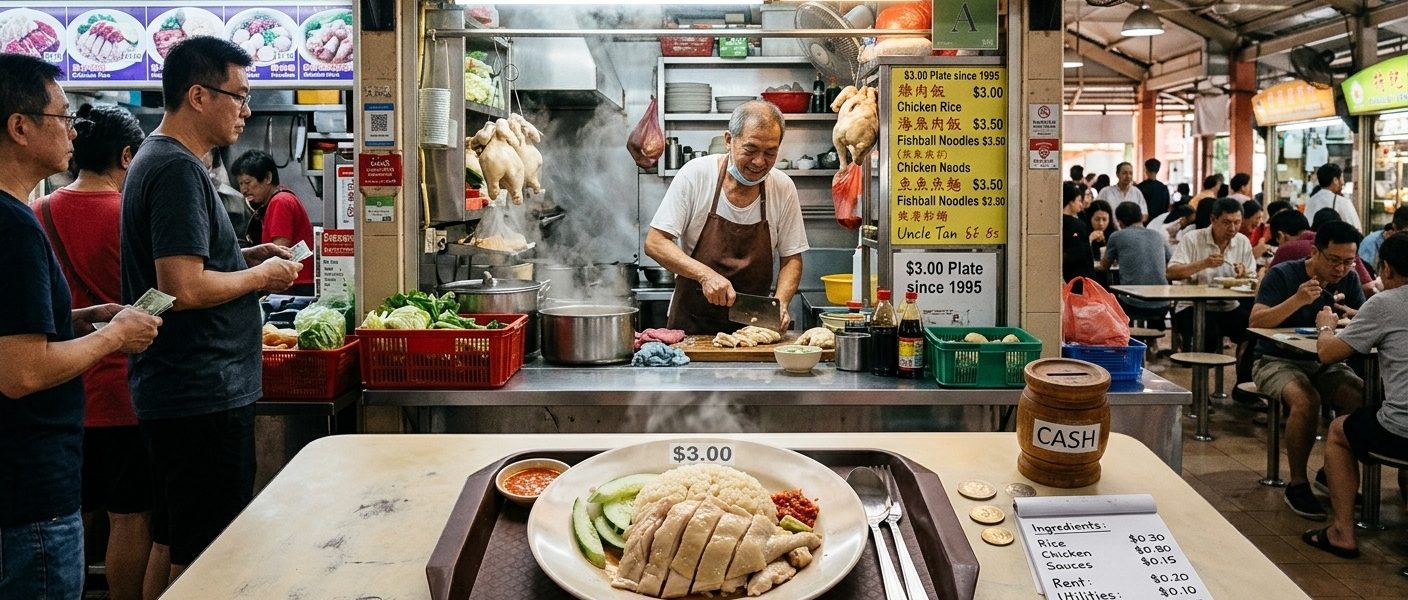
The plate lands in front of you before you have finished saying thank you. Char kway teow, dark with soy and wok hei, a handful of cockles glistening under the fluorescent light. You hand over three dollars. The uncle nods, already turning back to his wok. Behind you, the queue has not moved. This happens every morning, every lunch hour, at thousands of hawker stalls across Singapore. And somehow, despite everything that has gotten more expensive in this city, the price on the board has barely shifted.
How is that still possible?
The $3 Plate at a Glance
- Subsidised rents at NEA-managed hawker centres are the single biggest structural reason hawker prices stay low.
- Long-standing supplier relationships give experienced hawkers pricing buffers that newer food businesses cannot access.
- The loyalty contract between hawkers and their regulars functions as a quiet social brake on price increases.
- Hawkers routinely absorb cost increases in oil, gas, and ingredients rather than immediately passing them on.
- For roughly the same spend as fast-food alternatives, a hawker plate often delivers more craft, more flavour, and a story behind every bowl.
When Fast Food Starts to Feel Like the Sensible Option
There is a moment, usually around the third week of the month, when your wallet speaks louder than your stomach. You walk past a hawker centre and the queue snakes around the corner. You check the time. You think about the air-conditioned comfort across the road, the predictable portion, the loyalty points. Budget-pressed Singaporeans reach for fast food not because they love it more, but because it feels familiar, quick, and comparably priced.
That instinct is understandable. Browsing what passes for cheap chain food shows just how aggressively certain food brands have positioned themselves on price. But the math, when you work it honestly, rarely favours the chain. A hawker plate at $3 to $4 typically delivers more protein, more variety, and cooking that has been refined over years or even generations. What fast food gains in consistency, it concedes entirely in character.
The hawker centre, once you commit to joining that queue, usually returns the favour many times over.
The Rental Structure That Changes Everything
Singapore’s hawker centres did not stay affordable by accident. The government made a deliberate structural choice decades ago: keep the rents low enough that a hawker could earn a living without charging restaurant prices.
The National Environment Agency oversees most hawker centres in Singapore, maintaining a hawker centre management framework that includes subsidised stallholder rentals. For many stalls, especially those occupied by hawkers who have been in the system a long time, the monthly rental can be a fraction of what a commercial food court or mall kiosk would charge. That gap is significant. It is the structural reason a plate of chicken rice can stay at $3.50 while the same dish at a nearby air-conditioned restaurant costs three times as much.
This does not mean the economics are comfortable. It means they are survivable. And survivable, for a hawker who has been feeding the same neighbourhood for thirty years, is enough of a foundation to keep going.
Old Handshakes and Long Supplier Relationships
Walk into any hawker centre at six in the morning and you will see the deliveries. Crates of beansprouts. Buckets of sambal. Frozen pork belly wrapped in brown paper. These goods do not arrive through impersonal wholesale portals. They come from the same supplier who came last Tuesday, and the Tuesday before that, and the one ten years ago when the hawker was just getting started.
Long-standing supplier relationships give experienced hawkers a pricing buffer that newer food businesses simply cannot replicate. A hawker who has bought from the same pork supplier for fifteen years does not pay spot price when pork belly spikes. He calls his contact, explains the situation, and they find a number that works for both of them. The price adjusts, but it does not spike the way it would on the open market.
This is not sentiment. It is economics built on trust and consistent volume over time. The hawker brings predictable orders week after week. The supplier brings stable pricing. Both parties protect the relationship because both know it is harder to rebuild than to maintain.
Sitting Across from Mr Chew at Block 505
Mr Chew Ah Beng has been frying char kway teow at the same wok, in the same corner stall at Bishan’s Block 505 hawker centre, for twenty-two years. His plate is $3.50. It has been $3.50 for the last four years.
“My regular customers, they come every day. Some of them I know their children already,” he says, pausing to slide a fresh batch of flat rice noodles into the screaming-hot wok. “If I raise the price, where they go? They have to eat, right? I cannot simply hike and then not care.”
He is not unaware of the pressures. Cooking oil has gone up. Gas has gone up. The cockles he uses, which are non-negotiable in his version of the dish, cost more now than they did two years ago. He absorbs most of it. Not all of it, but most.
“I cut a little on the cockles during the bad months,” he admits, without any trace of complaint. “I don’t tell the customer. I just do what I can.”
This quiet negotiation, between what the hawker can absorb and what the regular can afford, is the beating heart of the $3 plate.
Breaking Down the Math Behind a Single Serving
When you break down the economics of one hawker plate, several cost layers stack together. Understanding them makes the price feel less like magic and more like hard-won discipline.
- Raw ingredients: For a typical plate of char kway teow, the noodles, egg, beansprouts, lap cheong, and cockles might cost between $1.20 and $1.60, depending on the day’s market prices.
- Gas and utilities: A busy stall running a gas wok through a full service can spend $200 to $400 a month on fuel alone, spread across hundreds of plates per day.
- Stall rental: At a subsidised NEA-managed centre, this might range from a few hundred dollars to around $1,000 monthly. That figure is well below commercial food court rates.
- Labour: Most hawkers at this price point are owner-operators. They pay themselves last, treating the margin as a slow wage drawn across months rather than a clean salary.
- The margin: After costs, the profit on a $3.50 plate might be between 60 cents and $1.20. Volume is everything. A good lunch rush makes the economics work. A slow, rainy Tuesday afternoon does not.
What Never Makes It onto the Price Board
The number chalked on a hawker stall tells you almost nothing about what the hawker has quietly swallowed to keep it there. Behind every plate that stayed at $3 through the past few years is a long list of cost increases that regulars never saw, because the hawker chose not to pass them on.
- Cooking oil prices, which spiked sharply due to global supply disruptions and have not fully come back down.
- Pork and seafood costs, which are sensitive to import conditions and weather events affecting regional supply chains.
- Seasonal price jumps in fresh produce around festive periods, when wholesale markets tighten and every stall competes for the same ingredients.
- Packaging costs for takeaway containers, which have increased as both material costs and regulatory requirements evolve.
- Utilities, where electricity and gas tariff adjustments happen independently of whatever the hawker happens to be earning that month.
Each of these gets absorbed in small, invisible ways. A slightly thinner portion of cockles during a bad week. A decision not to upgrade the signage this year. A quiet choice not to add a dollar to the price even when every cost signal points toward doing exactly that. The hawker takes the hit because raising the price feels, to many of them, like breaking a promise to the people who show up every day.
Flavour, Craft, and Twenty-Two Years of Wok Hei
There is something else the $3 plate carries that no price comparison can fully account for. It carries years of repetition. The char kway teow that Mr Chew plates in under three minutes is the product of thousands of servings, of adjusting the heat, reading the smoke, timing the egg, knowing the exact moment to add the beansprouts so they stay crisp rather than going limp. That skill is not incidental. It is the whole point.
A chef at a mid-range restaurant who has cooked for five years is written up in food guides. A hawker who has cooked the same dish for twenty-two years at the same wok is handed three dollars and a brief nod of thanks. The craft was always there. The price just kept it quiet.
That is not sustainable forever. Hawkers are aging. Succession is uncertain. The structural buffers that have held prices down are being tested in ways that were not true fifteen years ago. At some point, something gives.
What That Plate Has Been Carrying All Along
The $3 hawker plate is not cheap because Singapore has stood still. It is still at $3 because certain structures, relationships, and personal commitments have held firm against the current. Subsidised rents that kept the floor in place. Supplier trust built across decades of consistent orders. A hawker who looks at the familiar faces in his queue every morning and chooses not to move the number on the board, even when it costs him something real.
These are not abstract forces. They are choices made by specific people at specific stalls, day after day, out of a sense of responsibility to the neighbourhood they have spent their working lives feeding.
The next time you pick up that plate, it is worth pausing for a moment before you sit down. Not to feel guilty about the price. But to recognise, clearly, that what you are holding cost someone more than three dollars to put together. And that they made that choice for you.