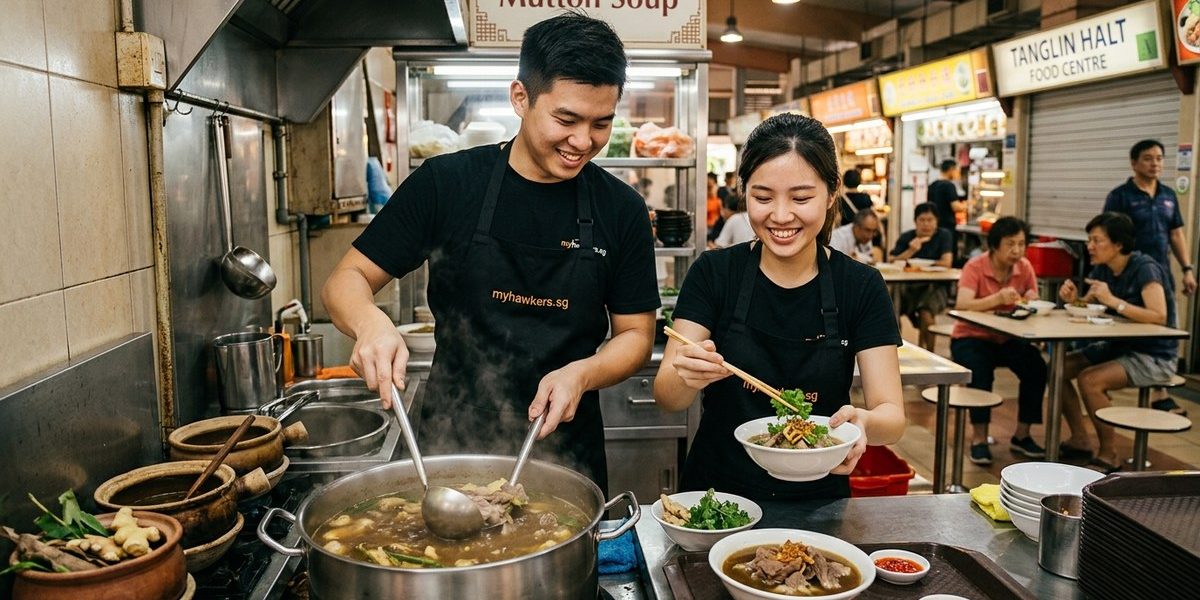
The last time you saw Hainanese mutton soup on a menu, your grandparents might have been the ones ordering it. This dish once filled the steam tables of Hainanese family restaurants across Singapore. Then it quietly vanished. Most foodies under 40 have never tasted it. A few older uncles still remember the rich, peppery broth and the way it warmed you from the inside out. Now, in a small stall at Tanglin Halt Market, a young couple is bringing that memory back to life.
A young hawker couple has revived a nearly extinct Hainanese mutton soup at Tanglin Halt Market. They tracked down a 60 year old handwritten recipe from a retired chef, then spent months perfecting the broth. The result is a bowl that tastes like 1960s Singapore. We break down the dish, how they did it, and why it matters for anyone who cares about hawker heritage.
The Bowl That Almost Disappeared
Hainanese mutton soup has roots that run deep into Singapore’s early hawker history. Hainanese immigrants who worked as chefs in British households and clubs learned to make slow cooked Western style stews. They adapted those techniques using local ingredients. Mutton became a favourite because it was affordable and took well to long simmering.
The soup was never as famous as Hainanese chicken rice. But it had a loyal following. The broth was clear yet intensely savoury. The meat was tender, often served with a sharp chilli dipping sauce and white bread for soaking up the gravy. By the 1990s, most stalls had stopped making it. The process was too long. The margins were too thin. The younger generation did not learn it.
Today, you can count the stalls serving authentic Hainanese mutton soup on one hand. That is why what is happening at Tanglin Halt matters.
Who Is Behind the Revival
The stall is run by a husband and wife team in their early 30s. He used to work in logistics. She was in marketing. Both grew up in the Tanglin Halt area. They remember their grandfathers talking about a mutton soup stall that used to operate near the old market in the 1960s. That stall closed before they were born. The taste lived only in stories.
Then they found a relative who had worked in that original stall. He still had the recipe. Not a printed card or a typed page. A handwritten note in faded blue ink on yellowed paper. The instructions were vague. “Add enough pepper until it feels right.” “Simmer until the meat listens.” They had to fill in the gaps.
They spent eight months testing the recipe. They cooked batch after batch. They invited older residents from the estate to taste and give feedback. Only when three different aunties said “this tastes like the old days” did they open for business.
What Makes Hainanese Mutton Soup Different
Many people confuse Hainanese mutton soup with other mutton dishes in Singapore. It is not the same as the Indian Muslim version with rich, dark gravy. It is not the Teochew style either. Here is how it stands apart.
| Feature | Hainanese Mutton Soup | Other Mutton Soups |
|---|---|---|
| Broth base | Clear, peppery, slow simmered stock | Often thick, spiced, or coconut based |
| Meat texture | Fall apart tender, almost like a stew | Can be chewy or shredded |
| Key seasoning | White pepper, ginger, and a touch of salt | Cumin, star anise, or curry spices |
| Accompaniment | White bread or plain rice | Roti prata, biryani rice, or baguette |
| Chilli dip | Vinegar based with fresh bird’s eye chilli | Usually sambal or curry based |
The broth is the star. It takes about six hours to make. The couple starts at 4am every day. They use mutton shoulder and bones. The stock is boiled with ginger, garlic, and whole white peppercorns. No artificial flavouring. No premix. Just patience.
How They Recreated the Recipe
The process was not straightforward. The original recipe had gaps. Some ingredients were listed by local names that are no longer common. Others had quantities that did not scale well to a modern hawker stall.
Here is how they turned a fading note into a working recipe.
- Decode the ingredients. They cross referenced each term with older relatives and a retired Hainanese chef from a hotel kitchen. One ingredient turned out to be a type of dried citrus peel that is now hard to find. They substituted with a local lime leaf.
- Test the cooking time. The original note said “cook until the house smells right.” They timed it. The correct simmering window was between five and a half to six hours. Any shorter and the meat was tough. Any longer and the bones made the stock bitter.
- Adjust for modern palates. The 1960s version was very peppery. Older tasters loved it. Younger testers found it overwhelming. They reduced the white pepper by about 20 percent and added a slight sweetness from caramelised onions. The result kept the soul of the original but felt balanced.
“The hardest part was knowing when to stop. You want to honour the past, but you also want people to actually eat it. If they don’t like it, the recipe dies again.”
The hawker, speaking about the process
Common Mistakes When Making Mutton Soup at Home
If you try to recreate this dish yourself, watch out for these pitfalls. The couple shared what they learned the hard way.
- Using the wrong cut of mutton. Shoulder or leg works best. Lean cuts like loin become dry and stringy.
- Skipping the blanching step. You must blanch the meat first to remove impurities. Otherwise the broth turns cloudy and bitter.
- Adding salt too early. Salt draws moisture out of the meat and toughens it. Add salt only in the last hour of cooking.
- Overpowering with spices. The Hainanese style is subtle. Too much star anise or cinnamon makes it taste like a completely different dish.
- Rushing the simmer. Low and slow is non negotiable. High heat makes the collagen break down unevenly.
Where Heritage Hawker Food Is Heading
Stories like this one are becoming more common. Young hawkers are not just opening stalls. They are acting as food archaeologists. They dig up old recipes, talk to elderly chefs, and rebuild dishes that the market had forgotten.
This trend is important for Singapore’s food culture. Each lost recipe takes with it a piece of history. When a dish disappears, we lose more than a flavour. We lose the context of who made it, why they made it, and how it connected communities.
The couple at Tanglin Halt is part of a larger movement. Across the island, other young hawkers are doing similar work. You can read about a former banker who rebuilt a famous lor mee recipe and a team reviving a 1950s laksa lemak. These are not nostalgia projects. They are acts of cultural preservation.
What You Will Taste at the Stall
When you order a bowl at Tanglin Halt, here is what to expect.
The soup arrives in a simple white bowl. The broth is pale gold. It smells of white pepper and ginger. The mutton is submerged, dark and tender. On the side, you get a small saucer of chilli vinegar and two slices of white bread.
- Start with the broth. It is clean and warming. The pepper hits the back of your throat but does not burn.
- Dip the bread into the soup. Let it soak for a few seconds. The texture is soft and comforting.
- Eat the mutton with the chilli vinegar. The acidity cuts through the richness of the meat.
- Save the last bit of broth for the end. Drink it like a tea. That is how the old regulars did it.
The stall sells out almost every day by 1pm. They make only about 80 bowls. There is no delivery. You have to go in person. That is part of the experience.
Tanglin Halt Market as a Food Destination
Tanglin Halt Market has been a quiet fixture in the Queenstown area for decades. It is not as famous as Tiong Bahru or Maxwell. But it has its own charm. The market is older, smaller, and less polished. The crowd is mostly residents who have been eating there since the 1970s.
The mutton soup stall has brought new visitors to the market. On weekends, you see younger couples and food bloggers alongside the regular uncles reading Chinese newspapers. The stall has become a reason to come to Tanglin Halt. Once you are there, you might also try the other heritage stalls in the same market. It is a reminder that some of the best hawker food is found in the less flashy centres.
If you want to understand more about how hawker centres shaped Singapore’s food landscape, our article on how the 1960s hawker relocation programme changed everything gives the full background.
How to Support Disappearing Hawker Trades
Not everyone can run a stall. But anyone can help keep these traditions alive. Here are a few practical ways.
- Visit stalls that serve rare dishes. Your patronage directly funds their ability to keep making them.
- Talk to elderly hawkers. Ask them about their recipes. Many love to share stories if you show genuine interest.
- Share posts about heritage food on social media. Word of mouth still drives foot traffic.
- Bring younger friends along. Introduce someone under 25 to a dish they have never tried.
- Write reviews that mention the history of the dish. It helps other food lovers find these places.
The couple at Tanglin Halt did not revive this recipe for fame or profit. They did it because they believed the dish deserved to exist. That kind of conviction is what keeps Singapore’s hawker culture alive.
A Bowl Worth the Trip
Tanglin Halt is not the easiest place to get to. It is a short walk from Commonwealth MRT, but it is not on the usual food tourist trail. You have to make a conscious decision to go there. Do it.
The Hainanese mutton soup at this stall is not just good food. It is a time capsule. One spoonful connects you to a version of Singapore that is almost gone. The young couple behind the counter are not just hawkers. They are custodians of a flavour that deserves to survive.
Go before the queue gets longer. Go before the recipe becomes a story again. And when you are there, take a moment to appreciate the work that went into that single bowl. It took months of trial, years of research, and a deep love for a dish that almost nobody remembered.
That is the kind of food worth travelling for.