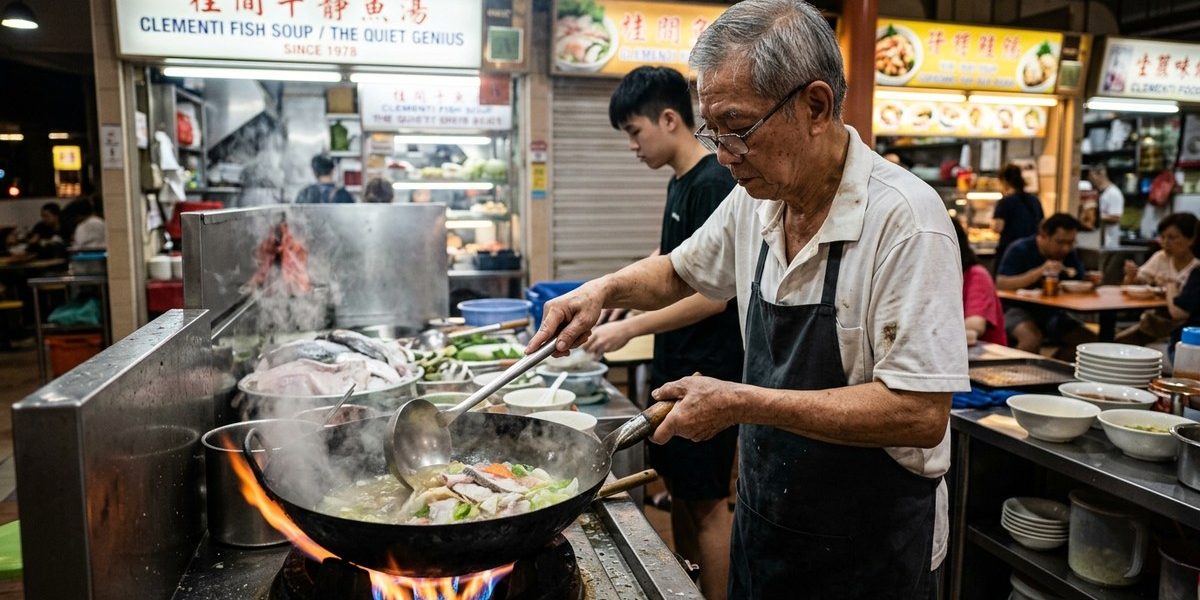
The morning air at Clementi 448 Market is still cool when the first customers arrive. They come for one thing: a bowl of fish soup that tastes like it was made by someone who has nothing left to prove. The man behind the stall moves with a rhythm that only decades can teach. He does not rush. He does not cut corners. And despite being at an age where most people would be enjoying their retirement, this Clementi fish soup hawker refuses to retire.
The Clementi fish soup hawker who refuses to retire is more than a story about food. It is a lesson in dedication, heritage, and the quiet genius of mastering one dish over a lifetime. This article explains why he stays, how his technique stands apart, and what his refusal to retire means for Singapore’s hawker culture in 2026.
The Man Behind the Wok
His name is not on any Michelin guide. You will not find his face on a viral TikTok. But for the regulars at Clementi 448 Market, he is a living legend. They call him “Uncle” and he knows their orders by heart. The uncle who runs this fish soup stall has been at it for over 40 years. He started when Clementi was still a sleepy estate, long before the condos and the MRT line made it a hotspot.
What drives a man to keep working when he could be resting? For him, it is not about money. His children are grown and doing well. His flat is paid off. He has enough savings to last. But every morning at 4am, he is at the market, choosing fish by touch and smell. He says the day he stops is the day he stops being useful. And that is a day he is not ready for.
Why He Refuses to Retire
The reasons are not what you might expect. It is not stubbornness or a fear of change. It is something deeper. Here are the real reasons this Clementi fish soup hawker refuses to retire:
-
His regulars depend on him. Many of his customers are elderly residents who live alone. His stall is not just a place to eat. It is a place where they see a familiar face. A place where someone asks if they have been eating well.
-
His craft is his identity. He learned to make fish soup from his father, who learned from his father before him. To stop would be to break a chain that has lasted three generations. He feels a responsibility to keep the recipe alive.
-
He has not found a worthy successor. This is the hardest part. He has trained several young cooks over the years. None of them stayed. The work is too hard, the hours too long, the pay too modest for the effort required. Until he finds someone who loves the wok as much as he does, he will not walk away.
The Technique That Sets Him Apart
Not all fish soup is created equal. At this stall, the difference is in the details. The uncle uses a method that most younger hawkers have abandoned. He insists on doing things the hard way because the hard way tastes better.
| Element | His Approach | Common Mistake |
|---|---|---|
| Stock base | Simmers fresh fish bones for 6 hours | Using stock cubes or powder |
| Fish selection | Whole batang fish, hand-cut daily | Pre-cut frozen fillets |
| Wok temperature | High heat, constant motion | Medium heat, slow cooking |
| Seasoning | White pepper and light soy only | Heavy MSG and salt |
| Soup clarity | Clear broth, no impurities | Cloudy or greasy broth |
He explains it simply: “The wok is not a machine. It is a tool that talks to you. You must listen.” When the oil hits the wok, he listens for the sizzle. When the stock goes in, he watches how it swirls. Every batch is different because the fish is different. He adjusts each time.
“Young people ask me for a recipe. I tell them there is no recipe. There is only feel. You cook with the same fish every day for 40 years, you will know when it is ready. I cannot write that down.”
What You Will Taste in the Bowl
When you order a bowl from this stall, you get more than food. You get a snapshot of Singapore’s hawker heritage. The soup is clean and bright. It tastes of the sea, not of salt. The fish is firm but tender, never mushy. The slices are thick enough to feel substantial but thin enough to cook in seconds.
He serves it with a choice of noodles or rice. The regulars know to ask for bee hoon, the thin rice vermicelli that soaks up the broth without falling apart. A dash of white pepper and a squeeze of lime complete the bowl. There is nothing fancy about it. That is the point.
A Vanishing Breed of Hawkers
This Clementi fish soup hawker who refuses to retire is part of a shrinking group. Across Singapore, elderly hawkers are closing their stalls. Some retire. Some pass away. Some simply give up because they cannot find help. The National Environment Agency has tried to attract young hawkers through incubation programmes. But the numbers are not keeping up.
The problem is not a lack of interest in eating hawker food. Singaporeans love their hawker centres. The problem is a lack of interest in being a hawker. The work is physically punishing. The margins are thin. And the prestige is still catching up to the reality of how important these cooks are to Singapore’s identity.
To understand why this matters, read our piece on why Tian Tian Hainanese chicken rice still has queues after 30 years. The same devotion applies here, just without the tourist crowds.
How to Support Hawkers Like Him
If you want to help preserve this heritage, you do not need to do anything complicated. Here are a few simple actions that make a real difference:
- Visit the stall during off-peak hours. The uncle works alone most days. A sudden rush of 20 people can overwhelm him. Go at 10am or 2pm when the crowd is thinner.
- Bring cash. Not every elderly hawker has adopted digital payments. Having exact change helps them avoid fumbling with coins.
- Say thank you. It sounds small, but a genuine word of appreciation can make his entire day.
- Share the story. Tell a friend about this stall. Bring a colleague. Post about it online. Word of mouth is still the most powerful tool for keeping these stalls alive.
For more hidden stalls worth your time, check out our list of 10 hawker stalls only locals know about.
What the Future Holds
The uncle does not like to talk about the future. When asked, he shrugs and says, “I take it one day at a time.” But those who know him well suspect he will keep going until his body refuses. He has seen too many peers close their stalls. He does not want to be another name on that list.
There is hope, however. In 2026, more young Singaporeans are showing interest in hawker work. The stigma is fading. Programmes by the government and private groups are making it easier to learn the trade. But the uncle is cautious. He has trained five young people in the last decade. Only one lasted more than a year.
He says the problem is not skill. It is patience. “Young people want to be good in six months. This work takes years. You cannot rush the wok.”
The Quiet Genius of Simplicity
There is a reason this Clementi fish soup hawker refuses to retire. It is not because he has no other options. It is because he knows that what he does matters. In a world that celebrates the new and the novel, he represents something rare: consistency. Day after day, year after year, he shows up and makes the same bowl of soup. And every bowl is excellent.
That is the quiet genius. It is not about flashy techniques or secret ingredients. It is about showing up. It is about caring about the details when no one is watching. It is about knowing that a good bowl of fish soup can make someone’s day better.
A Legacy Worth Preserving
The next time you are at Clementi 448 Market, take a moment to watch him work. Notice how he handles the wok. Notice how he greets his regulars. Notice how he still cares, even after all these years. That is the legacy of a true hawker.
If you want to see other hawkers who have dedicated their lives to their craft, read about the 78-year-old uncle behind Chinatown’s best char kway teow. Or learn about three generations behind the wok in Singapore’s oldest family-run stalls.
For now, the uncle is still there. His hands are a little slower than they used to be. His back aches by noon. But he is still there. And as long as he is, Clementi will have one of the best bowls of fish soup in Singapore.
How to Find the Stall
If you want to taste his work, here is what you need to know:
- Location: Clementi 448 Market, stall number 01-24
- Opening hours: 7am to 2pm, Tuesday to Sunday (closed on Mondays)
- What to order: Fish soup with bee hoon, add an extra piece of fish if you are hungry
- Price range: $4.50 to $6.00 per bowl
- Best time to visit: 10am to 11am, after the breakfast rush but before lunch
Go before it is too late. These stalls do not stay open forever. And when they close, a part of Singapore’s soul closes with them.
The Wok Speaks for Itself
The Clementi fish soup hawker who refuses to retire does not need to explain himself. His wok does the talking. One taste of his soup and you understand. This is not just food. This is a lifetime of learning, compressed into a single bowl. It is worth every minute of the journey to Clementi.
Support your local hawkers. They are the keepers of Singapore’s culinary memory. And once they are gone, no amount of fancy restaurants or viral food trends can bring them back.