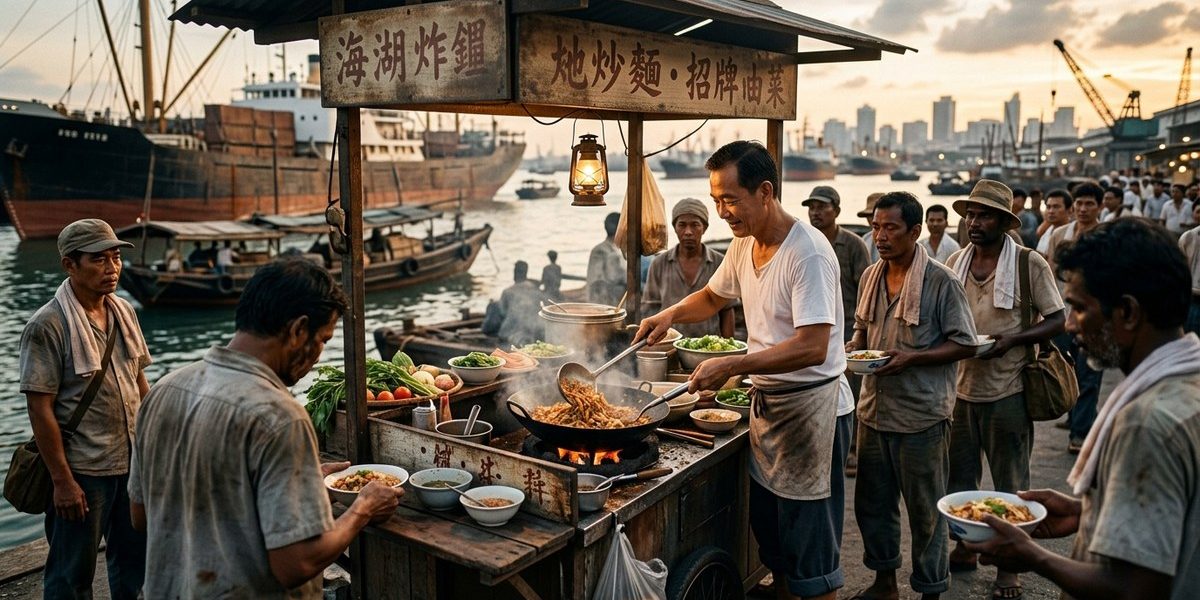
The clatter of steel on stone. The hiss of a charcoal stove. The sharp call of a vendor announcing his wares. This was the soundtrack of Singapore’s waterfront in the 1960s. Before container ships dominated the horizon, before the skyline was a forest of cranes, the harbour was a living, breathing muscle of our economy. And at the centre of that muscle were the men who swung the cargo hooks, the stevedores who braved the tropical sun, and the lightermen who navigated the crowded waters. They needed fuel. Not just any fuel, but hot, cheap, and filling meals that could be eaten in ten minutes flat. The people who provided that fuel were the forgotten hawker heroes of the 1960s.
The hawkers who fed Singapore’s 1960s harbour workers were the unsung backbone of our nation’s growth. Operating from pushcarts and makeshift stalls, they served hearty, affordable meals that sustained a gruelling 12-hour workday. Their legacy lives on in the hawker centres we cherish today, but their stories of grit and sacrifice are fading. This article honours those pioneers and the dishes that kept Singapore’s port alive.
The Waterfront Was a Different World
If you walked along the Singapore River in the 1960s, you would not see the sleek boats of today. You would see a chaotic, noisy, and sweaty artery of trade. Lighters, those small wooden cargo boats, were packed so tightly you could almost walk across them. Coolies balanced massive loads on their shoulders. The air smelled of salt, diesel, and spices. This was not a place for the faint hearted.
The harbour workers, mostly Chinese labourers from Hokkien and Teochew communities, along with Indian and Malay workers, started their days before sunrise. They worked until sunset. Their breaks were short. They did not have the luxury of sitting down for a proper meal. They needed food that was fast, portable, and packed with calories to replace the energy they burned hauling cargo.
This is where the hawkers stepped in.
The Pushcart Armada
Hawkers in the 1960s did not have the luxury of a permanent stall with a fan. They operated from pushcarts, wooden carts, and sometimes just a basket balanced on a pole. They set up shop at the edge of the docks, near Boat Quay, and along the roads leading to the godowns. Their timing was precise. They knew exactly when the shift changes happened.
“My father used to wake up at 3am to prepare his ingredients. By 5am, he was pushing his cart down to the river. He knew the first batch of coolies would be arriving by 6am, and they needed a hot breakfast before the sun got too hot.” This is a story I heard from the son of a now retired hawker who sold bee hoon at the harbour.
These hawkers were not just selling food. They were providing a service that kept the port running. A hungry worker is a slow worker. A slow worker loses income. The hawkers understood this. They became an essential part of the harbour ecosystem.
What Did They Serve the Harbour Workers?
The menu was simple, but it was designed for maximum energy and minimum fuss. These were not fancy dishes. They were the working class staples that many of us still love today.
- Bee Hoon (Rice Vermicelli) in Soup: A light but warming bowl of broth with slices of fish cake or pork. It was easy to eat standing up.
- Nasi Lemak Wrapped in Banana Leaf: The coconut rice was a powerhouse of energy. The hawker would wrap it in a neat banana leaf parcel with a piece of fried fish or egg. Workers could slip it into their pockets and eat it during a break.
- Roti Prata: The Indian Muslim hawkers were masters of this. A couple of flaky pratas with a dab of curry was a filling and affordable breakfast.
- Kway Teow Noodles: Stir fried with bean sprouts and a little lard for flavour. It was hot, oily, and satisfying.
- Teh Tarik: The sweet, frothy milk tea was not a meal, but it was a lifeline. It provided a sugar hit and a moment of rest.
The portions were generous. The prices were low. The hawkers operated on razor thin margins, but they made up for it with volume.
The Rhythm of the Harbour
A typical day for a hawker near the harbour followed a strict rhythm. Here is how it worked:
- Pre-dawn preparation (3am to 5am): The hawker would visit the wet market to buy fresh ingredients. Then came the hours of washing, chopping, and marinating. The broth had to be simmered. The sambal had to be ground.
- The morning rush (6am to 9am): The first wave of workers arrived. This was the busiest period. The hawker needed to serve food fast. There was no time for small talk. It was purely transactional.
- The midday lull (10am to 11am): The harbour quietened down. The hawker would use this time to restock, clean his cart, and maybe eat his own breakfast.
- The afternoon push (12pm to 2pm): A second wave of workers came for lunch. The sun was at its peak. The hawker worked under a small awning, sweating as much as his customers.
- Evening wind down (5pm to 7pm): The last shift change. After this, the hawker would pack up his cart and head home to start the cycle again.
| Time of Day | Worker Activity | Hawker Task | Key Dish |
|---|---|---|---|
| 3am to 5am | Resting / preparing for work | Market run, ingredient prep | N/A |
| 6am to 9am | Heavy cargo loading | Serving morning rush | Nasi lemak, bee hoon soup |
| 10am to 11am | Tea break / lighter work | Restocking, cleaning | Teh tarik, small snacks |
| 12pm to 2pm | Intense manual labour | Serving lunch rush | Kway teow, roti prata |
| 5pm to 7pm | End of shift | Final sales, packing up | Leftover dishes, takeaway |
The Hardships They Faced
It is easy to romanticise the past, but the life of a hawker in the 1960s was brutal. They faced constant threats from the authorities. Street hawking was technically illegal in many areas. They had to be alert for raids. If they were caught, their carts could be confiscated. They lost their livelihood in an instant.
They also faced the elements. The monsoon rains would flood the streets. The heat was relentless. There was no health insurance, no paid leave. If a hawker fell sick, his family did not eat.
But they persisted. Why? Because the money, while small, was reliable. The harbour workers were loyal customers. They paid in cash, and they paid every day. The relationship between hawker and labourer was built on trust and mutual respect.
The Dishes That Survived
Many of the dishes that were born or popularised in this era are still with us. The next time you order a plate of kway teow at a hawker centre, remember that its roots are in the need for fast, hot, and cheap food for tired men. The nasi lemak we enjoy today, with its crispy chicken wing and egg, started as a simple parcel for a coolie.
Some of the surviving legacy can be traced in stories like the ones we share about why Tian Tian Hainanese chicken rice still has queues after 30 years. That same spirit of serving quality food with speed was born at the docks.
You can also see it in the work of the 78-year-old uncle behind Chinatown’s best char kway teow. He learned his trade in an era where you had to be fast, efficient, and friendly to keep your customers coming back.
Why We Must Remember Them
The hawker heroes of the 1960s did not leave behind Michelin stars. They did not have Instagram accounts. Many of them could not even read or write. But they left behind a legacy of hard work, resilience, and community. They fed the men who built the foundations of modern Singapore.
When the government moved hawkers into licensed centres in the 1970s and 1980s, many of these harbour hawkers retired. They were too old to adapt. The younger generation did not want the backbreaking life of a pushcart vendor. The stories of the dockside stalls faded from memory.
But the flavours did not fade. They were carried into the hawker centres by the next generation. The three generations behind the wok at some of our oldest stalls can trace their lineage back to a grandfather who once parked his cart at the edge of the Singapore River.
Honouring the Unsung
So how do we honour these forgotten hawkers? It is not about building a statue. It is about understanding the story behind the food we eat. It is about respecting the history of the hawker trade.
Here are a few ways we can keep their memory alive:
- Support heritage stalls. When you visit a hawker centre, look for the older stalls that have been around for decades. The uncle or auntie behind the counter might be a direct link to that 1960s era.
- Learn the history. Read articles and books about Singapore’s social history. Understand that your $3 plate of noodles carries the weight of a nation’s labour.
- Share the stories. Tell your friends and family about the harbour workers and the hawkers who fed them. Do not let these stories disappear.
- Visit the old locations. Take a walk along the Singapore River. Imagine the scene in the 1960s. The buildings have changed, but the spirit of the place remains.
The Spirit Lives On
The harbour workers are mostly gone now. The pushcarts are long gone. But the spirit of the hawker who wakes up before dawn to serve his community is still very much alive. When you see a young hawker today working hard to perfect his recipe, he is carrying on a tradition that was forged in the heat and sweat of the 1960s waterfront.
The next time you enjoy a meal at a hawker centre, take a moment. Look at the steam rising from the wok. Listen to the sizzle of the lard. Remember that this tradition was not born in a clean, air conditioned food court. It was born on the streets, by the river, serving the men who carried Singapore on their shoulders. The forgotten hawker heroes may not have names etched in history books, but their legacy is etched into every bowl of noodles we eat.