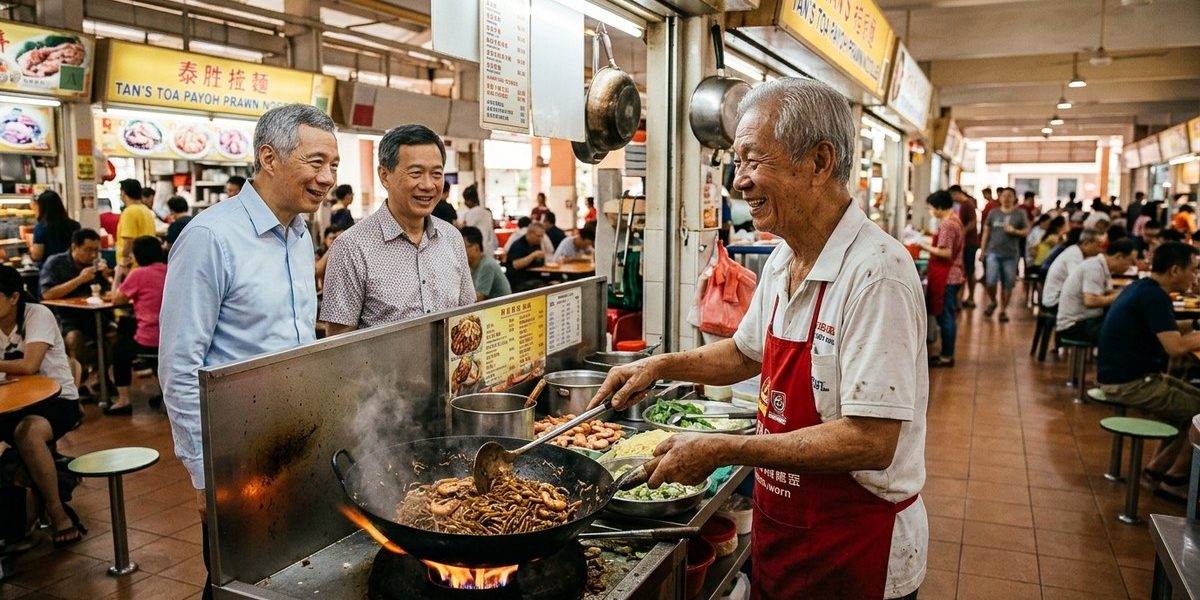
In the heart of Toa Payoh, where the smell of sizzling lard and chicken rice drifts through the corridors of a neighbourhood that has seen Singapore grow from swamps to skyscrapers, there is a hawker stall that holds a secret. Its owner, a quiet man with steady hands and a worn apron, has fed not one but two of Singapore’s Prime Ministers. Yet he never hung a photo on the wall. He never bragged. For decades, the story of this Toa Payoh hawker legend and the prime ministers who ate at his table remained buried under the hum of exhaust fans and the clatter of metal bowls. Until now.
This article reveals the untold story of a humble Toa Payoh hawker who served Hainanese chicken rice to two Singapore Prime Ministers. You will learn how his unwavering consistency, refusal to compromise on ingredients, and quiet dedication turned a simple stall into a piece of living heritage. More than a food story, it is a lesson in how authenticity earns the highest respect.
The Stall That Never Needed a Sign
Walk through Toa Payoh Central in 2026, and you might miss it. There is no neon board. No laminated menu with celebrity endorsements. Just a simple metal counter, a stack of porcelain bowls, and the sound of a cleaver working through steamed chicken.
The stall is called Hainanese Heritage Rice. But regulars just call it “Ah Heng’s place”.
Ah Heng, whose full name is Tan Kim Heng, started his pushcart in 1965. He was 22 years old then. Singapore was still finding its feet as a new nation. Toa Payoh was being carved out of swampland and pig farms. Ah Heng would wheel his cart to construction sites, selling chicken rice wrapped in banana leaves to the workers building the first HDB flats.
That humble pushcart became the foundation of a legacy.
How a Toa Payoh Hawker Legend Met Two Prime Ministers
The first visit came in 1978. Then Prime Minister Lee Kuan Yew was touring the newly completed Toa Payoh estate. According to residents who witnessed it, Mr Lee stopped at Ah Heng’s stall after a community walkabout. He had heard from his driver that the chicken rice here was special.
Mr Lee ordered one plate. White chicken, fragrant rice, a side of clear soup. He ate quietly. Then he asked for a second plate.
Ah Heng later told his family that Mr Lee did not say much. He just nodded, paid, and left. But the nod was enough. From that day, plainclothes officers would sometimes queue for takeaway. The word spread, but Ah Heng never used it.
The second Prime Minister visit happened in 2005. Mr Lee Hsien Loong, then in his second year as Prime Minister, came to Toa Payoh for a National Day dinner event. His advance team had already called ahead. They requested the same order his father had eaten nearly three decades earlier.
By then, Ah Heng was in his sixties. He still stood at the wok every morning at 5am. He still deboned every chicken by hand. He served the younger Mr Lee the same recipe he had served his father.
“I never changed the recipe because I never needed to,” Ah Heng once told a regular. “The chicken must be fresh. The rice must be fragrant. The chilli must be made fresh every morning. If you do these three things, you do not need a gimmick.”
The Unwritten Rules of a Legend
What made Ah Heng’s stall worthy of two Prime Ministers? It was not luck. It was a set of principles he never broke.
- Source only from one farm. Ah Heng used the same supplier for 40 years. The chickens were free range, slaughtered the same morning.
- Never use frozen chicken. He said frozen meat changes the texture of the skin. The signature “shiny” skin only comes from fresh birds.
- Cook rice in chicken fat, not oil. Most stalls use vegetable oil for fragrance. Ah Heng rendered his own chicken fat daily.
- Grind fresh chilli every morning. The chilli paste was never kept overnight. Leftover chilli was given to staff or discarded.
- Serve only until the chicken runs out. He never cooked extra to extend hours. When the last piece was sold, the stall closed.
These rules seem simple. But they are brutally hard to maintain for 50 years.
What You Can Learn from a Toa Payoh Hawker Legend
Ah Heng’s approach is a masterclass in consistency. Here is how his principles apply to any craft, whether you run a stall or a business.
- Ingredient integrity matters more than marketing. You cannot buy the kind of trust he built.
- Repeat customers are your best advertisement. He never spent a dollar on advertising. His queue was his sign.
- Stay small to stay excellent. He never expanded. He never franchised. He stayed at one stall.
- Respect the process. He deboned each chicken in under 90 seconds. That skill took years to perfect.
Common Mistakes That Kill a Hawker’s Reputation
Based on observing successful and failed stalls in Toa Payoh, here is a comparison of what works and what does not.
| Principle | What Ah Heng Does | What Failed Stalls Do |
|---|---|---|
| Sourcing | Same farm for 40 years | Switches suppliers to save $0.50 per kg |
| Preparation | Hand debone, hand cut | Uses pre cut frozen portions |
| Chilli | Fresh grind every morning | Uses factory made chilli paste |
| Rice | Cooked in rendered chicken fat | Cooked in vegetable oil |
| Closing time | Stops when chicken runs out | Keeps cooking with leftover chicken |
| Pricing | Fair, never raised unnecessarily | Raises prices every year without improving quality |
The Quiet Retirement and the Unfinished Story
Ah Heng retired in 2018. His eldest son, James Tan, now runs the stall. James trained beside his father for 15 years before taking over. He still follows the same five rules. He still refuses to use frozen chicken. He still grinds chilli at 5am.
The younger Mr Tan is less shy than his father. He will tell you the story if you ask. But he will not put up a sign. He says the food should speak for itself.
In 2024, the stall received a Michelin Bib Gourmand. James did not frame the certificate. He placed it inside the drawer.
How to Experience This Toa Payoh Hawker Legend Yourself
If you want to taste the same chicken rice that two Prime Ministers ate, here is what you need to know.
- Location: Toa Payoh Central, Block 190, #01-12. The stall is inside the coffee shop facing the HDB hub.
- Timing: Opens at 10:30am. Closes when the chicken runs out, usually by 2pm. Do not come at 3pm.
- What to order: The white chicken rice with an extra side of liver. Ask for the old school chilli, not the sweet version.
- Cash only. No PayNow, no Nets. James says the queue moves faster without the terminal.
- Weekday only. They stopped weekend operations in 2020. James wanted a day off.
The Deeper Meaning of This Story
Why does this matter in 2026? Because Singapore’s hawker culture is at a crossroads. Every year, more elderly hawkers retire. Their recipes retire with them. The younger generation often chooses convenience over craft. But stories like Ah Heng’s remind us that the best food is not about trends or viral marketing. It is about a person who decided, decades ago, that he would never cut corners.
This Toa Payoh hawker legend fed two Prime Ministers because he treated every customer like a Prime Minister. That is the real secret.
If you want to read more about the heritage of our hawkers, check out the story of a 78-year-old uncle behind Chinatown’s best char kway teow. Or learn about three generations behind the wok and Singapore’s oldest family-run hawker stalls.
The Legacy Lives in the Queue
Ah Heng passed away in 2021 at the age of 78. His funeral was small, just as he wanted. But the queue at his son’s stall has not shortened. In fact, it has grown longer.
Younger Singaporeans now come not just for the food, but for the story. They want to taste the plate that Lee Kuan Yew ordered twice. They want to sit at the same plastic table where a Prime Minister once sat without any fanfare.
That is the power of a Toa Payoh hawker legend. He did not need a billboard. He did not need a social media manager. He just needed to make the best chicken rice he could, every single day, for 50 years.
Go visit James. Order the white chicken. Add extra chilli. And when you take your first bite, remember that you are eating a piece of Singapore’s history that almost nobody wrote down. Until now.