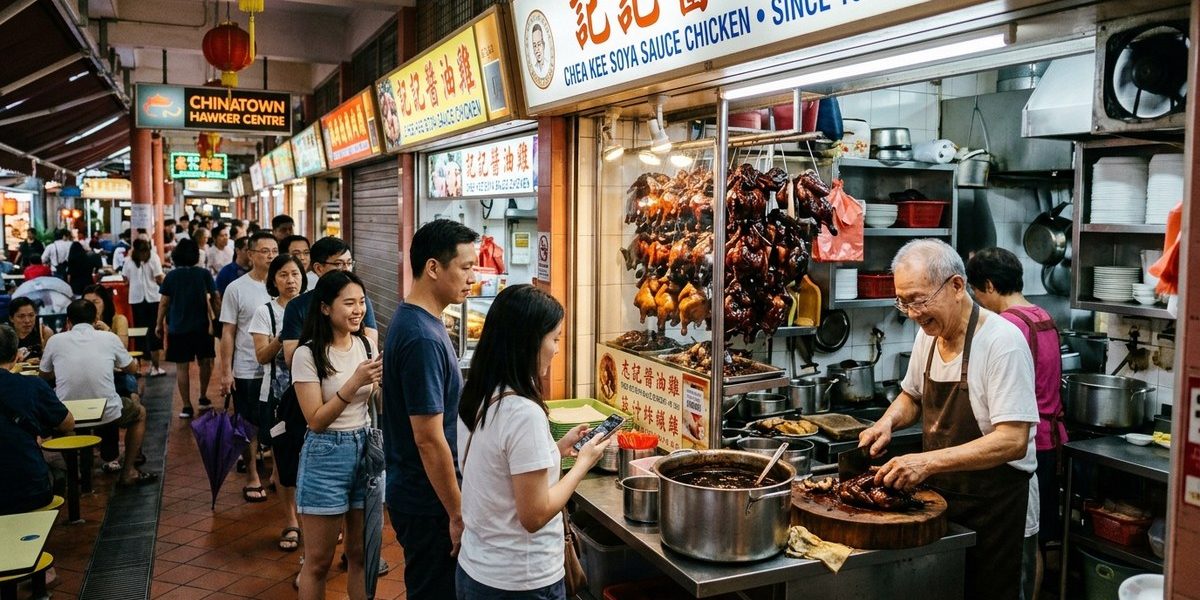
The scent hits you before you see the line. It is deep, almost smoky, with a saltiness that clings to the air like humidity before a tropical storm. You round the corner of the bustling Chinatown complex, and there it is: a snaking queue of office workers, aunties with reusable bags, and tourists clutching their phones. They are all waiting for the same thing. Not chicken rice. Not laksa. A bottle of soy sauce. The Chinatown soy sauce stall queue is a living monument to patience and palate, and in 2026, it shows no signs of shortening.
This Chinatown soy sauce stall queue proves that heritage beats hype every time. The 90-year-old recipe, passed down through three generations, uses a traditional slow-fermentation method that mass-produced sauces cannot replicate. Locals queue for the complex umami flavour that transforms simple dishes like Hainanese chicken rice and fried noodles. The wait is part of the experience, and the reward is a taste of living Singaporean history.
The Story Behind the Sauce
This stall does not rely on social media gimmicks. There are no neon signs or viral dance challenges. The owner, now in his late 60s, learned the recipe from his father, who learned it from his father before him. The original recipe dates back to the 1930s, when the family sold homemade soy sauce from a pushcart along South Bridge Road.
Back then, soy sauce was not a condiment. It was a cornerstone of flavour. Every household used it to braise, dip, and season. The family’s version was different because it was aged in large clay urns, left to ferment under the sun for at least 18 months. That patience created a sauce with layers: salty, sweet, and a lingering savouriness that factory sauces cannot touch.
Today, the stall operates from a small corner in a Chinatown food centre. The urns are still there, stacked against the back wall. The process has not changed. And the queue has become a landmark.
Why People Queue 40 Minutes for Soy Sauce
The question everyone asks is simple. Why wait that long for something you can buy for two dollars at the supermarket?
The answer lies in the taste. This soy sauce is not just salty water with colouring. It is a living ingredient. When you drizzle it over white rice, the rice absorbs the sauce and transforms into something rich. When you use it to braise pork belly, the meat takes on a deep mahogany colour and a sweetness that caramelises in the mouth.
Regulars say the sauce elevates everything. One customer, a retiree who has been buying from the stall for 30 years, told us he uses it only for special dishes. “I save it for my Hainanese chicken rice,” he said. “It makes the chicken taste like how it used to when I was a kid.”
“This sauce has memory. You taste the sun, the clay, the time. You cannot rush that.” – Regular customer, queuing since 1998
What Makes This Sauce Different? A Simple Breakdown
The difference comes down to three factors. Here is how this heritage recipe compares to standard commercial soy sauce.
| Factor | Heritage Stall Sauce | Commercial Bottled Sauce |
|---|---|---|
| Fermentation time | 18 to 24 months in clay urns | 3 to 6 months in stainless steel vats |
| Ingredients | Whole soybeans, wheat, sea salt, rainwater | Defatted soy meal, hydrolysed protein, caramel colour, preservatives |
| Flavour profile | Complex, layered, umami with natural sweetness | One-note salty, often harsh |
| Price per bottle | $8 to $12 | $2 to $4 |
| Wait time | 30 to 45 minutes | Zero |
The table shows why people queue. You pay more, and you wait longer. But you get a product that has no shortcut.
How to Navigate the Chinatown Soy Sauce Stall Queue
If you want to try it yourself, you need a strategy. The queue can look intimidating, but regulars have developed a system.
-
Go on a weekday morning. The stall opens at 9 am. The best time to arrive is between 9:30 am and 10:30 am on a Tuesday, Wednesday, or Thursday. Weekends are chaos. Monday lunch hour is also heavy.
-
Bring cash and small notes. The stall does not accept cards or PayNow. The owner prefers exact change. It speeds up the line for everyone.
-
Know your order before you reach the front. The menu is simple. There are three sizes of bottles: small (250ml), medium (500ml), and large (1 litre). Some customers also buy the fermented soybean paste, which is excellent for stir-fries. Do not ask for samples. The owner will wave you off.
-
Bring your own bag. The stall does not provide plastic bags. In line with Singapore’s green initiatives, you are expected to carry your purchase. Many regulars bring a small tote or a reusable grocery bag.
-
Be patient and polite. The owner is friendly but focused. He has been doing this for decades. A simple “thank you” in English or Mandarin goes a long way.
Common Mistakes First-Timers Make
Even experienced foodies slip up. Here are the most common errors people make at this stall.
- Arriving during lunch rush (12 pm to 1:30 pm) and expecting a short wait. The queue can double during these hours.
- Asking for a taste test. The stall does not offer samples. You buy based on reputation.
- Bringing a credit card. The stall is cash only. You will have to leave the queue to find an ATM.
- Buying only one small bottle. Regulars warn that once you try it, you will want more. Many first-timers regret not buying the large size.
- Expecting the sauce to taste like supermarket ketchup. It is not sweet in the same way. It is savoury, earthy, and intense. Use it sparingly at first.
Where This Stall Fits in Singapore’s Hawker Heritage
This stall is part of a larger story. It belongs to a group of heritage hawkers who have resisted change for decades. They are the ones who still use wood-fired stoves, hand-grind their spices, and ferment their sauces in the open air.
Singapore’s hawker culture was recognised by UNESCO in 2020, but the recognition did not create these traditions. It simply acknowledged what locals already knew. The value of these stalls is not just in the food. It is in the continuity. The Chinatown soy sauce stall queue is a direct link to the street vendors of the 1930s.
If you want to understand this heritage better, read about how the 1960s hawker relocation programme changed the landscape. Or learn about the secret recipes that heritage hawkers guard with their lives. Each stall has a story, and this soy sauce stall is one of the oldest.
What the Queue Tells Us About Singapore in 2026
There is something hopeful about this queue. In a city that moves at lightning speed, where every service promises instant delivery, here is a line of people willingly waiting 40 minutes for a condiment. It suggests that Singaporeans still value craft over convenience.
The queue also includes a surprising number of young people. Millennials and Gen Z foodies make up at least half the line on any given day. They are not buying the sauce because their grandmothers told them to. They are buying it because they tasted it at a friend’s house and realised that real soy sauce is a completely different product from the bottled stuff.
Social media has helped, but not in the way you might think. There are no sponsored posts. The stall does not have an Instagram account. Instead, food bloggers and home cooks share their own photos of dishes made with the sauce. The word spreads organically, one bowl of rice at a time.
The Future of the Stall
The owner is not getting younger. He has trained his nephew, but the nephew works a corporate job and only helps on weekends. There is no guarantee that the stall will survive another decade.
This is the same challenge facing many heritage hawkers across Singapore. The work is physically demanding. The hours are long. The margins are thin. And the next generation often prefers air-conditioned offices to hot hawker centres.
But for now, the queue remains. And as long as people are willing to wait, the 90-year-old recipe will keep flowing.
Taste the Legacy for Yourself
The best way to understand this stall is to visit it. Stand in the line. Watch the regulars chat with each other. Smell the fermentation wafting from the urns. And when you finally reach the front, buy a bottle. Take it home. Drizzle it over plain rice. That first bite will tell you everything you need to know.
If this story resonates with you, explore more of Singapore’s hidden hawker gems. Read about why Tian Tian Hainanese Chicken Rice still has queues after 30 years. Or discover the story behind the 78-year-old uncle who makes Chinatown’s best char kway teow. Each stall has a legacy worth tasting.
The Chinatown soy sauce stall queue is not an inconvenience. It is an invitation. An invitation to slow down, to taste something real, and to connect with a Singapore that still remembers how to wait for good food.