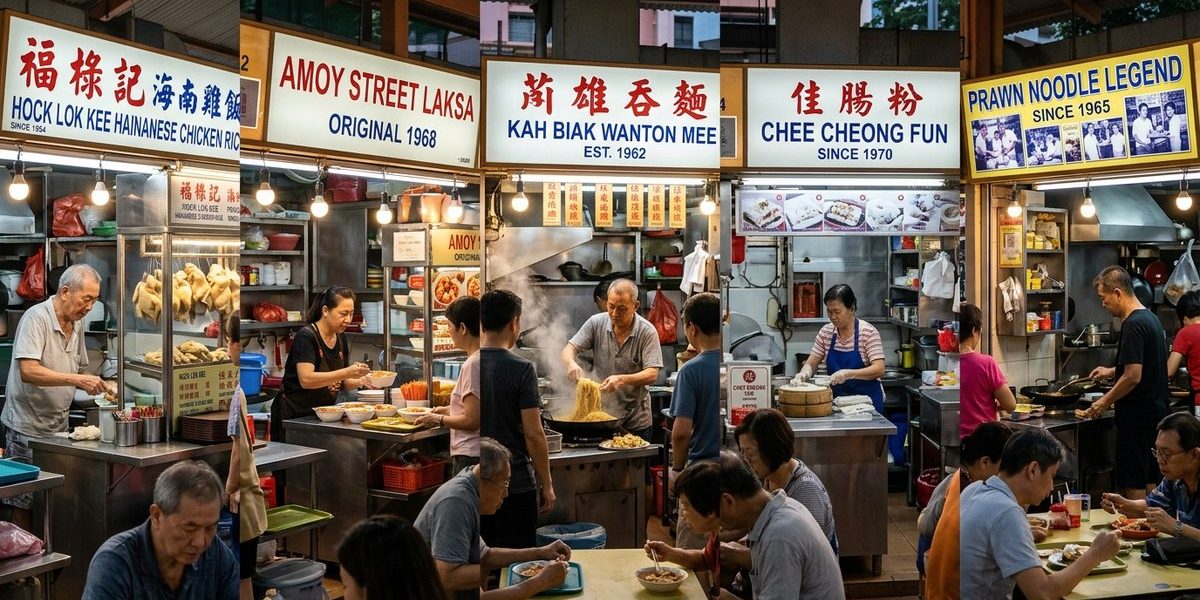
The year is 1968. A Hokkien mee seller in Geylang pushes his cart along a muddy lane, balancing a charcoal stove and a wok that has been seasoned for decades. Within a decade, that same cart would be gone. The government’s hawker relocation programme, running from the late 1960s through the 1970s, moved thousands of street vendors into purpose-built centres. Many hawkers hung up their woks for good. But a handful of stubborn, brilliant cooks carried their recipes into these new concrete spaces and never changed a single ingredient. Those are the stalls we are chasing today.
The 1970s hawker relocation programme forced thousands of street vendors into permanent centres, but five heritage hawker stalls in Singapore kept their original recipes intact. From a Maxwell Road chicken rice stall that refused to change its seasoning ratios to a Tiong Bahru popiah maker still using a 1950s batter recipe, these stalls prove that authenticity survives urban planning. This guide shows you where to find them and how to spot a true heritage recipe yourself.
When Street Food Went Indoors
The hawker relocation programme was not a small affair. Between 1968 and the mid 1980s, the government moved an estimated 18,000 street hawkers into licensed premises. The goal was simple: clean up the streets, improve hygiene, and create a more orderly Singapore. But for the hawkers, it meant leaving behind their regular customers, their established routes, and in some cases, their equipment.
Some hawkers adapted. Many retired. A small number treated the move as a challenge to prove that their food was never about the location. It was about the recipe.
Today, in 2026, these survivors are more than just food stalls. They are living archives of taste. Let us look at five of them.
1. The Hainanese Chicken Rice Master Who Would Not Dilute
At Maxwell Food Centre, one stall still draws a line that snakes past the dessert drinks stall and the curry puff seller. The family behind this stall started selling chicken rice from a pushcart near Ellenborough Market in the 1940s. When the relocation orders came, they moved to the newly built Maxwell Market in 1972.
The second generation owner, now in his seventies, still insists on poaching the chickens in a broth that has been topped up but never fully replaced since the 1950s. He calls it the “mother stock.” Every new batch of soup gets a portion of the old one. This technique gives the rice that silky, savoury depth that no amount of seasoning can replicate.
If you want to understand how heritage hawker stalls Singapore residents defend with passion, start here. The queue is long by 11am on a weekday. Go at 10am and you will wait ten minutes instead of forty.
2. The Popiah Skin That Refused to Change
Popiah is a delicate art. The skin, made from wheat flour and water, must be paper thin yet strong enough to hold a filling of turnip, bean sprouts, and prawn. In Tiong Bahru Market, a third generation popiah maker still spreads the batter by hand on a hot steel plate. She learned the motion from her grandmother, who learned it from her mother before that.
During the relocation programme, her family moved from a street corner in Chinatown to a stall inside the market in 1973. The government offered them a modern stove. They refused. The traditional charcoal stove, they argued, gave the skin a consistent, gentle heat that gas could not match.
Today, she is the only popiah stall in the area that still makes skins from scratch. Most others buy factory made wrappers. The difference is noticeable. Her popiah stays crisp for the first ten minutes after rolling. Factory skins turn soggy within three.
For a deeper look at how this family survived the relocation, read our story on the last traditional popiah stall in Katong that locals guard jealously.
3. The Char Kway Teow That Survived the Move to Bedok
Before Bedok Interchange Hawker Centre existed, a Teochew couple sold char kway teow from a cart outside the old Bedok cinema. They used pork lard, fresh cockles, and a dark soy sauce that the husband’s father had mixed himself. In 1975, the government told them they had to move indoors.
The husband was against it. He believed that char kway teow needed the open air, the smoke from the wok mixing with the evening breeze. His wife insisted. She argued that a permanent stall meant they could invest in a better stove and serve more customers. They moved in 1976.
The recipe never changed. They still use the same soy sauce blend, still fry with lard, still char the noodles over high heat until the edges crisp. The stall has passed to their son, who is now in his fifties. He says the only concession he has made is installing a ventilation hood so the smoke does not set off the fire alarm.
This stall is one of the 6 heritage hawker stalls that still use wood fired charcoal stoves in Singapore.
4. The Hokkien Mee That Crossed the Road and Kept Cooking
When the old market in Geylang was demolished in 1978, a Hokkien mee seller faced a dilemma. His regulars were mostly factory workers who walked past his cart every evening. If he moved to the new food centre two blocks away, would they follow?
He took the risk. He relocated to the newly opened Geylang Serai Market in 1979. To keep his regulars, he did something unusual: he printed small cards with his new stall number and handed them out with every order for the last month of street selling.
His recipe for Hokkien mee uses yellow noodles, prawns, squid, and a stock made from pork bones that simmers for six hours. He never uses stock cubes. His son, who now runs the stall, still follows the same timetable. The stock goes on the stove at 5am. The stall opens at 11am. By 1pm, the stock has the exact consistency his grandfather demanded.
You can find more stories of family run stalls in our feature on three generations behind the wok.
5. The Laksa Lemak That Started as a Pushcart
Katong laksa is famous. But the version served at one particular stall in Joo Chiat has a backstory that few people know. The original owner, a Peranakan woman, started selling laksa from a pushcart in the 1950s. She used a coconut milk base that she grated fresh every morning. Her rempah (spice paste) contained thirty ingredients, including wild ginger flower and a specific type of dried shrimp that she sourced from a single supplier.
When the relocation programme reached her area in 1974, she moved to a small coffeeshop. She refused to modernise her process. No electric grater. No pre packaged coconut milk. Every bowl of laksa still starts with freshly grated coconut.
Her granddaughter now runs the stall. She has kept the same supplier for the dried shrimp. The supplier’s grandson now runs that business. Two families, two generations, one unbroken supply chain.
This laksa is featured in our article on the only stall in Singapore that still makes laksa lemak from scratch using a 1950s recipe.
How to Identify a True Heritage Hawker Stall
Not every old stall is a heritage stall. Some have changed their recipes over the years, swapping lard for vegetable oil or replacing fresh stock with powder. Here is a table to help you spot the difference.
| Feature | Heritage Stall | Modernised Stall |
|---|---|---|
| Stock base | Made from scratch daily, often using bones or prawn shells | Uses stock cubes, powder, or pre made bases |
| Cooking fat | Lard, coconut oil, or rendered animal fat | Vegetable oil or margarine |
| Equipment | Charcoal stove or well seasoned wok | Gas stove or induction cooktop |
| Recipe source | Handed down verbally or in a worn notebook | Written down, measured, and standardised |
| Queue behaviour | Regulars know the owner by name | Regulars are rare; mostly new customers |
If the stall ticks three or more boxes on the left, you have found a heritage stall.
The Common Mistakes People Make When Visiting Heritage Stalls
Even food lovers make errors when they visit these stalls. Here are the most frequent ones.
- Arriving at peak lunch hour. Most heritage stalls sell out by 1pm. Go at 10.30am or 2.30pm.
- Asking for less oil or less salt. The recipe is balanced. Asking for changes throws off the flavour.
- Taking photos of the cooking process without asking. These hawkers are protective of their methods.
- Expecting air conditioning. Many heritage stalls are in older centres with ceiling fans only.
- Ordering takeaway for a dish that needs to be eaten immediately. Char kway teow and popiah lose quality within ten minutes.
How to Plan Your Heritage Hawker Crawl
If you want to visit all five stalls in a single day, follow this order.
- Start at Tiong Bahru Market for popiah. The stall opens at 8am. Eat early.
- Walk to Maxwell Food Centre for chicken rice. Arrive by 10.30am.
- Take a bus to Geylang Serai Market for Hokkien mee. Aim for 12pm.
- Head to Joo Chiat for laksa lemak. The stall opens at 1pm.
- End at Bedok Interchange Hawker Centre for char kway teow. The stall serves until 8pm.
This route takes about six hours including travel and waiting time.
Why These Recipes Survived
The 1970s relocation programme could have erased Singapore’s street food culture. For many hawkers, it did. But the stalls that survived had something in common: they treated their recipes as non negotiable. The recipe was not a collection of ingredients. It was a contract with the customer.
One hawker told us, “If I change the soy sauce, I break the promise my father made to his regulars.” That sense of duty is what keeps these stalls alive. It is also why, in 2026, you can still taste the same char kway teow that a Bedok cinema worker ate in 1974.
For more on how hawker culture survived the move indoors, read from pushcarts to permanent stalls.
Preserving the Taste of a Nation
The next time you queue at a heritage hawker stall, notice the details. Look at the wok. Is it blackened from decades of use? Listen to the hawker. Do they greet regulars by name? Smell the stock. Does it smell like real pork bones or like powder?
These small clues tell you whether you are eating a recipe that survived the relocation programme or a modern version that lost its soul along the way. Singapore’s hawker culture is UNESCO recognised, but it lives in these small, stubborn acts of preservation. One batch of stock. One hand rolled popiah skin. One wok that refuses to be replaced.
Go find these stalls. Eat their food. And when you do, tell them you know their story. They will appreciate that more than any online review.