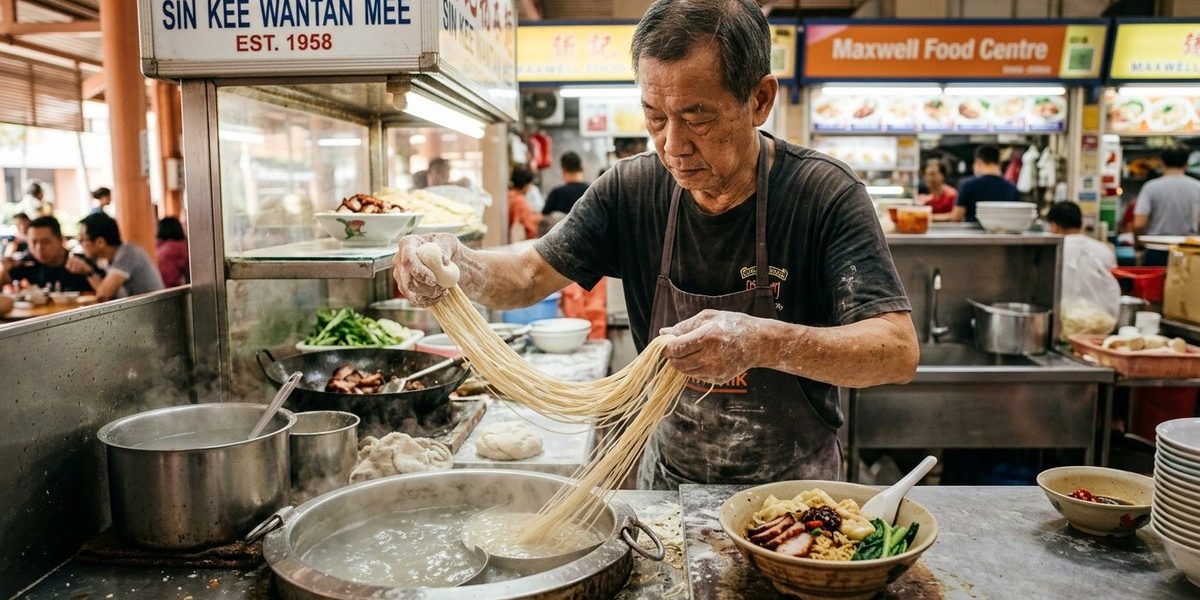
The rhythmic slap of dough against a wooden board. The steady, hypnotic stretching and folding of gluten strands. This is the sound of hand-pulled wanton mee, a craft that is disappearing from Singapore’s hawker scene at an alarming rate. Most stalls today use factory-made noodles, which are consistent and efficient. But they lack that unique, springy texture that only comes from a pair of skilled human hands working a single piece of dough for over an hour. In 2026, finding a bowl made with truly hand-pulled noodles feels like striking gold. This guide is your map to the few remaining masters who still practise this dying art.
Hand-pulled wanton mee is a vanishing craft in Singapore. In 2026, fewer than a handful of hawkers still make their noodles from scratch daily. The key difference is texture: hand-pulled noodles have a bouncier, more resilient bite than machine-cut ones. This guide covers where to find these stalls, what to look for, and why you should visit them soon before they retire for good.
What Makes Hand-Pulled Noodles So Special
The process is called “la mian” in Mandarin, which literally means “pulled noodles.” A block of dough is kneaded, rested, and then stretched repeatedly. With each pull, the dough is folded back on itself, creating more and more strands. A master can turn a single lump of dough into hundreds of perfectly even noodles in minutes.
This technique creates a protein network that machine extrusion cannot replicate. The result is a noodle that is chewy, springy, and able to hold onto sauce without turning mushy. When you pair this with a well made char siew and a dollop of chilli vinegar, you get a bowl of wanton mee that is simply in a different league.
The problem is that this skill takes years to master. It is physically demanding work. Most younger hawkers simply do not want to learn it when they can order a bag of pre-made noodles for a few dollars.
Where to Find Singapore’s Last Hand-Pulled Wanton Mee in 2026
We have scoured the island to find the stalls that still do things the old way. These are the hawkers who wake up before dawn to start their dough. They are the keepers of a tradition that deserves your support.
1. Hill Street Tai Hwa Pork Noodle (Killiney Road)
This is the most famous name on the list. Tai Hwa’s bak chor mee is legendary, and their hand-pulled noodles are a core reason why. The stall has held a Michelin star since 2016, and the queue snakes around the coffeeshop daily. They still make their noodles by hand every morning. The texture is unmistakable: bouncy, slightly uneven in thickness, and incredibly satisfying.
Address: 466 Crawford Lane, #01-01, Singapore 190465
Open: 9:30am to 7:30pm (closed on Mondays)
Pro tip: Go on a weekday afternoon if you want to avoid the lunch rush.
2. Fei Da Bak Chor Mee (Whampoa)
Tucked inside Whampoa Drive Food Centre, this stall is a favourite among locals who know their noodles. The uncle here has been pulling noodles for over 30 years. His technique is a joy to watch. He uses a traditional method that involves a wooden rolling pin and a lot of upper body strength. The noodles here are slightly thicker, which gives them a hearty, satisfying bite.
Address: 91 Whampoa Drive, #01-02, Singapore 320091
Open: 11:00am to 8:00pm (closed on Wednesdays)
Pro tip: Pair your noodles with their homemade pork lard crisps for extra flavour.
3. Sin Heng Handmade Noodles (Geylang)
This stall is a bit of a hidden gem. It is located in a quiet corner of Geylang Lor 29. The hawker here is a third-generation noodle maker who learned the craft from his father in Johor. He uses a slightly different flour blend that gives his noodles a yellowish hue and a softer texture. It is a distinct style that is worth seeking out.
Address: 29 Lorong 29 Geylang, #01-01, Singapore 388074
Open: 10:30am to 9:00pm (closed on Tuesdays)
Pro tip: Ask for your noodles “mee kia” (thin) for the most authentic experience.
How to Spot the Real Deal
Not every stall that claims to serve hand-pulled noodles actually does. Here is a simple table to help you tell the difference.
| Feature | Hand-Pulled Noodles | Machine-Made Noodles |
|---|---|---|
| Texture | Springy, bouncy, slightly uneven | Uniform, smooth, sometimes rubbery |
| Appearance | Slight variation in strand thickness | Perfectly even strands |
| Elasticity | High; noodles snap back when stretched | Lower; noodles may break easily |
| Taste | Rich, wheaty flavour | Neutral, bland |
| Price | Usually $5 and above | Often $3 to $4 |
If you see the hawker actively pulling and stretching dough in the stall, that is the best sign. If not, ask them directly. Most honest hawkers will tell you if they use factory noodles.
The Art of Watching a Master at Work
Watching a hand-pulling session is a performance in itself. Here is what happens in a typical morning at one of these stalls:
- Mixing the dough: The hawker combines flour, water, eggs, and a touch of lye water. The mixture is kneaded into a stiff ball.
- Resting the dough: The dough is left to rest for at least 30 minutes. This allows the gluten to relax and become more pliable.
- First pull: The dough is shaped into a thick strip. The hawker grips both ends and lifts it, letting gravity stretch the dough.
- Folding and repeating: The strip is folded in half and pulled again. This is repeated dozens of times. With each cycle, the number of strands doubles.
- Cutting and cooking: Once the desired thickness is reached, the noodles are cut and immediately dropped into boiling water.
“The secret is not in the strength, but in the rhythm. You must feel the dough. If you pull too hard, it tears. If you pull too soft, the strands are uneven. It takes about three years just to learn the feel.”
* Uncle Ah Hock, a 68-year-old hand-pulling master at Sin Heng Handmade Noodles.
Why This Craft Is Dying Out
The reasons are simple. Hand-pulling is labour intensive. It requires physical stamina that most young people do not have. The profit margins are thin. A hawker can make maybe 50 portions of hand-pulled noodles in an hour. A machine can produce thousands.
The average age of a hand-pulling hawker in Singapore is now over 60. Many have no successors. Their children have moved into white-collar jobs. The knowledge is being lost with each retirement.
This is not just about noodles. It is about the loss of a cultural craft that has been passed down for generations. When these uncles retire, their recipes and techniques will vanish with them.
What You Can Do to Help Preserve This Heritage
You do not need to become a hawker yourself. But you can make a difference with your choices.
- Visit the stalls. The simplest way to support them is to eat their food. Every bowl sold is a vote for keeping the tradition alive.
- Bring your friends. Introduce someone younger to the taste of real hand-pulled noodles. The more people appreciate it, the more likely someone will want to learn the craft.
- Share the story. Post about your experience on social media. Tag the stall. Word of mouth is still the most powerful tool for hawkers.
- Be patient. These stalls often have long queues. The noodles take time to prepare. Do not rush the hawker. Let them work at their own pace.
- Learn about the history. Read our article on the secret recipes they guard with their lives to understand how these family traditions are protected.
A Complete Guide to Ordering Like a Pro
Ordering hand-pulled wanton mee is slightly different from ordering the regular version. Here is a simple checklist.
- Decide on your noodle texture. Ask for “mee kia” (thin), “mee pok” (flat), or “mee hoon” (vermicelli).
- Specify your sauce preference. “Dry” means the noodles are tossed in a dark, savoury sauce. “Soup” means the noodles come in a light broth.
- Choose your toppings. Standard options include char siew, wanton dumplings, and minced pork.
- Add a side of pickled green chillies. This is the classic accompaniment that cuts through the richness.
- Pay at the counter and find a seat. The hawker will call your number when your order is ready.
The Future of Hand-Pulled Noodles in Singapore
There is a glimmer of hope. A few young hawkers have started taking an interest in the craft. Some have enrolled in heritage food programmes run by the government. A handful of stalls have even opened in the past two years that advertise “artisan hand-pulled noodles.”
But the reality is that the number of true masters is shrinking. In 2026, you can still find a few. In five years, that number could be down to zero. This is not a prediction of doom. It is a call to action.
If you have ever wanted to taste what wanton mee was like in the old days, now is the time. Do not wait until it is too late. The hand-pulled wanton mee 2026 scene is fragile, but it is still alive. Go out there and enjoy it while you can.
Supporting the Hawkers Who Keep the Flame Alive
The hawkers featured in this guide are not just selling food. They are preserving a piece of Singapore’s soul. They are the same kind of dedicated artisans we wrote about in three generations behind the wok. Their stories are worth knowing.
When you visit, take a moment to chat with them. Ask about their history. Most of them love to share their knowledge. You might learn something that no food blog can teach you.
And if you find a bowl you love, tell the hawker. A simple “shiok” or “very nice” goes a long way. These are long, hot, tiring days for them. Your appreciation matters.
Your Next Step: Plan Your Hawker Hunt for This Weekend
Here is a practical plan to get you started.
- Pick one stall from the list above.
- Check their opening hours and days off.
- Go during a non-peak hour (2pm to 4pm is usually safe).
- Bring cash. Many of these stalls do not accept cards or PayNow.
- Order your noodles and a side of their signature item.
- Take a photo of the hawker at work (ask permission first).
- Share your experience with a friend or online.
This simple act of eating is the most powerful way to keep the tradition alive. Every bowl you eat is a story that continues. Do not let the story end.