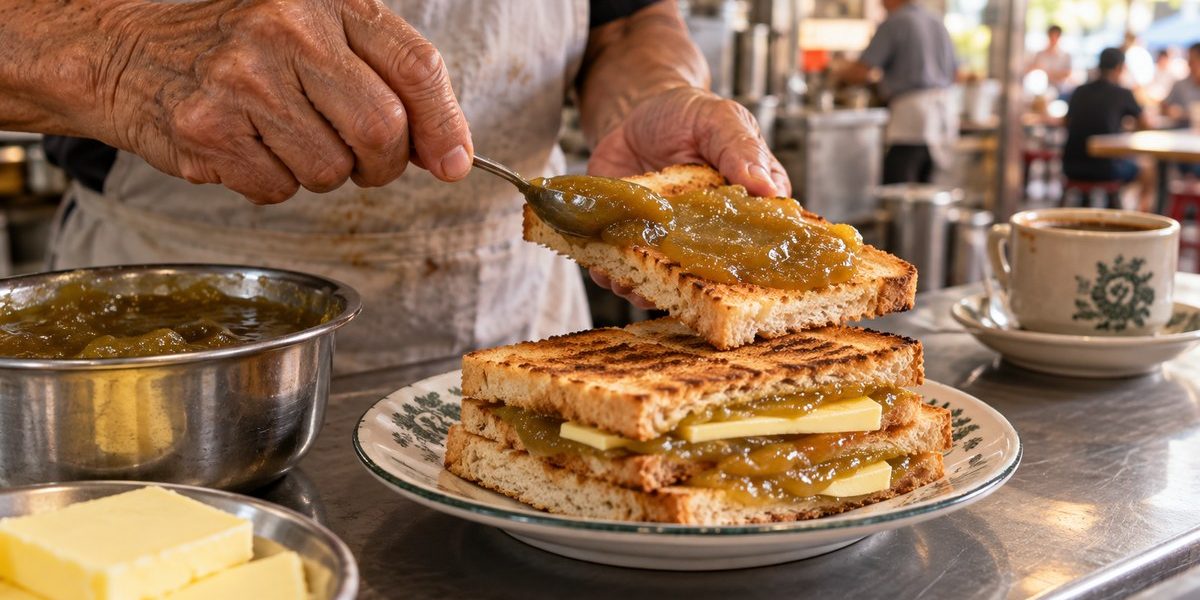
The smell hits you before you even reach the queue. Warm coconut, pandan, and the faint char of toasted bread. That is the scent of a kopitiam breakfast that has not changed in seven decades. In Bedok, one stall still makes its kaya from scratch every morning. No factory premixes. No shortcuts. Just the same traditional handmade kaya toast recipe Singapore has cherished since the 1950s. And in 2026, as more stalls switch to mass-produced kaya, this Bedok gem stands as a living archive of flavour.
A traditional handmade kaya toast recipe Singapore depends on three things: freshly grated coconut milk, aged pandan leaves, and a slow simmer of at least four hours. The Bedok stall profiled in this guide has followed the same method since the 1950s. They toast bread over charcoal, spread the kaya thick, and add a slab of cold butter. No machines. No preservatives. Just heritage in every bite.
What Makes a Kaya Recipe Truly Traditional
The word “traditional” gets thrown around a lot. But for the uncles and aunties who run heritage stalls, it means something specific. A traditional handmade kaya toast recipe Singapore uses only four core ingredients: coconut milk, pandan leaves, sugar, and eggs. That is it. No thickeners. No artificial flavouring. No stabilisers.
The process has not changed since the Hainanese immigrants first served kaya toast in Singapore’s early kopitiams. They brought the technique of slow-cooking coconut jam from their homeland and adapted it to local tastes. Over time, the recipe became sweeter and richer, reflecting Singapore’s love for indulgence at breakfast.
Here is what separates a handmade kaya from a factory version:
- Texture: Hand-stirred kaya has a slightly grainy feel because the coconut is freshly grated. Factory kaya is unnaturally smooth from industrial blenders.
- Colour: Real pandan gives a pale green hue. Artificial versions are bright neon green.
- Aroma: You can smell the pandan and coconut immediately. Fake kaya smells only of sugar.
- Mouthfeel: Handmade kaya melts on the tongue. Mass-produced kaya feels waxy.
The 70-Year-Old Method: Step by Step
The stall in Bedok follows a strict daily routine. They start at 5am, before the sun rises. Here is how they make their traditional handmade kaya toast recipe Singapore come to life.
- Grate fresh coconut. They use mature coconuts, not young ones. The flesh is grated finely and squeezed through a muslin cloth. The first press gives the richest milk.
- Blanch pandan leaves. The leaves are boiled briefly to soften them. Then they are pounded to release the aromatic oils. The stall keeps its own pandan plants growing in pots behind the stall.
- Combine and simmer. The coconut milk, pandan juice, sugar, and a pinch of salt go into a heavy pot. The fire is kept low. Someone must stir the mixture every few minutes for the next four hours.
- Add eggs. Beaten egg yolks are drizzled in slowly while stirring. This thickens the kaya and gives it a custard-like richness.
- Cool and store. The kaya is left to cool in shallow trays. It is never refrigerated. It sits at room temperature and gets used within 24 hours.
“If you use a machine to stir, the kaya becomes too fine. You lose the rustic bite. My grandfather taught me that the wrist must feel the change in the mixture. That is how you know it is done.” – Third-generation hawker, Bedok
Common Mistakes When Making Kaya at Home
Many home cooks try to recreate a traditional handmade kaya toast recipe Singapore and end up disappointed. The table below shows the most frequent errors and how to avoid them.
| Mistake | Why It Happens | The Fix |
|---|---|---|
| Kaya turns out too watery | Using thin coconut milk from a carton | Use freshly squeezed thick coconut milk only |
| Kaya tastes bitter | Overcooking the pandan leaves | Blanch for 30 seconds max, then pound gently |
| Kaya separates into layers | Adding eggs too fast | Drizzle eggs in a thin stream while stirring constantly |
| Kaya burns at the bottom | Using high heat to speed up the process | Keep the flame low and stir every 3 minutes |
| Kaya is not fragrant enough | Skipping the pandan or using extract | Fresh pandan is non-negotiable for authentic flavour |
Why This Bedok Stall Refuses to Modernise
In an era where convenience rules, this stall’s dedication to a traditional handmade kaya toast recipe Singapore feels almost rebellious. The owner told us that several suppliers have offered to sell them pre-made kaya at a lower price. They said no every time.
The reasons are personal. The stall’s regulars include elderly residents who grew up eating this exact kaya. Some have been coming since the 1970s. Changing the recipe would break a trust built over generations. There is also the matter of pride. The current owner learned the recipe from his father, who learned it from his own father. That lineage matters in Singapore’s hawker culture.
If you want to understand why heritage food survives, read about why these 5 hawker stalls have been serving the same family recipe for over 70 years. The same principles apply here.
How to Find the Stall and What to Order
The stall is located at Bedok Interchange Hawker Centre. It does not have a flashy sign. Look for the queue that forms before 7am. That is how you know you are in the right place.
When you reach the front, order a set. It comes with two slices of charcoal-toasted bread, a generous spread of kaya, a thick pat of cold butter, and your choice of kopi or teh. The total is under $3.50.
Some tips for first-timers:
- Go early. The kaya often sells out by 10am.
- Ask for your bread to be “extra toasted” if you like a crunchy texture.
- Dip the toast into your coffee. That is how the regulars do it.
- Do not ask for wholemeal bread. They only serve white bread, as tradition demands.
For more morning options in the area, check out the East Coast Breakfast Trail where locals queue before 9am.
The Science Behind the Perfect Kaya Texture
The texture of a traditional handmade kaya toast recipe Singapore is not accidental. It comes from the emulsification of coconut fat with egg yolks. When you stir the mixture at a low temperature, the fat molecules from the coconut wrap around the protein in the eggs. This creates a stable emulsion that does not separate.
The pandan adds more than flavour. It contains a compound called 2-acetyl-1-pyrroline, which is the same molecule that gives jasmine rice its aroma. This compound binds to the fats in the coconut milk, making the fragrance last longer on your palate.
This is why factory kaya never tastes the same. Industrial processes heat the mixture too quickly, breaking the emulsion. The result is a greasy, separated jam that lacks the creamy unity of the handmade version.
How to Replicate This at Home (Without Spending 4 Hours)
If you cannot make it to Bedok, you can still attempt a simplified version of a traditional handmade kaya toast recipe Singapore. The key is to respect the core techniques while saving time where possible.
Here is a condensed method:
- Use canned coconut cream instead of grating fresh coconut. It is not perfect, but it saves an hour.
- Use frozen pandan leaves. They are available at most wet markets in Singapore.
- Cook for 2 hours instead of 4, but stir more frequently.
- Add the eggs off the heat to prevent scrambling.
Even with these shortcuts, the result will be far superior to any store-bought kaya. You will taste the difference immediately.
The Future of Handmade Kaya in Singapore
There is concern among food heritage advocates that traditional handmade kaya toast recipe Singapore knowledge is disappearing. The younger generation often prefers the convenience of instant kaya packets. But there is hope.
In 2026, several young hawkers have started reviving old recipes. They are documenting their methods on social media and offering workshops. The Bedok stall featured here has even trained two apprentices under 30. One of them plans to open a new stall in Tampines later this year.
To see how other heritage dishes are being preserved, read about the vanishing art of traditional kueh-making elderly hawkers keeping Peranakan sweets alive. The same spirit drives the kaya toast revival.
What You Can Do to Support Heritage Hawkers
Supporting stalls that use a traditional handmade kaya toast recipe Singapore is simple. You just need to show up and order. Every plate sold is a vote for keeping the old ways alive.
Here are actionable steps:
- Visit Bedok Interchange Hawker Centre on a weekday morning. Weekends are crowded.
- Bring your children or younger relatives. Let them taste real kaya so they know what it should taste like.
- Share this article with friends who think all kaya is the same.
- Leave a Google review for the stall. Positive reviews help them stay visible.
If you are new to exploring Singapore’s hawker centres, start with hidden neighbourhood gems 7 underrated hawker centres locals swear by. You will discover more stalls like this one.
Preserving the Taste of Childhood
A traditional handmade kaya toast recipe Singapore is more than a list of ingredients. It is a memory. It is the taste of Saturday mornings before school. It is the smell of kopitiams that have not changed in 50 years. And it is the reason why people still queue at 6.45am in Bedok.
The stall we have covered in this article represents everything that is worth preserving about Singapore’s food heritage. They do not use shortcuts because they respect their customers. They do not raise prices because they believe breakfast should be affordable. They do not change because they know that some things are perfect as they are.
Next time you bite into a piece of kaya toast, pause for a moment. Think about the hands that stirred the kaya. Think about the pandan leaves that were pounded before sunrise. Think about the 70-year-old recipe that travelled from a Hainanese kitchen to a Bedok hawker stall. That is the real taste of Singapore.