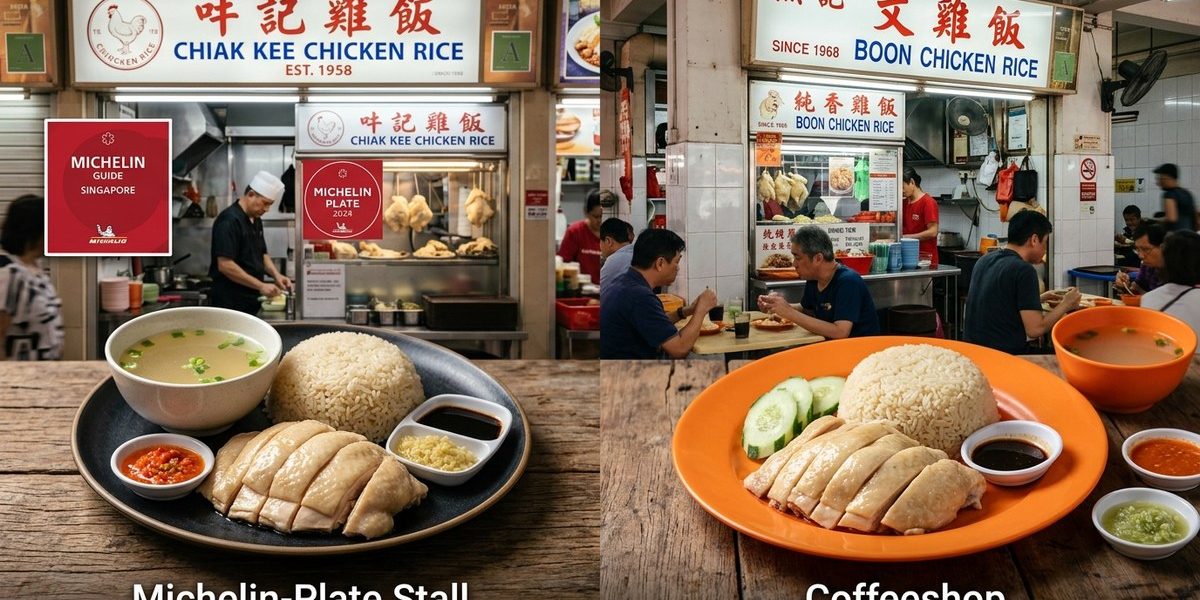
A plate of Hainanese chicken rice can cost anywhere from $3.50 to $6.00. One comes from a Michelin-recognised hawker stall with a queue that snakes around the block. The other comes from a neighbourhood coffeeshop where the uncle knows your regular order by heart. Both claim to serve the best version. So which one actually deserves your lunch money? We ate our way through Singapore to find out.
There is no single winner in the Michelin vs coffeeshop chicken rice debate. Michelin-recognised stalls deliver exceptional consistency and technique, making them a safe bet for first-timers. But many coffeeshop stalls, honed over decades for a loyal local crowd, offer soulful renditions that rival any award-winning plate. Your choice depends on what matters more: a polished, benchmark experience or a hidden gem with character. Both deserve a spot on your makan list.
What the Michelin Plate Actually Means for Chicken Rice
The Michelin Guide’s Bib Gourmand and Plate categories are not the same as a star. A Plate designation means the inspectors found the food good, fresh, and prepared with skill. It is a seal of approval, but it does not guarantee that the stall is the absolute best in Singapore. What it does guarantee is a baseline of quality that is hard to argue with.
Michelin-recognised chicken rice stalls like the famous one at Maxwell Food Centre have built their reputations on three things: precision, consistency, and volume. They poach their birds in water that is kept at an exact temperature. The skin is taut and glossy. The meat is tender right down to the bone. Every plate that leaves the stall looks identical to the one before it.
This level of control comes from years of practice and a system that treats every bird the same way. For a tourist or a first-time visitor, this reliability is gold. You know what you are getting.
The Coffeeshop Champion: Where Soul Meets Skill
Walk into any HDB estate coffeeshop in Toa Payoh, Bedok, or Ang Mo Kio, and you will find a chicken rice stall that has been serving the same families for two or three generations. These stalls rarely get media attention. They do not have a PR team. What they have is a fiercely loyal customer base that will queue in the rain for a plate of their favourite white chicken.
The difference here is often in the details. A coffeeshop stall might use a slightly older bird for a deeper flavour. The rice might be cooked in a smaller batch, giving it a fluffier texture. The chilli sauce might have a family recipe that has been adjusted over forty years of feedback from regulars.
These stalls also tend to offer more flexibility. You can ask for extra skin. You can request your chicken with more fat. You can get a side of braised egg tofu that the uncle makes fresh each morning. It is a personalised experience that a high-volume Michelin stall cannot always match.
How to Judge a Great Plate of Chicken Rice
Before we compare the two sides directly, let us agree on what makes a plate of chicken rice exceptional. Use this checklist the next time you sit down for a meal.
| Component | What to Look For | What to Avoid |
|---|---|---|
| Chicken skin | Glossy, taut, with a thin layer of gelatinous fat | Dull, loose, or thick yellow fat |
| Breast meat | Moist, with a slight bounce when pressed | Dry, stringy, or chalky texture |
| Rice grains | Plump, separate, and fragrant with chicken fat | Clumpy, mushy, or bland |
| Chilli sauce | Tangy, slightly sweet, with a fine ginger kick | Watery, overly sweet, or one-dimensional |
| Ginger garlic sauce | Sharp but balanced, not overpowering | Weak or absent ginger flavour |
A stall that nails all five components is a keeper, regardless of whether it has a Michelin Plate or not.
The Case for Michelin-Recognised Stalls
Let us give credit where it is due. Michelin-recognised stalls have mastered the fundamentals. They have to, because they are judged by some of the toughest critics in the world.
Consistency is their superpower. You can visit the same stall three times in a month, and each plate will taste nearly identical. The chicken will be poached to the same doneness. The rice will have the same fragrance. This is harder than it sounds. It requires strict control over ingredients, timing, and training of staff.
They handle high volume without dropping quality. A stall that serves hundreds of birds a day cannot afford to be sloppy. Their systems are built for speed and precision. This is why they are a safe recommendation for anyone who wants a benchmark experience.
They attract the best ingredients. Top suppliers often prioritise stalls with Michelin recognition. This means these stalls get first pick of the freshest birds, which directly impacts the final dish.
If you want to understand what a technically perfect plate of chicken rice tastes like, start with a Michelin-recognised stall. Read more about why Tian Tian Hainanese chicken rice still has queues after 30 years to understand the legacy behind the queue.
The Case for the Coffeeshop Stall
Now let us talk about the unsung heroes. The coffeeshop stall that has been around since the 1980s. The one with the handwritten sign and the uncle who still wears a singlet while he chops chicken.
Character comes through in every bite. A coffeeshop stall often has more room to experiment. The uncle might add a touch more sesame oil to his chicken. He might use a different brand of soy sauce. These small variations create a plate that feels personal.
The price is almost always lower. You can get a generous plate of chicken rice at a coffeeshop for $3.50 to $4.50. At a Michelin-recognised stall, you are looking at $5.00 to $6.50. For a family of four, that difference adds up.
The experience is more relaxed. No snaking queue of tourists. No pressure to eat and leave. You can sit with your tray, drink a kopi-O, and take your time. The atmosphere is pure Singapore.
Hidden gems are everywhere. Some of the best chicken rice in Singapore is served at stalls that have never been reviewed by a guidebook. They are known only to the residents of that neighbourhood. Finding one feels like discovering a secret.
For a deeper look at the people behind these stalls, check out the story of how a former banker built Tiong Bahru’s most talked-about lor mee stall. It shows the kind of passion that drives hawkers at every level.
How to Choose: A Simple Decision Framework
Stop wondering and start eating. Use this numbered guide to pick your next chicken rice spot.
- Identify your goal. Are you trying to understand the gold standard of chicken rice? Go Michelin. Are you looking for a satisfying, affordable lunch near home? Go coffeeshop.
- Check the queue. A long queue at a Michelin stall usually means fresh batches coming out. A long queue at a coffeeshop stall means the locals approve.
- Look at the chicken. Before you order, glance at the birds hanging in the stall. The skin should be shiny and golden. If it looks dry or pale, move on.
- Ask a regular. If you see an auntie or uncle eating alone, ask them which stall they prefer. Locals are the best food critics.
- Try both styles. The only way to settle the debate for yourself is to eat at both types of stalls. Compare them side by side.
When the Michelin Name Falls Short
No system is perfect. Some Michelin-recognised stalls rest on their laurels. The quality might dip during peak hours when the stall is rushing to clear a long queue. The chicken might be slightly overcooked. The rice might sit under a heat lamp for too long.
Also, the Michelin Guide only sends its inspectors a few times a year. A stall that was excellent during their visit might have changed hands or cut corners since then. The Plate is a snapshot, not a lifetime guarantee.
This is where the coffeeshop stall has an advantage. It answers to its regulars every single day. If the quality drops, the customers will tell the owner directly. There is no PR buffer. The feedback is immediate and personal.
The Heritage Factor: Why Both Deserve Respect
Chicken rice is not just food. It is a story of migration, adaptation, and survival. The Hainanese immigrants who first sold this dish in Singapore adapted a traditional poached chicken recipe to suit local tastes. They added chilli. They perfected the rice. They turned a simple meal into a national icon.
When Hainanese cooks left the British kitchens, the birth of chicken rice empires began. Today, both Michelin stalls and coffeeshop stalls carry that legacy forward. One does it with global recognition. The other does it with neighbourhood loyalty. Both are valid.
“A Michelin Plate tells you the food is good. But a coffeeshop stall that has been open for 40 years tells you the food is loved. There is a difference.” — veteran hawker, speaking on condition of anonymity
A Final Taste Test: Our Verdict
We visited three Michelin-recognised stalls and three hidden coffeeshop stalls over two weeks. We ordered the same thing each time: one portion of white chicken rice, no soup, standard chilli.
The Michelin stalls won on consistency. Every plate looked like it was photographed for a cookbook. The rice was fragrant and fluffy. The chicken was perfectly poached.
The coffeeshop stalls won on soul. One stall in a quiet corner of Bedok served a chicken that was so flavourful, we did not even need the chilli. Another in Ang Mo Kio had a ginger garlic sauce that was the best we have ever tasted.
Our honest conclusion? There is no winner. There is only the right plate for the right moment. If you are on a food pilgrimage and want to taste the benchmark, queue at a Michelin stall. If you want a meal that feels like home, find a coffeeshop stall in a heartland estate and become a regular.
Your Next Makan Mission
Here is what we want you to do. Pick one Michelin-recognised chicken rice stall and one neighbourhood coffeeshop stall that you have never tried. Visit both within the same week. Compare them using the table above. Then decide for yourself which one you prefer.
You might be surprised by what you find. And if you discover a new favourite, share it with someone. That is how hawker culture stays alive.
For more hidden gems that locals guard closely, read our guide to 10 hawker stalls only locals know about (and how to find them). Your next great plate of chicken rice is waiting.