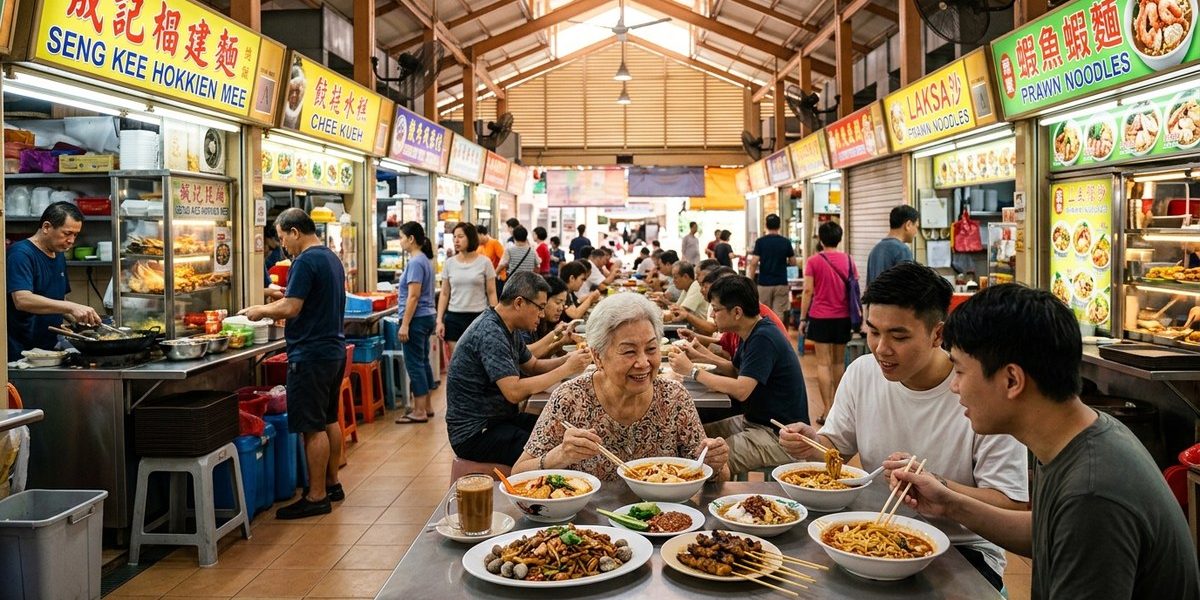
You have been to Maxwell. You have queued at Old Airport Road. You have taken the obligatory photo of Tian Tian’s chicken rice and felt the satisfaction of a well-planned food hunt. But there is a whole other world of hawker excellence hiding in plain sight, and it sits in a mature estate that many foodies drive past on the way to somewhere else. Ang Mo Kio does not have the tourist buzz of Chinatown or the Instagram fame of Tiong Bahru. What it does have is a concentration of third-generation hawkers, heritage recipes that have not changed since the 1970s, and queues that are formed entirely by people who live within a two-kilometre radius. This is not a neighbourhood that needs to prove itself. It simply cooks.
Ang Mo Kio is Singapore’s most underrated hawker destination, home to at least four major food centres with stalls that have been perfecting single dishes for decades. Unlike tourist-heavy spots, these hawkers serve a loyal local crowd that demands consistency. The best hawker food Ang Mo Kio offers ranges from Michelin-recognised noodle masters to hidden popiah specialists you will not find on any top-ten list.
Why Ang Mo Kio Deserves Your Attention
Think about the last time you travelled across the island for a meal. You probably went to a famous stall in a famous centre. Now think about the last time a friend dragged you to their neighbourhood coffee shop because “the wanton mee here is better than anything in town.” That is the energy Ang Mo Kio runs on. The estate was developed in the 1970s, which means its hawker centres matured alongside the community. The stalls that survived did so because they earned the trust of picky residents who eat there three times a week.
The result is a food scene that feels unpolished in the best way. There are no QR code menus or fusion concepts here. There are uncles wiping their woks with decades-old wrist movements and aunties who remember your usual order after one visit. This is hawker culture at its most honest.
The Four Ang Mo Kio Hawker Hubs You Need to Know
Not all hawker centres in Ang Mo Kio are created equal. Some specialise in breakfast, others shine during dinner. Here is a breakdown of the four main clusters and what each one does best.
| Hawker Centre | Best For | Must Try Dish | Peak Timing |
|---|---|---|---|
| Ang Mo Kio 724 Market | Breakfast and lunch | Fishball noodles | 7am to 10am |
| Chong Boon Market | Late morning snacks | Popiah and kueh | 9am to 11am |
| Ang Mo Kio Central Market | Dinner and supper | Hokkien mee | 5pm to 8pm |
| Cheng San Market | Weekend family meals | Carrot cake and laksa | 10am to 1pm |
Each of these centres has a distinct personality. 724 Market feels like a community kitchen where everyone knows each other. Chong Boon is smaller but houses some of the oldest stalls in the area. Central Market gets chaotic during dinner hours, and Cheng San is the go-to for families who want variety under one roof.
The Stall That Changed My Mind About Ang Mo Kio
I will admit something. I used to be one of those people who thought the best hawker food Ang Mo Kio could offer was decent but not destination-worthy. Then I visited a specific stall at 724 Market that completely shifted my perspective.
The stall sells fishball noodles. That sounds simple. But the soup base has a depth that most stalls cannot achieve because they rush the process. The owner simmers his stock for over six hours, starting at 4am every morning. The fishballs are made by hand, not ordered from a supplier. The chilli is house-made and fermented for two weeks. When you sit down with that bowl, you are tasting the difference between a cook who follows a recipe and a hawker who lives by one.
This is the kind of dedication you find in Ang Mo Kio. These stalls do not rely on viral marketing. They rely on the fact that if you serve a bad bowl on a Tuesday, the uncle at table five will tell you about it on Wednesday.
How to Plan Your Ang Mo Kio Hawker Crawl
A successful food trail in Ang Mo Kio requires a strategy. The centres are spread out, and some stalls sell out before lunch. Here is a practical sequence that minimises travel time and maximises taste.
- Start at Chong Boon Market around 9am. Order a popiah from the elderly couple who have been rolling them since 1982. Eat it fresh while the skin is still crisp.
- Walk to 724 Market by 10am. Grab a bowl of fishball noodles and a side of fried carrot cake. Share with a friend so you have room for what comes next.
- Take a short bus ride to Cheng San Market before noon. Order the laksa and a plate of white carrot cake. The queue moves fast.
- Rest during the afternoon heat. Visit the Bishan Park or the Ang Mo Kio Town Garden West to walk off the morning.
- Return to Ang Mo Kio Central Market around 5.30pm. The Hokkien mee stall will have just fired up its wok. Order one serving with extra pork lard. That is non-negotiable.
This route covers five different dishes across four centres. It respects the opening hours of each stall and gives you breaks between meals.
What Makes Ang Mo Kio’s Hawker Heritage Different
The hawker culture in Ang Mo Kio did not develop by accident. It was shaped by the people who moved into the estate during Singapore’s great housing migration of the 1970s and 1980s. Families from Chinatown, Geylang, and Kampong Glam relocated to these new flats, and they brought their recipes with them.
“My grandfather opened this stall in 1978 because the whole block moved here from the same street in Chinatown. He knew everyone would follow. Food is how we kept the community together.” – Third-generation hawker at Chong Boon Market
This history explains why the food here feels more personal. These stalls were not opened by entrepreneurs looking for a business opportunity. They were opened by cooks who wanted to feed their neighbours. That difference shows in every dish.
To understand how this migration shaped Singapore’s broader food landscape, read about how the 1960s hawker relocation programme forever altered Singapore’s food landscape. It puts Ang Mo Kio’s story into a national context.
Dishes You Must Try in Ang Mo Kio
If you only have one day, focus on these dishes. They represent the strongest offerings in the area.
- Hokkien Mee at Central Market. The noodles are thin and the stock is dark from hours of simmering pork bones. Ask for extra sambal chilli.
- Popiah at Chong Boon. The skin is made on the premises. That alone makes it superior to 90 percent of popiah stalls in Singapore.
- Fishball Noodles at 724 Market. The soup is the star here. It has a clean, savoury finish that does not rely on MSG.
- Laksa at Cheng San. The gravy is thick and the coconut milk tastes fresh. Some stalls water down their laksa to save costs. This one does not.
- Carrot Cake at Cheng San. Both white and black versions are excellent. Order the white one if you want a clean taste, and the black one if you want a punch of sweet soy sauce.
For a deeper look at one of Singapore’s most debated noodle dishes, check out the Hokkien mee rivalry that has divided Singaporeans for decades. Ang Mo Kio’s version stands proudly in that debate.
Common Mistakes Visitors Make
Ang Mo Kio hawker centres have a rhythm. New visitors often trip over unspoken rules that locals follow without thinking. Here are the most common errors and how to avoid them.
- Arriving at 1pm for lunch. Many stalls open early and close by 2pm. If you show up at 1.30pm, you will find empty trays and aunties wiping down counters. Go early or go for dinner.
- Ordering one dish per person. The portions are generous, but the point of a hawker crawl is variety. Share everything. Order three dishes for two people.
- Ignoring the coffee shop stalls. Not all great food lives inside a hawker centre. Some of the best wanton mee in Ang Mo Kio comes from a coffee shop stall that has no signage. Look for queues. That is your sign.
- Skipping the weekday visits. Weekend crowds at Cheng San can be brutal. If you can, go on a Tuesday or Wednesday morning. The food is the same, but the experience is calmer.
How Ang Mo Kio Compares to Other Hawker Destinations
You might wonder if Ang Mo Kio can really compete with established names like Old Airport Road or Maxwell. The honest answer is that it competes on different terms. Old Airport Road has more variety. Maxwell has better marketing. But Ang Mo Kio has higher consistency.
| Factor | Ang Mo Kio | Old Airport Road | Maxwell |
|---|---|---|---|
| Queue length | Short to medium | Long | Very long |
| Price | Lower | Average | Higher |
| Variety | Focused | Wide | Tourist-friendly |
| Heritage depth | Very high | High | Medium |
| Parking availability | Good | Poor | Poor |
If you value a relaxed meal with deep heritage and fair prices, Ang Mo Kio wins. If you want to try thirty different dishes in one afternoon, stick with Old Airport Road.
For more hidden gems across Singapore, read about 10 hawker stalls only locals know about and how to find them. Ang Mo Kio features prominently in that list.
The Future of Ang Mo Kio’s Hawker Scene
2026 has been a year of change for Singapore’s hawker culture. Several older stalls in Ang Mo Kio have passed from one generation to the next. Some have closed permanently. But new young hawkers are also stepping in, bringing fresh energy without abandoning tradition.
One notable example is a stall at Central Market that recently reopened under the management of a 34-year-old former engineer. He kept his grandfather’s Hokkien mee recipe exactly the same but introduced a digital queueing system. The older customers were sceptical at first. Now they appreciate not having to stand in line for 40 minutes.
This blend of respect for the past and adaptation to the present is what will keep Ang Mo Kio relevant. The best hawker food Ang Mo Kio serves today will likely still be served a decade from now, because the new generation understands that you do not fix what is not broken.
Your Ang Mo Kio Hawker Checklist
Use this list to track your progress. Each item represents a stall or dish that defines the area.
- Fishball noodles at 724 Market (Stall 01-18)
- Popiah at Chong Boon Market (Stall 02-06)
- Hokkien mee at Central Market (Stall 03-12)
- Laksa at Cheng San Market (Stall 04-09)
- White carrot cake at Cheng San Market (Stall 04-15)
- Wanton mee from the unnamed coffee shop stall along Ang Mo Kio Avenue 3
- Kueh salat from the dessert stall at Chong Boon (available before 10am only)
The Last Word on Ang Mo Kio Hawker Food
Ang Mo Kio does not need your validation. It has been feeding its community for over forty years, and it will continue to do so long after the food bloggers move on to the next neighbourhood. But if you are willing to step away from the famous names and explore a place that values substance over hype, you will discover a version of Singapore’s hawker culture that feels more honest, more personal, and more rewarding.
Next Saturday morning, skip the queue at Maxwell. Take the MRT to Ang Mo Kio instead. Walk into 724 Market at 8am. Order a bowl of fishball noodles from the uncle who has been there since 1978. Listen to the sound of the neighbourhood waking up around you. That is the real Singapore. It has been here all along.