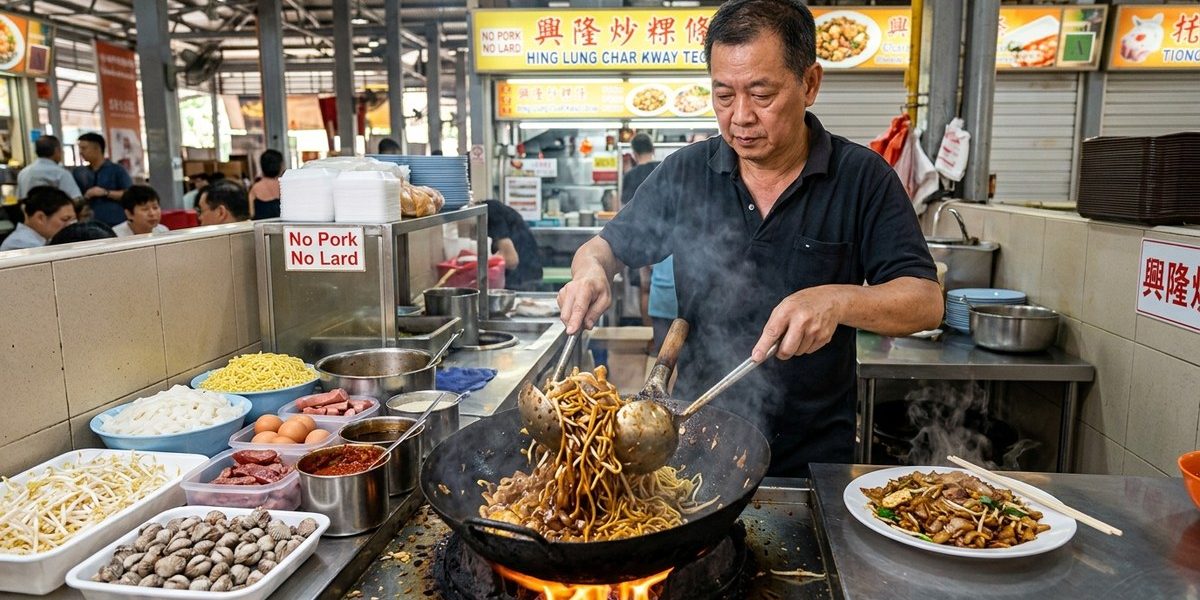
You spot a long queue at a hawker centre. The uncle behind the wok is moving with a rhythm that looks almost choreographed. Smoke rises. The smell of lard and chilli hits you. You want what everyone else is having. But when you reach the front, you freeze. You point at the price board and say, “One char kway teow.” The uncle nods, turns to his wok, and you get a standard plate. It is good. But it could have been better.
To get a fresher, premium plate of char kway teow, you need to use the secret lingo that regulars know. Say “kosong” for no chilli, “tambah” for extra egg, or “jiu” for extra lard. Order during off-peak hours. Ask for “special” to get more cockles and prawns. These simple char kway teow ordering tips will change how you eat at any hawker stall.
Why Your Ordering Style Matters More Than You Think
Char kway teow is not a dish you can mass produce. Each plate is a performance. The hawker tosses flat rice noodles into a blistering hot wok with a handful of ingredients. The heat must be just right. The timing must be precise. If you order during the lunch rush, the hawker is under pressure. He cooks multiple plates at once. Your noodles might sit under a heat lamp for a minute while he finishes the other orders.
That is why the secret lingo exists. It is not about being fussy. It is about communicating exactly what you want so the hawker can prioritise your plate. And when you use the right words, the hawker knows you are a regular. He respects that. He will take a little more care with your order.
The Secret Lingo That Gets You a Fresher Plate
These are the terms you need to know. They come from the hawker centres of Singapore and Malaysia. Use them with confidence.
Kosong (pronounced “koh-song”)
This means “zero” or “none” in Malay. Say “kosong” to ask for no chilli. Some hawkers add a lot of chilli paste by default. If you prefer a milder flavour, just say “kosong” when you order.
Tambah (pronounced “tam-bah”)
This means “add more.” You can say “tambah telur” for an extra egg. A fried egg on top of your char kway teow is a luxury move. The yolk runs into the hot noodles and creates a rich, silky coating. It is worth the extra dollar.
Jiu (pronounced “jee-yoo”)
This is the Hokkien word for “oil.” But in hawker lingo, it means extra lard. Lard is the secret to that glossy, savoury finish. A “jiu” order tells the hawker to add an extra scoop of pork fat to the wok. Your noodles will come out shinier and more flavourful.
Special
This is the premium option. A “special” plate usually comes with more cockles, more prawns, and sometimes Chinese sausage. The price is higher, but the portion is loaded. If you see a stall with a “special” option on the menu, that is the one to order.
Goreng (pronounced “go-reng”)
This is Malay for “fried.” Some stalls offer “goreng” as a style where the noodles are fried until slightly crisp. The texture changes. The edges of the noodles become crunchy while the centre stays soft. It is a different experience from the standard soft noodle.
Take away versus eat here
This matters more than you think. If you say “take away,” the hawker will cook your noodles a little less done. They continue to cook inside the packed container. If you want your noodles just right, say “makan sini” (eat here). The plate comes directly from the wok to your table.
A Step-by-Step Guide to Your First Order
Follow these steps the next time you approach a char kway teow stall.
-
Observe the queue first. If the stall has a long line, the hawker is likely cooking in batches. Your order might be pre-cooked. Walk away and come back during an off-peak hour. The best time to order is between 10:30am and 11:30am, or after 2:30pm.
-
Read the price board carefully. Look for the words “special,” “tambah,” or “goreng.” These are your premium options. If you see “CKT Special $6.00,” that is the one to order.
-
Make eye contact with the hawker. Do not shout from the side. Wait until he looks at you. Then say your order clearly. For example: “One special char kway teow, tambah telur, jiui.” That means one premium plate with extra egg and extra lard.
-
Specify your spice level. If you want chilli, say nothing. If you do not, say “kosong.” If you want extra spicy, say “tambah sambal” (add more chilli paste).
-
Pay first, then wait. Most stalls operate on a pay-first system. Hand over your cash or scan the QR code. Then stand to the side and wait for your number to be called.
Common Mistakes Tourists Make (And How to Avoid Them)
Here is a table that shows what tourists often do wrong and what the correct move is.
| Mistake | What Tourists Do | What Locals Do |
|---|---|---|
| Ordering during peak hours | Queue at 12:30pm for a rushed plate | Visit at 11am for a relaxed cook |
| Not specifying spice level | Get a default spicy plate they cannot finish | Say “kosong” for no chilli or “tambah sambal” for extra |
| Ordering “take away” by default | Noodles become soggy in the container | Say “makan sini” for the freshest experience |
| Pointing at the menu instead of speaking | Hawker assumes you want the basic version | Use the secret lingo to get premium ingredients |
| Asking for “no lard” | Lose the signature flavour and gloss | Embrace the lard or choose a stall that uses vegetable oil |
| Ordering one plate for the whole group | Each plate is cooked individually; sharing causes delays | Order multiple plates at once and let the hawker stagger them |
How to Spot a Quality Char Kway Teow Stall in 30 Seconds
You do not need to taste the food first. Look for these signs.
- The wok is black and seasoned. A well-used wok has a dark patina from years of frying. That is a good sign. A shiny new wok means the stall is either new or does not cook enough.
- The fire is loud. You should hear the gas flame roaring. High heat is essential for the char (burned) flavour. If the fire is low, the noodles will be soggy.
- The hawker uses a metal spatula, not a plastic one. Metal spatulas scrape the wok and create that smoky flavour. Plastic spatulas are a red flag.
- There is a container of lard on the counter. You will see a small tub of white fat near the wok. That is the secret ingredient. If you do not see it, ask.
- The queue is mostly locals. If the line is full of Singaporeans chatting in Singlish, you are in the right place. Tourists tend to queue at stalls with English menus and bright photos.
“A good char kway teow hawker does not need to shout. The wok does the talking. If you hear the sizzle and smell the smoke before you see the stall, you are close to something special.” — Uncle Swee, 45-year veteran at a Bedok hawker centre
The Best Times to Order for Maximum Freshness
Timing is everything. Here is a breakdown of when to go.
- Morning (7am to 9am): Most char kway teow stalls are not open yet. They start preparing ingredients around this time. Skip the morning.
- Late morning (10am to 11:30am): This is the golden window. The hawker has just set up. The wok is hot. The ingredients are fresh. There is no rush. You will get the best plate of the day.
- Lunch (12pm to 1:30pm): Avoid if possible. The hawker is under pressure. He is cooking multiple plates at once. The quality drops.
- Afternoon (2pm to 4pm): A good second window. The lunch crowd is gone. The hawker has time to focus on each order. Some stalls close for a break between 3pm and 5pm, so check before you go.
- Evening (6pm to 8pm): Dinner rush. Same problem as lunch. The hawker is tired. The quality is inconsistent.
- Late night (9pm to 11pm): Some stalls reopen for supper. This is a gamble. The hawker might be using leftover ingredients from the day. But if he starts a fresh batch, the quality can be excellent.
What to Do If the Stall Is Too Busy
Sometimes you arrive at a famous stall and the queue is twenty people deep. Do not give up. Use this strategy.
First, check if the stall offers a “pre-order” system. Some stalls let you call ahead or order through a messaging app. Second, look for a less famous stall nearby. The best char kway teow is not always the one with the longest queue. Third, come back during the late morning window. The queue will be shorter and the quality will be higher.
If you must queue, do not stand there silently. Watch the hawker. Learn his rhythm. When you finally reach the front, you will know exactly what to say.
The Complete Checklist for Your Next Order
Here is a bulleted list to keep in your phone or your memory.
- Say “makan sini” for eat-in
- Say “special” for premium ingredients
- Say “tambah telur” for an extra egg
- Say “jiu” for extra lard
- Say “kosong” if you do not want chilli
- Say “goreng” if you want crispy noodles
- Pay first, then wait for your number
- Eat immediately while the noodles are hot
Why This Knowledge Preserves Hawker Culture
When you use the secret lingo, you are not just getting a better plate. You are participating in a tradition that goes back decades. Hawker culture in Singapore is built on relationships. The hawker knows your face. He remembers your order. He gives you the best cockles from the bottom of the pile.
This is why three generations behind the wok still matter. When you order like a local, you help keep these stalls alive. You tell the hawker that his craft is valued. You tell the younger generation that this food is worth preserving.
The next time you visit a hawker centre, try it. Walk up to the stall and say, “One special char kway teow, tambah telur, jiu.” The hawker will pause. He will look at you with a small nod. Then he will cook your plate with extra care. That is the power of knowing the lingo.
Your Turn to Order Like a Pro
You now have the tools. The next step is to use them. Pick a hawker centre this week. Find a char kway teow stall with a black wok and a roaring fire. Stand in front of the uncle and speak the words. Do not be shy. He has heard it all before. He will appreciate that you took the time to learn.
And if you want to go deeper into the world of hawker food, read about how to find the best char kway teow at any hawker centre. Or discover the story behind the 78-year-old uncle behind Chinatown’s best char kway teow.
The wok is waiting. Go get your plate.