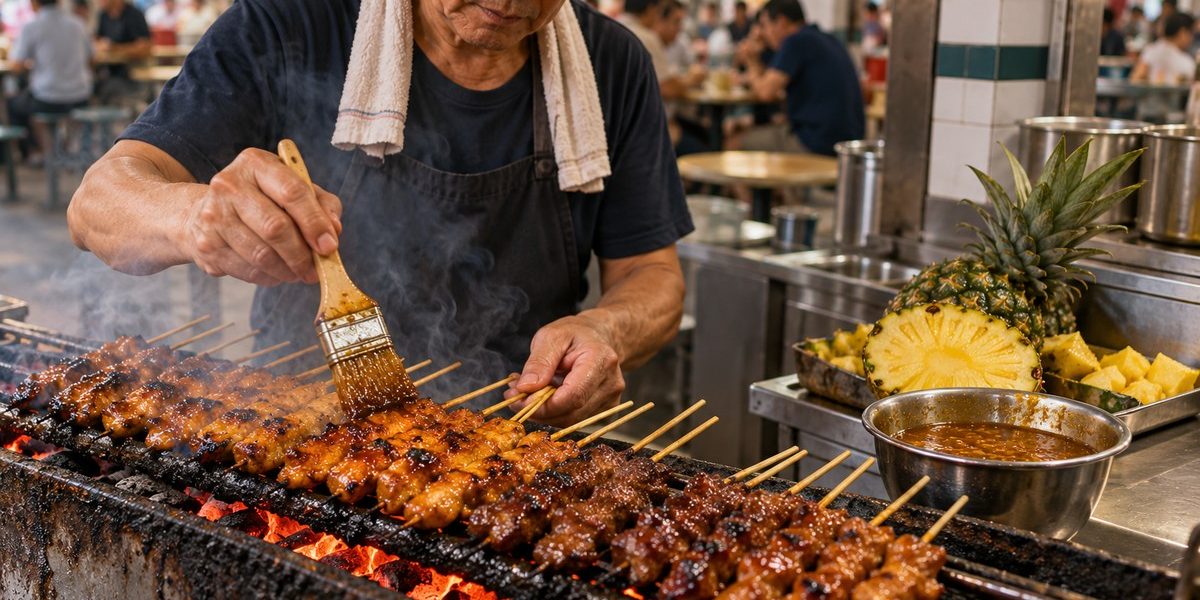
This Bedok satay stall legend owes its four-decade run to one surprising ingredient that most modern stalls have abandoned. The family behind it has kept the same recipe since 1986, refusing to cut corners even as costs rose. Located in a quiet corner of Bedok, this stall proves that heritage hawker food survives on patience, not trends. Their secret is something you probably have in your kitchen right now.
Some food legends are born from complex techniques. Others, like this Bedok satay stall legend, come from a single, stubborn choice that defies modern convenience. For 40 years, this family-run stall in the heart of Bedok has been serving skewers that taste exactly the same as they did in the mid 1980s. Regulars who moved away still make the trip back, sometimes driving from as far as Jurong, just for one plate. The queue never seems to shrink. And the reason is something you would never guess.
Most satay stalls today rely on electric grills or gas-powered rotisseries. They are faster, cleaner, and easier to maintain. But this stall does not use any of that. The unlikely ingredient that makes their satay unforgettable is charcoal. Not just any charcoal, but a specific grade of lump charcoal sourced from a single supplier in Malaysia, the same one they have used since day one.
The stall’s owner, now in his late 60s, still insists on firing up the charcoal pit every morning at 5am. He says the smoke from charcoal gives the meat a flavour that gas can never replicate. The fat drips onto the embers, creating a burst of aromatic smoke that rises back into the skewers. It is a cycle of flavour that has kept customers coming back for four decades.
Why Charcoal Makes All the Difference
Many people assume that satay is all about the marinade. And yes, the blend of turmeric, lemongrass, and coconut milk matters. But the cooking method is just as important. When you use charcoal, the heat is uneven. That sounds like a bad thing, but it is actually the secret. The hot spots sear the meat, locking in juices. The cooler spots allow the meat to cook through gently without drying out.
Gas grills produce even heat across the entire surface. That sounds efficient, but it leads to meat that is cooked uniformly without the contrast of charred edges and tender centres. Charcoal gives you that contrast. Each skewer has slightly different levels of caramelisation, which is why no two sticks taste exactly the same. That variation is what keeps your palate interested.
Electric grills are even worse. They often dry out the meat because the heat comes from one direction only. Charcoal radiates heat from below and from the sides of the pit, cooking the skewers from multiple angles. The result is juicier meat with a smoky crust that no gas flame can produce.
The Family Behind the Stall
This Bedok satay stall legend is not just about the charcoal. It is about the people who have been tending the fire for two generations. The founder, Mr Tan, started the stall in 1986 after learning the trade from his father, who ran a pushcart in the old Bedok Market. Back then, they used a simple metal drum cut in half as their grill. The setup was crude, but the charcoal was always high quality.
Mr Tan’s son, now in his early 40s, joined the business full time in 2010. He had a diploma in business management and could have taken an office job. But he chose to stay. He says the smell of charcoal smoke reminds him of his childhood, helping his father stack skewers after school. Today, he manages the stall while his father still insists on lighting the charcoal every morning.
“My father says the charcoal is like a living thing. You have to understand it. If you rush it, you burn the meat. If you let it die down, the meat is undercooked. He can tell just by looking at the colour of the embers whether it is ready. That is 40 years of experience you cannot learn from a book.”
That father-son partnership is rare in Singapore’s hawker scene. Many young people shy away from the heat and long hours. But this family has managed to keep the tradition alive by adapting without abandoning the core method. They now accept digital payments and have a simple ordering system to manage queues. But the charcoal pit has not changed.
How to Tell If a Satay Stall Uses Real Charcoal
You might be wondering how to spot a genuine charcoal-grilled satay stall without having to ask. Here is a simple checklist to help you identify the real deal:
- Look for smoke colour. Charcoal produces a thin, blueish smoke. Gas grills produce thicker, white smoke.
- Check the grill surface. Real charcoal leaves behind ash and small embers. Gas grills have clean metal bars.
- Smell the air. Charcoal grilled meat has a distinct smoky aroma that lingers. Gas grilled meat smells more like burnt oil.
- Observe the cook. Charcoal grilling requires constant attention. The cook will be turning skewers frequently. Gas grill cooks often leave skewers unattended.
If you visit this stall, you will notice all four signs immediately. The smoke rises in thin wisps. The grill is covered in a layer of grey ash. The air smells like a campfire. And Mr Tan never stops moving, flipping each skewer with practiced precision.
Common Mistakes That Ruin Satay
Many stalls try to replicate the charcoal effect but fail. Here is a breakdown of what goes wrong and how this Bedok stall avoids those pitfalls.
| Mistake | Result | How This Stall Avoids It |
|---|---|---|
| Using low grade charcoal | Meat tastes like chemical fumes | They only buy from one trusted supplier |
| Marinating too long | Meat becomes mushy and salty | Marinade is applied exactly 4 hours before grilling |
| Overcrowding the grill | Skewers steam instead of sear | Only 20 sticks on the grill at a time |
| Using frozen meat | Loss of moisture and texture | Meat is sourced fresh daily from the same butcher |
| Skipping the basting | Dry, flavourless surface | They baste with coconut oil and leftover marinade every 2 minutes |
These details might seem small, but they add up. A regular customer once told us that she tried to make satay at home using a charcoal barbecue. She followed a recipe from the internet. The result was dry and bitter. She came back to the stall the next day and told Mr Tan. He simply smiled and said, “The charcoal is not the only thing. You need to respect the fire.”
The Future of This Bedok Satay Stall Legend
The big question on every regular’s mind is whether the stall will survive after Mr Tan retires. His son has given a reassuring answer. He plans to keep the charcoal pit running for as long as there is demand. He has even trained two young helpers in the art of charcoal grilling, something that is becoming a lost skill.
But there are challenges. The price of good quality charcoal has gone up by nearly 40% over the past five years. The supplier in Malaysia is getting older and may stop production soon. The family is already looking for alternative sources, but they refuse to switch to cheaper alternatives. They would rather raise prices slightly than compromise on quality.
Another challenge is the weather. Charcoal grilling in Singapore’s humidity is not easy. The embers can die down if the air is too damp. Mr Tan has installed a small awning and a fan system to keep the charcoal burning steadily. It is a constant battle against the elements.
How to Visit and What to Order
If you want to experience this Bedok satay stall legend for yourself, here is what you need to know:
- Go early. The stall opens at 11am but the best cuts sell out by 1pm. If you arrive after 2pm, you might only get the less popular parts.
- Order the mixed platter. It comes with pork, chicken, and mutton skewers. Each meat is marinated differently. The mutton is the star, with a deeper, gamier flavour that pairs perfectly with the charcoal smoke.
- Do not skip the ketupat. The compressed rice cakes are made in house. They soak up the peanut sauce beautifully.
- Ask for extra chilli. The sambal is made fresh every morning. It has a tangy, fermented kick that cuts through the richness of the meat.
- Bring cash. The stall accepts PayNow but sometimes the network is slow. Cash is still the safest option.
The stall is located at a coffeeshop along Bedok North Street 3. It is not in a fancy food centre. The chairs are plastic. The tables are sticky. But that is part of the charm. You are not paying for ambience. You are paying for 40 years of perfected technique.
Why This Matters for Hawker Heritage
Stalls like this one are becoming rare. According to a 2025 survey by the National Environment Agency, only 12% of hawker stalls in Singapore still use traditional charcoal grills. Most have switched to gas or electric induction for efficiency. That is good for business, but it erases a part of our food heritage.
Charcoal grilling is not just about flavour. It is about a way of cooking that requires patience, observation, and respect for ingredients. It is a craft that cannot be automated. When you eat satay from this stall, you are tasting a method that predates modern kitchens. You are tasting history.
The son told us that he sometimes gets offers from food delivery platforms to expand. They want him to open a central kitchen and ship frozen satay nationwide. He has turned them all down. He says the satay would lose its soul if it was cooked anywhere else. The charcoal pit is not just a tool. It is the heart of the business.
Keeping the Fire Alive
This Bedok satay stall legend is more than a place to eat. It is a reminder that some things are worth doing the hard way. Charcoal grilling is messy, slow, and physically demanding. But it produces food that no modern appliance can replicate. The family behind this stall has chosen to preserve that tradition, not out of stubbornness, but out of love for their craft.
Next time you are in Bedok, take a detour from the usual food centre haunts. Find this unassuming coffeeshop. Order a plate of satay. Watch the charcoal glow. Smell the smoke. And appreciate the fact that you are eating something that was made the same way it was 40 years ago. That kind of consistency is rare in any city. In Singapore, it is almost miraculous.
If you enjoyed this story, you might also like reading about why Tian Tian Hainanese Chicken Rice still has queues after 30 years or the 78-year-old uncle behind Chinatown’s best char kway teow. Both stories celebrate the same spirit of dedication that keeps Singapore’s hawker heritage alive.