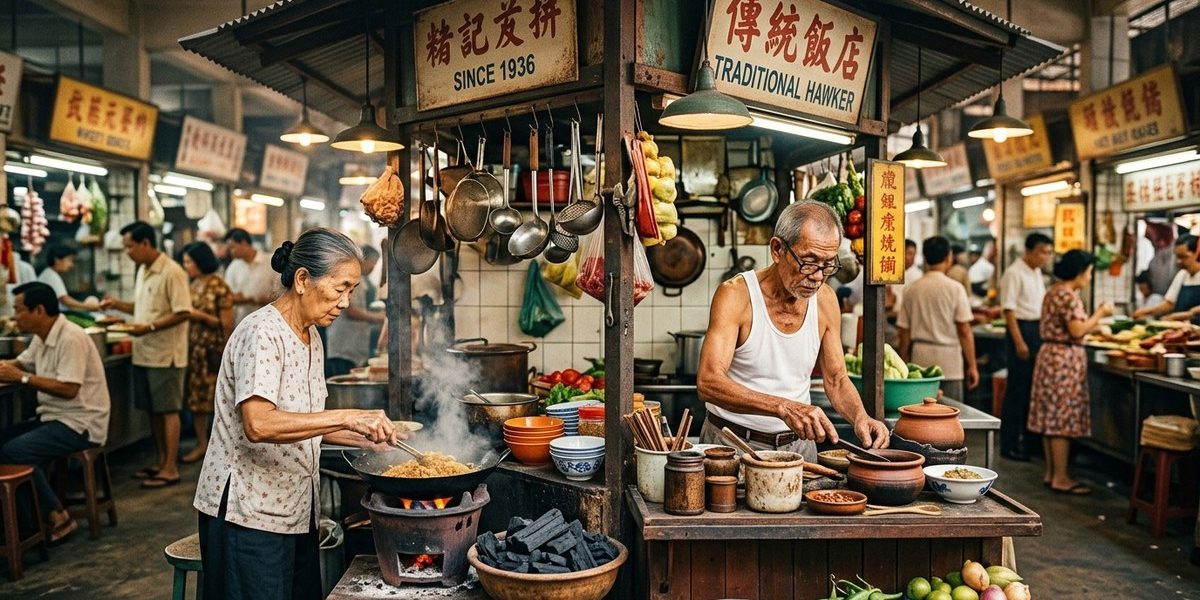
In 1957, Singapore conducted a census that would become a time capsule for the island’s street food scene. It recorded more than just numbers. It captured the heartbeat of a generation of hawkers who fed the city from pushcarts, five-foot ways, and makeshift stalls. Sixty-nine years later, that document reads like a menu of dishes we have lost. Some trades have vanished completely. Others survive in just a handful of stalls. This article walks through what the 1957 hawker census reveals about Singapore’s lost food trades, and why these records matter for anyone who cares about heritage.
The 1957 hawker census recorded over 6,000 street vendors across Singapore, many selling foods that are now rare or extinct. Dishes like satay bee hoon, ice ball, and traditional kueh from specific dialect groups have faded as hawkers aged and younger generations chose different careers. Understanding these lost trades helps us appreciate what remains and what we still need to protect.
What the 1957 Census Actually Recorded
The census was not a simple headcount. It was a detailed survey conducted by the Singapore government to understand the规模和 of street hawking. At the time, hawkers operated without formal licences. They sold everything from cooked food to household goods. The census aimed to classify them by trade, ethnicity, and location.
The final count showed over 6,000 hawkers in the city area alone. That number did not include the many unregistered vendors who evaded the survey. The census listed trades we still recognise, like Hainanese chicken rice and satay. But it also recorded dozens of categories that sound foreign to modern ears.
One of the largest groups was “itinerant food sellers”. These were hawkers who carried their stalls on their backs or on bicycles. They moved from street to street, following the crowds. Today, almost no hawker operates this way. The relocation programme of the 1970s and 1980s permanently changed the business model.
The Lost Trades That Once Fed Singapore
The census reveals trades that have all but disappeared. Each one tells a story about the communities that shaped Singapore.
Satay Bee Hoon
Satay bee hoon was a popular dish in the 1950s and 1960s. It consisted of rice vermicelli served with a spicy peanut sauce, similar to satay gravy. The sauce was thinner than modern satay sauce, and it was poured over the noodles. Hawkers sold it from pushcarts in areas like Bugis Street and Chinatown.
By the 1980s, satay bee hoon had faded. The exact reasons are unclear, but changing tastes and the difficulty of making the sauce from scratch likely played a role. Today, you might find one or two stalls claiming to serve it, but the version they sell is often a reinterpretation. The original recipe is mostly lost.
Ice Ball
Before air conditioning was common, ice ball was a treat that cooled Singaporeans down. A hawker would shave a block of ice into a ball, then douse it with coloured syrup, evaporated milk, and sometimes red bean or jelly. The ice ball was served on a small plate or in a plastic bag.
The census lists dozens of ice ball vendors. They operated near schools, markets, and bus stops. By the 1990s, the trade had nearly vanished. Health regulations made it difficult to sell shaved ice from open carts. Today, you might see ice ball at heritage food fairs, but it is no longer a daily street food.
Traditional Kueh from Specific Dialect Groups
The census recorded kueh sellers by dialect group. Hokkien kueh, Teochew kueh, and Peranakan kueh were listed as separate categories. Each group had its own specialties. Hokkien kueh included ang ku kueh and soon kueh. Teochew kueh featured orh nee and kueh chap. Peranakan kueh was known for colourful layered desserts.
Today, most kueh stalls sell a generic mix. The distinctions between dialect groups have blurred. Many traditional recipes require ingredients that are hard to source or skills that take years to learn. The census reminds us that kueh was once a deeply regional food, tied to specific communities.
Mee Rebus with Game Meat
The census lists a category for “game meat noodle soup”. This referred to mee rebus made with wild boar, deer, or even monkey meat. These meats were available in Singapore’s rural areas and mangrove swamps. Hawkers would slow cook the meat with spices and serve it over yellow noodles.
Game meat consumption declined as Singapore urbanised. By the 1970s, hunting was restricted, and wild meat became unavailable. The trade disappeared. No hawker stall today serves game meat mee rebus. It is a dish that exists only in memory and old records.
Roti John with Traditional Fillings
Roti john is still around, but the 1957 census shows a wider variety of fillings than what we see today. Hawkers used minced mutton, sardines, and even leftover curry. The bread was not the standard baguette we use now. It was a thicker, denser loaf that absorbed the egg mixture differently.
Modern roti john has been standardised. Most stalls use canned tuna or chicken. The census suggests that roti john was once a creative way to use leftovers, not a fixed recipe.
How the Census Documented the Decline
The census did not just record trades. It also tracked the movement of hawkers. Officials noted which streets had the highest concentration of vendors and which trades were growing or shrinking.
By 1957, some trades were already in decline. The census shows that “itinerant fruit sellers” had dropped by 30 percent compared to a 1950 survey. “Cooked food hawkers” were stable, but their numbers would peak in the 1960s before dropping sharply.
The census also recorded the age of hawkers. Many were over 50. This was a warning sign. If younger people did not take over the stalls, the trades would die. That warning proved accurate.
A Table of Vanished and Endangered Trades
Here is a summary of trades recorded in the 1957 census. Some are gone. Others are endangered.
| Trade | Status in 1957 | Status in 2026 | Notes |
|---|---|---|---|
| Satay bee hoon | Common | Nearly extinct | Fewer than 5 stalls remain |
| Ice ball | Common | Extinct as street food | Only at heritage events |
| Game meat mee rebus | Niche | Extinct | Banned ingredients |
| Dialect-specific kueh | Common | Endangered | Less than 20 specialist stalls |
| Roti john (traditional) | Common | Endangered | Most stalls use modern recipe |
| Itinerant food seller | Very common | Extinct | Relocation programme ended it |
| Mee siam | Common | Endangered | Few stalls left in hawker centres |
| Indian rojak (original) | Common | Endangered | Modern versions differ greatly |
Why These Trades Vanished
Several factors caused the decline. Understanding them helps us see which current trades might be at risk.
The Relocation Programme
The biggest change was the government’s decision to move hawkers into licensed centres. This happened between 1971 and 1986. The goal was to improve hygiene and reduce traffic congestion. It succeeded in those aims, but it also changed the economics of hawking.
Street hawkers could operate with low overheads. They had no rent, no utility bills, and no fixed hours. Once they moved into centres, they had to pay rent, comply with opening hours, and meet health standards. Some trades could not survive the transition. Ice ball vendors, for example, could not afford the cost of a permanent stall.
Changing Tastes
Singaporeans’ palates changed. The 1957 census reflects a population that ate more rustic, filling food. Dishes like satay bee hoon were heavy and sweet. As incomes rose, people wanted lighter, more varied options. New cuisines from Japan, Korea, and the West entered the market.
Younger generations also lost the connection to traditional foods. A child growing up in the 1980s might never have tried satay bee hoon. Their parents had moved on to other dishes. The cycle of knowledge was broken.
Ingredient Availability
Some trades depended on ingredients that became scarce. Game meat is the clearest example. Others required specific types of fish, vegetables, or spices that are no longer farmed or imported in the same quantities.
Traditional kueh makers often used ingredients like gula melaka, pandan, and coconut milk. These are still available, but the quality has changed. Mass produced versions lack the depth of flavour that came from traditional methods.
Labour and Succession
Hawking is hard work. Long hours, hot kitchens, and low margins make it unattractive to many. The 1957 census noted that most hawkers were middle aged. Their children often chose office jobs over the family trade.
This is still a problem today. Many heritage stalls are run by hawkers in their 60s and 70s. When they retire, the recipes go with them. The census foreshadowed this crisis decades ago.
How to Find the Last Remaining Stalls
If you want to taste these lost trades, you need to know where to look. Here is a practical process.
- Check the National Heritage Board’s list of heritage hawker stalls. They maintain a directory of stalls that have been operating for at least 30 years.
- Visit older hawker centres like Tiong Bahru Market, Maxwell Food Centre, and Old Airport Road Food Centre. These centres have a higher concentration of traditional stalls.
- Look for stalls that specialise in a single dish. A stall that only sells kueh or only sells mee siam is more likely to use a traditional recipe.
- Talk to the hawkers. Ask about their history and their ingredients. Many are happy to share stories.
- Follow food heritage groups on social media. Groups like the Singapore Heritage Society and the Slow Food community often highlight endangered dishes.
What We Can Learn from the 1957 Census
The census is more than a historical document. It is a lesson in fragility. Trades that seemed permanent in 1957 are now gone. The forces that killed them are still active. Relocation, changing tastes, ingredient shortages, and labour issues continue to shape the hawker scene.
But the census also shows resilience. Some trades from 1957 are still thriving. Hainanese chicken rice, satay, and char kway teow are more popular than ever. The difference is that these dishes adapted. They changed with the times while keeping their core identity.
The lost trades did not adapt. That is the key takeaway. Preservation requires more than nostalgia. It requires active support. When you buy from a heritage stall, you are not just buying food. You are keeping a trade alive.
The Role of Documentation in Preservation
The census is a form of documentation. It recorded what existed at a specific moment. Without it, we would not know about satay bee hoon or game meat noodles. We would have only vague memories.
Documentation is one of the most powerful tools for preservation. When we write about stalls, photograph their food, and record their recipes, we create a record for the future. That is why My Hawkers SG exists. We want to make sure that the stalls of today are not forgotten tomorrow.
If you want to help, you can start by visiting the stalls we feature. Read our article on why Tian Tian Hainanese chicken rice still has queues after 30 years. Or learn about the last traditional popiah stall in Katong that locals guard jealously. Every visit matters.
A Call to Taste Before It Is Too Late
The 1957 census is a reminder that no food trade is permanent. The stalls we love today could be gone in a generation. The best way to honour the past is to eat in the present.
Next time you are at a hawker centre, look for the older stalls. The ones with handwritten signs. The ones where the hawker is over 60. Order something you have never tried. Ask about the recipe. Take a photo. Share it with a friend.
That is how we keep the trades alive. Not by locking them in a museum, but by eating them. The 1957 census shows us what we lost. It is up to us to decide what we keep.