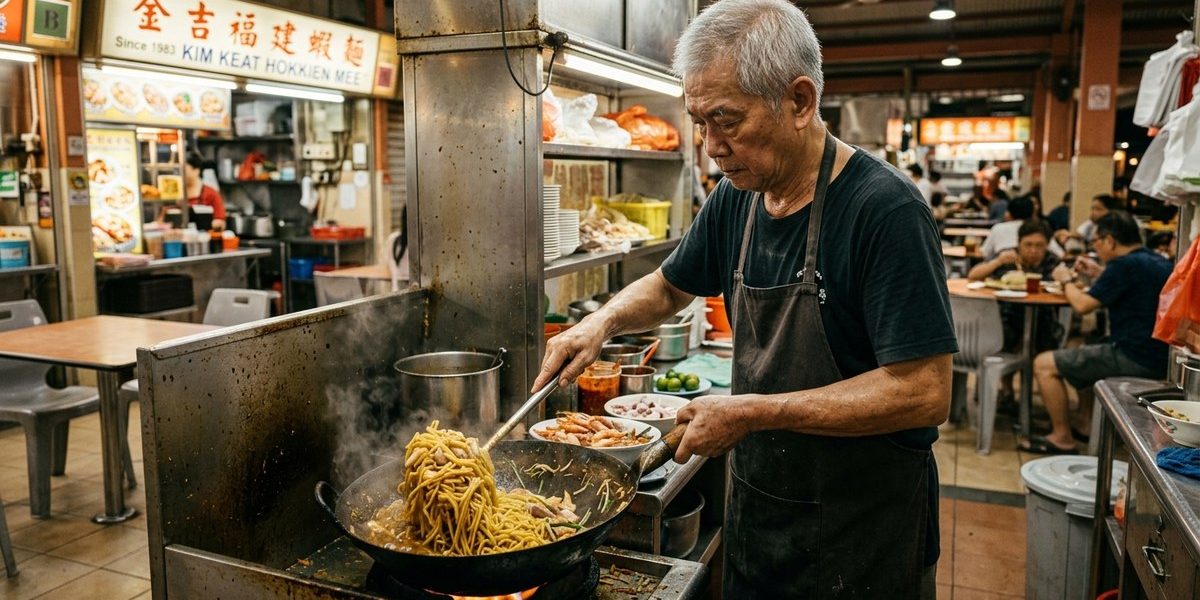
Toa Payoh has always been a heartland hub for serious eaters. You know the estate. It is home to some of Singapore’s most enduring hawker legends. But every so often, a stall slips through the cracks. It stays off the radar. No blogger has written about it. No TikTok video has sent crowds its way. And that is exactly why the food tastes the way it does. We are talking about a Hokkien Mee stall that has been operating in plain sight for 40 years. The recipe has never changed. The family has never sought fame. And until now, it was not on any food blog. If you are searching for genuine Toa Payoh Hokkien Mee, this is the kind of place that makes the hunt worthwhile.
Toa Payoh holds some of Singapore’s best kept food secrets, and this Hokkien Mee stall is proof. For 40 years, a family has served a recipe not found on any food blog. The stall stays under the radar, drawing loyal regulars who know true heritage noodles. No influencer queues here, just honest wok hei and broth made from scratch daily. Find out where it is and why locals guard this address so carefully. This is real hawker food at its finest.
Why Toa Payoh Produces Such Memorable Hokkien Mee
Toa Payoh is not just another housing estate. It is one of Singapore’s oldest satellite towns, and it has a food culture that was built over decades. The hawker centres here were planned together with the flats. That means the stalls have been serving the same families for generations. A child who ate Hokkien Mee here in the 1980s now brings their own children. That continuity creates a standard that is hard to find elsewhere.
The Hokkien Mee in Toa Payoh tends to lean towards the older style. It is not the overly wet version you see at some newer stalls. It is also not the dry, separate-ingredients type. Instead, it sits right in the middle. The noodles are braised in a rich prawn stock until they absorb every drop of flavour. Then the wok hei seals it all in. This is the version that grandparents remember. And that is exactly what this secret stall delivers.
Hokkien Mee has always been a dish of balance. Too much stock and you get a soupy mess. Too little and the noodles turn stiff. The best stalls, like this one, know exactly when to stop cooking. They let the noodles rest for just a moment before serving. The result is a plate that glistens without being greasy. It is a texture that Singaporeans recognise immediately.
If you want to understand why this stall stands out, it helps to know what makes a great Hokkien Mee in the first place. Here is a breakdown of the common mistakes and how this stall avoids them.
| Common Mistake | What Goes Wrong | How This Stall Does It |
|---|---|---|
| Overcooking the noodles | Noodles become mushy and lose bite | The uncle times each batch by hand, pulling the noodles at the exact moment they turn springy |
| Using weak prawn stock | The flavour falls flat and watery | Stock is simmered for hours with real prawn heads and shells, no shortcuts |
| Skimping on lard | The dish lacks richness and aroma | Fresh lard is rendered daily on the spot, added just before serving |
| Burning the garlic | Bitterness ruins the entire wok | Garlic goes in at the last possible moment, only until fragrant |
| No wok hei | The noodles taste home cooked, not hawker grade | High flame throughout, constant tossing, the wok is never allowed to cool |
This table shows you exactly what to look for at any Hokkien Mee stall. If a stall gets all five points right, you are in good hands. This particular stall gets every single one right, which is why regulars have kept coming back for four decades.
The Stall That Time Almost Forgot
The stall does not have a flashy signboard. There is no Instagram handle printed on the awning. In fact, if you walk past without paying attention, you might miss it entirely. It sits in a quiet corner of a Toa Payoh hawker centre that most people only visit for the coffee shop next door. The family keeps the same hours they kept in 1986. They open when the stock is ready. They close when it runs out. That is usually around lunch time.
The current owner learned the recipe from his father. The father learned it from his own uncle, who ran a pushcart in the old Toa Payoh market before the hawker centres existed. That pushcart had no name. It was just known as the Hokkien Mee at the market. People found it by smell. They followed the aroma of prawn shells and lard, and they lined up in the alley. That pushcart is long gone, but the recipe lives on at this permanent stall.
“My father always said, if the prawn stock is good, you do not need anything else. No pork rib, no sambal, no extra sauce. Just good stock and good noodles. That is the secret.” — The stall owner, who prefers to remain unnamed
This philosophy is rare today. Many stalls try to mask weaker broth with chilli or dark soy sauce. This family trusts their stock. They serve the Hokkien Mee with just a small wedge of calamansi and a spoonful of sambal on the side. The sambal is homemade, but it is meant as an accent, not a crutch. The first bite should always be plain. That is when you taste the 40 years of practice.
How to Visit and What to Order
Finding the stall is part of the experience. It is not listed on any major food directory. The address is known mostly by word of mouth. Here is how to make sure you get there at the right time and leave satisfied.
- Go between 9.00 am and 11.00 am. The stall opens around 8.00 am, but the first batch of stock needs time to reach its prime. Arriving at 9.00 am gives you the freshest noodles without the crowd. By 11.30 am, the longer queue forms and some ingredients run low.
- Order the large portion if you are alone. The large comes with extra pork belly and a handful of large prawns. It is filling enough for a full meal. The small portion is better as a snack, but you will regret not ordering more.
- Say “not too wet” if you prefer a drier wok hei. The uncle will adjust the stock level for you. Regulars know this trick. It gives the noodles a slightly charred edge that is hard to describe.
- Add a fried egg if available. Not all days have eggs, but when they do, ask for it half boiled. The yolk mixes into the noodles and creates a richer sauce.
- Bring cash. The stall does not accept PayNow or credit cards. It is one of the last cash only stalls in the area. There is an ATM nearby, but it charges a fee.
What Else to Pair With Your Hokkien Mee
Toa Payoh is full of hidden gems. If you are making the trip for this Hokkien Mee, you might as well turn it into a full hawker crawl. The area around this stall has several other stalls that have been running for decades.
- A classic carrot cake stall nearby that still fries each order on a charcoal heated wok. The white version is crispy on the outside and soft inside.
- An old school rojak stall that uses a thick, dark shrimp paste. The lady owner has been at it since 1992. She cuts every ingredient by hand.
- A soya bean milk stall that makes their own beancurd from scratch. The beancurd is served warm with a drizzle of gula melaka. It is a good way to end the meal.
All three stalls are within a five minute walk of the Hokkien Mee. They are the kind of places that do not need to advertise. Locals just know.
Why This Stall Matters for Singapore’s Hawker Heritage
Every time a stall like this closes, a piece of Singapore’s food history disappears. The recipe is not written down. It exists only in the owner’s hands and in the memory of his regulars. When he decides to retire, that recipe could vanish forever. This is happening across the island. Young hawkers face high rents and long hours. Many choose not to take over from their parents.
Stalls like this one are living archives. They preserve not just a taste, but a technique. The way the uncle handles the wok, the way he adds the lard at the exact moment, the way he knows when the noodles have absorbed enough stock, none of that can be taught in a textbook. It comes from decades of repetition. That is why we document these places. That is why we ask you to visit them.
The food you eat here is not trend driven. It is not a fusion concept. It is the same Hokkien Mee that a father fed his family in 1986. That continuity is rare. And it is worth protecting.
If you are interested in other stories like this, you can read about the secret recipes that hawkers guard with their lives. Or learn how to spot a quality Hokkien Mee stall in 30 seconds so you never end up with a disappointing plate.
Bringing the Family to Try It Together
This is the kind of place that works for all ages. The flavours are familiar enough for older Singaporeans who remember the old pushcart days. The texture is robust enough for younger eaters who want real wok hei. And the price is gentle on the wallet. A large plate costs well under ten dollars. Two people can share a large and add a side dish for a complete meal that costs less than a fast food combo.
Bring your parents. They will recognise the taste. Bring your friends who claim they have tried every good Hokkien Mee in Singapore. They will be proven wrong. And bring a sense of patience. The line moves slowly because the uncle cooks every order individually. He does not batch cook. He does not rush. That is why the noodles taste the way they do.
The stall is not on any food blog. It is not on any must eat list. It is just a quiet corner of Toa Payoh where a family has been doing the same thing for 40 years. That is rare in 2026. And it is worth your time.
Go find it. Order the large. Squeeze the calamansi over the noodles. Take that first bite and taste what hawker heritage really means. Then tell your friends. But only the ones who will appreciate it.