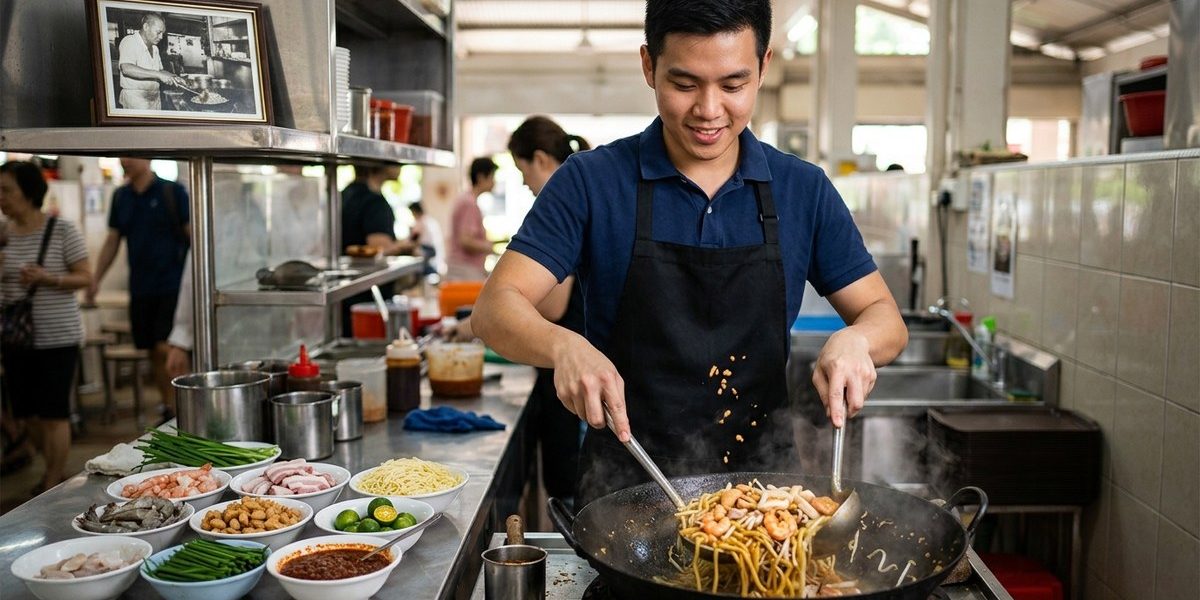
The smell of pork lard and prawn stock still hits you before you reach the stall. But the plate that arrives looks different from what your grandfather might have queued for 40 years ago. The noodles are glossier. The broth is lighter. And there is a whisper of something unexpected in the finish.
This is the story of how a third-generation hawker took his grandfather’s Hokkien Mee recipe and quietly reinvented it for 2026. He did not abandon tradition. He listened to it, then asked a simple question: what would this dish taste like if we cooked it for today?
A third-generation hawker in Singapore has modernised his family’s Hokkien Mee recipe by shortening the stock simmer time, using lighter soy, and adding a touch of smoked paprika for depth without heaviness. He kept the lard and the wok hei but reduced the oil. The result is a cleaner, brighter version that appeals to younger diners while still honouring the original. This article breaks down his exact methods and the thinking behind each change.
Why This Hokkien Mee Feels Different
Traditional Hokkien Mee is a heavy hitter. Dark soy, thick stock, and a generous slick of lard oil make it deeply satisfying but also rich. For many younger Singaporeans, that richness can feel too cloying, especially in our humid climate.
The third-generation hawker, whom we will call Ah Meng for this piece, noticed something during his first year running the stall. His regulars were mostly in their 50s and 60s. The younger crowd came once, said it was “too heavy”, and walked to the nearby ramen shop.
So Ah Meng did not change the soul of the dish. He changed the body.
He reduced the amount of dark soy by half. He swapped the standard pork fat rendering method for a cleaner technique. He added a pinch of smoked paprika, a spice his grandfather would never have touched. The result is a plate of noodles that still tastes unmistakably like Hokkien Mee, but one you could eat on a Tuesday afternoon without needing a nap afterwards.
The Three Core Changes in the Modern Recipe
Ah Meng’s approach is not about gimmicks. It is about precision. Here are the three adjustments that define his modern Hokkien Mee recipe.
1. The Stock Is Shorter but More Concentrated
The old method: simmer prawn heads and pork bones for four hours. The result is a deeply savoury stock but also one that can turn cloudy and heavy.
Ah Meng’s method: simmer for 90 minutes at a gentle bubble, not a rolling boil. He adds the prawn heads only in the last 30 minutes. This keeps the stock clear and the prawn flavour bright rather than muddy.
| Traditional Method | Modern Method |
|---|---|
| 4 hour simmer | 90 minute simmer |
| Rolling boil throughout | Gentle bubble, low heat |
| Prawn heads added at start | Prawn heads added in last 30 minutes |
| Stock is dark and thick | Stock is clear and light |
| Requires more pork fat to balance | Needs less oil because stock is cleaner |
2. Lard Is Still Used, but Sparingly
This is the change that got Ah Meng the most pushback from his father. “No lard means no Hokkien Mee,” his father said.
Ah Meng agreed. He still uses lard. But he renders it differently. Instead of deep frying the pork fat until it is dark brown and intensely smoky, he renders it over medium heat until it is just golden. The lard retains a nutty flavour without the heavy, almost burnt note.
He also uses it as a finishing drizzle rather than a cooking base. The noodles are fried in a neutral oil first. The lard goes on at the very end, just before serving. This way, you taste the lard without feeling like you are drinking it.
3. A Touch of Smoked Paprika for Depth
This is the most controversial addition. Smoked paprika is not a traditional Hokkien ingredient. But Ah Meng noticed that the dish lacked a certain “lift” after he reduced the dark soy. Dark soy contributes not just colour but a fermented, almost smoky note.
The smoked paprika mimics that depth without adding the sticky sweetness of extra soy. He uses less than half a teaspoon per portion. You would not identify it as paprika. You would just notice that the noodles taste more rounded.
“I told my father, the wok hei is still there. The prawn stock is still there. The lard is still there. I just cleaned up the edges. If the dish tastes better, why does it matter where the smoke comes from?”
Ah Meng, third-generation hawker
How to Recreate This Modern Hokkien Mee at Home
If you want to try this approach in your own kitchen, here is a step by step guide. This is not the full recipe (that stays in the family), but the framework is clear enough for any home cook to follow.
-
Start with the stock. Use 500g of prawn shells and heads plus 300g of pork bones. Cover with water and bring to a gentle bubble. Skim the foam. After 60 minutes, remove the pork bones. Add the prawn shells and heads. Simmer for another 30 minutes. Strain and set aside.
-
Prepare the noodles. Use fresh yellow noodles and thick bee hoon in a 70:30 ratio. Rinse them briefly under warm water to remove excess oil. Drain well.
-
Render the lard. Cut 100g of pork fat into small cubes. Cook over medium heat until golden, not dark brown. Remove the cracklings and set aside. Reserve the liquid lard.
-
Fry the aromatics. In a hot wok, add one tablespoon of neutral oil. Fry minced garlic (two cloves) and sliced shallots (one medium) until fragrant. About 30 seconds.
-
Add the noodles. Toss in the noodles and stir fry for one minute. Add 200ml of your prepared stock. Let it reduce slightly.
-
Season lightly. Add one teaspoon of light soy, half a teaspoon of fish sauce, and a pinch of smoked paprika. Toss well.
-
Finish with lard. Drizzle one teaspoon of the rendered lard over the noodles. Toss once more. Plate and top with the lard cracklings, sliced prawns, and a squeeze of calamansi.
Common Mistakes When Modernising a Heritage Recipe
Ah Meng shared a few pitfalls he saw other young hawkers make when trying to update classic dishes. Avoid these.
- Removing all the fat. Hokkien Mee needs some fat. Without it, the noodles feel dry and the spices have nothing to carry. Reduce the fat, do not eliminate it.
- Using stock cubes. The whole point of modernising is to improve clarity and flavour. Stock cubes add MSG and a metallic aftertaste that ruins the clean profile.
- Overcomplicating the seasoning. One or two new ingredients is enough. Ah Meng saw a stall that added truffle oil, gochujang, and sesame. The result was a mess. Pick one twist and commit to it.
- Ignoring the wok hei. No amount of clever ingredient swaps can replace the breath of the wok. The wok must be screaming hot. If your home stove cannot reach that temperature, use a cast iron pan and preheat it for five minutes.
Where Heritage Meets the Future
Ah Meng’s stall is not trying to be fine dining. It is still a hawker centre. The queue still forms at 11:30am. The price is still under six dollars. The only difference is that the people in the queue now include teenagers in school uniforms and young couples with babies.
That is the real measure of success for any heritage dish. Not whether it wins a Michelin star. Not whether a food blogger calls it “elevated”. But whether the next generation actually wants to eat it.
If you want to see how other hawkers are keeping traditions alive, read our story on why Tian Tian Hainanese chicken rice still has queues after 30 years. Or check out how a former banker built Tiong Bahru’s most talked about lor mee stall.
The One Thing You Should Take Away
Modernising a family recipe is not about erasing the past. It is about translating the past into a language that today’s eaters understand. Ah Meng did not throw away his grandfather’s notebook. He read it carefully, then wrote a new page.
The next time you eat Hokkien Mee, ask yourself: does this taste like it was made for me, right now, in 2026? If the answer is yes, then the hawker has done their job. If the answer is no, maybe it is time for a reinvention.
Go find a stall that respects the old but cooks for the new. Your taste buds, and your digestion, will thank you.