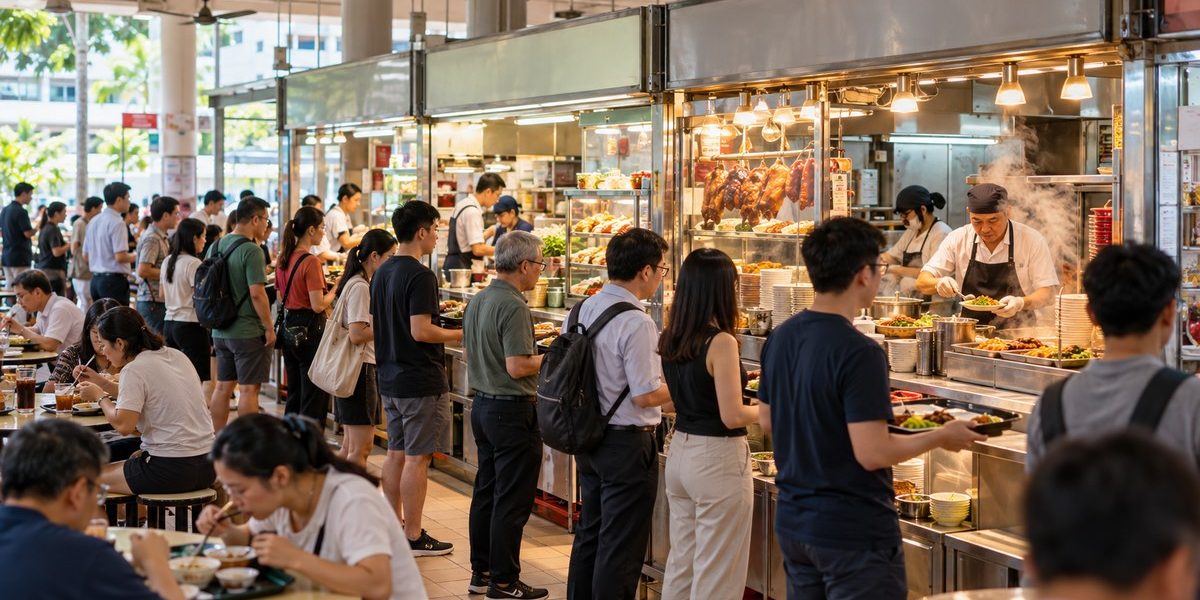
You are standing at the entrance of a hawker centre. The air smells like wok hei, chilli, and coconut. Twenty stalls are open. Ten have queues. One has a line that snakes past three tables. That is the stall you want. But how do you know for sure? The secret to finding the best hawker food in Singapore is not luck. It is a skill. And anyone can learn it.
The best hawker stalls reveal themselves through five signs: a steady queue of locals, visible cooking action, a focused hawker, limited menu options, and clean but worn equipment. By reading these clues, you can skip the tourist traps and eat like a Singaporean. This guide teaches you the system, the common mistakes to avoid, and how to apply it at any hawker centre in Singapore.
Why the Queue Is Your Best Friend (and Your Worst Enemy)
A long queue is the most visible signal of a great stall. But not all queues are equal. A line of office workers at 12:15 PM on a Tuesday means something different from a line of tourists holding selfie sticks at 3:00 PM on a Saturday.
The queue you want is the one built by regulars. These are the auntie with her own container, the uncle in construction boots, and the young couple who live three blocks away. They are not here because a blogger told them to be. They are here because the food is consistently good.
Look at who is standing in line. If you see mostly local faces, people in slippers and singlet, or office workers in name badges from nearby companies, you have found a strong candidate. If the queue is mostly visitors with cameras, proceed with caution. The stall might be famous, but famous does not always mean best.
The 5-Step System for Choosing Any Hawker Stall
This method works at every hawker centre, from Old Airport Road to Chomp Chomp, from Maxwell to Bedok Interchange. Use it every time.
-
Scan the stalls before you queue. Walk the entire hawker centre once. Do not commit to the first stall you see. Note which stalls have queues, which have empty seats, and which have steam rising from their woks. This takes two minutes and saves you from a disappointing meal.
-
Check the hawker’s hands. A great hawker is always moving. They are chopping, stirring, plating, or wiping. If the hawker is sitting down scrolling a phone while the queue grows, something is off. The best hawkers work with urgency because they care about timing.
-
Count the items on the menu. A stall with forty dishes on the board is a jack of all trades. A stall with five dishes, or even just one, is a master. Look for specialization. A stall that only sells Hainanese chicken rice has perfected that one thing. A stall that sells chicken rice, laksa, nasi lemak, and curry puffs is probably average at all of them.
-
Watch the wok. For stir-fried dishes like char kway teow or Hokkien mee, the wok should be smoking hot. You should see flames licking the sides. The hawker should be tossing ingredients, not letting them sit. If the wok looks cold or the oil is not shimmering, move on.
-
Look at the chopping board. A clean, organized workstation is a sign of discipline. A messy stall with ingredients everywhere might still taste good, but it is a gamble. The hawkers who respect their workspace usually respect their recipes too.
What the Stall Tells You Before You Order
You can learn a lot from a stall before you say a single word. The physical clues are everywhere.
-
The queue length. A line of 5 to 8 people is ideal. It means the food is popular but the wait is reasonable. A line of 30 people might mean the stall is understaffed or the hawker is slow. You decide if the wait is worth it.
-
The age of the hawker. Older hawkers often carry decades of experience. But do not dismiss young hawkers. Many of them, like the career-switchers we feature in our story on corporate-to-hawker transitions, bring fresh energy and modern techniques.
-
The queue of regulars. If someone brings their own tupperware, that is a gold star. If a customer orders without looking at the menu, that is another. These are repeat customers. They know exactly what they want.
-
The chilli level. A stall that offers sambal belacan, fresh cut chilli padi, and house-made chilli sauce is serious about flavour. A stall that only has factory packets of sweet chilli is telling you something.
Common Mistakes and How to Avoid Them
Even experienced food hunters make errors. Here is a table of the most common mistakes and what to do instead.
| Mistake | Why It Happens | What to Do Instead |
|---|---|---|
| Joining the longest queue without checking who is in it | Assuming length equals quality | Scan the faces in the queue. More locals = better bet. |
| Ordering from a stall with 30 menu items | Thinking variety means skill | Pick a stall that specializes in 3 to 5 dishes. |
| Going to a hawker centre at peak tourist hour | Visiting when crowds are highest | Go at 10:30 AM for lunch or 2:30 PM for a late meal. |
| Ignoring a stall because it looks old | Judging by appearance | Worn equipment often means years of daily use. |
| Trusting only Michelin Bib Gourmand stickers | Overvaluing awards | Awards help, but a queue of uncles is more reliable. |
“I tell my students: do not trust the queue. Trust the person in the queue. If you see an auntie with a wet market bag waiting for her noodles, that is the real review.” — Mr K. F. Seetoh, veteran food writer and hawker culture advocate.
How to Time Your Visit for the Best Experience
Timing is everything. The best hawker stalls sell out. If you arrive at 1:30 PM for lunch, the star stall might already be closed. Here is a general guide for peak hours.
-
Breakfast (6:30 AM to 9:00 AM). Go for traditional kueh, chwee kueh, and soft boiled eggs. Stalls that serve these open early and close by lunch.
-
Lunch (11:00 AM to 12:30 PM). Arrive before the office crowd. By 12:15 PM, the queues at popular stalls at Amoy Street and Golden Shoe will be long.
-
Tea break (2:30 PM to 4:00 PM). This is the sweet spot. Many stalls are still open but the lunch rush is over. You get shorter queues and fresher ingredients.
-
Dinner (6:00 PM to 7:30 PM). Similar to lunch. Arrive early or wait until 8:00 PM.
-
Supper (10:00 PM to midnight). Chomp Chomp, East Coast Lagoon, and Geylang Serai come alive. Look for stalls with charcoal grills and steam rising from large pots.
What to Look for by Dish Type
Different dishes have different clues. Here is how to spot quality for five popular hawker classics.
Hainanese chicken rice. The chicken skin should be smooth and glossy, not wrinkled. The rice should be fragrant with pandan and ginger, not clumpy. The chilli should be house-made, not bottled. If the stall uses a blowtorch to crisp the skin, that is a good sign.
Char kway teow. The noodles should be black from the soy sauce, not pale. You should see cockles, bean sprouts, and Chinese sausage in the mix. The plate should arrive with a slight sheen of oil, not swimming in it. Watch for the wok heat. If the hawker is not sweating, the wok is not hot enough.
Bak chor mee. The minced pork should be freshly cooked, not pre-fried and sitting in a tray. The vinegar should be sharp, not watery. The lard should be visible in the crispness of the noodles. A great bowl has a balance of sour, savoury, and fatty notes.
Laksa. The gravy should be thick and coconut-rich, not thin like soup. You should see pieces of fish cake, cockles, and laksa leaves. The stall should be simmering the gravy in a large pot, not reheating from a packet.
Roti prata. The dough should be flipped and stretched by hand. The prata should be thin and crispy, not doughy and thick. Watch for the oil temperature. If the prata is greasy, the oil is too cold.
Signs That a Stall Is Past Its Prime
Not every famous stall stays good forever. Here are red flags to watch for.
-
The hawker has hired too many assistants and no longer cooks personally. The quality drops when the founder steps away.
-
The queue is still long, but the faces are all tourists. Locals have moved on to the next generation.
-
The stall has expanded its menu too much. A stall that used to sell only wanton mee now sells chicken rice, nasi lemak, and fried rice. That is a warning.
-
The prices have gone up but the portion size has shrunk. This happens when a stall becomes a brand.
-
The hawker looks tired or disengaged. Running a hawker stall is exhausting. Some hawkers lose their passion after decades. You can taste it.
How to Use This Guide at Any Hawker Centre
You do not need to memorize everything. Just remember the core principle: read the stall before you order. Walk the centre. Watch the hawker. Check the queue demographics. Count the menu items. Then decide.
For a deeper look at specific stalls, read our feature on why Tian Tian Hainanese Chicken Rice still has queues after 30 years. It explains how heritage and consistency keep a stall at the top.
If you want to find stalls that even most locals miss, our list of 10 hawker stalls only locals know about is a great starting point.
The Joy of Finding Your Own Stall
The best part of this skill is that it turns every hawker visit into a small adventure. You are not just eating. You are reading the room, spotting the clues, and making a smart choice. Sometimes you will pick wrong. That is fine. Every wrong pick teaches you something new.
Over time, you will develop your own shortcuts. You might learn that a specific uncle in Toa Payoh always uses the freshest prawns. You might discover that a stall in Bedok only opens at odd hours but serves the best lor mee in the east. That knowledge is yours. It cannot be Googled.
Singapore’s hawker culture is alive and evolving. New stalls open. Old stalls close. Recipes pass from one generation to the next. The system in this guide will help you navigate it all, whether you are visiting Maxwell for the first time or returning to your favourite neighbourhood centre.
So next time you walk into a hawker centre, take a breath. Walk the full circuit. Watch the woks. Study the queues. Then pick your stall with confidence. The best meal of your trip is waiting. You just need to know where to look.