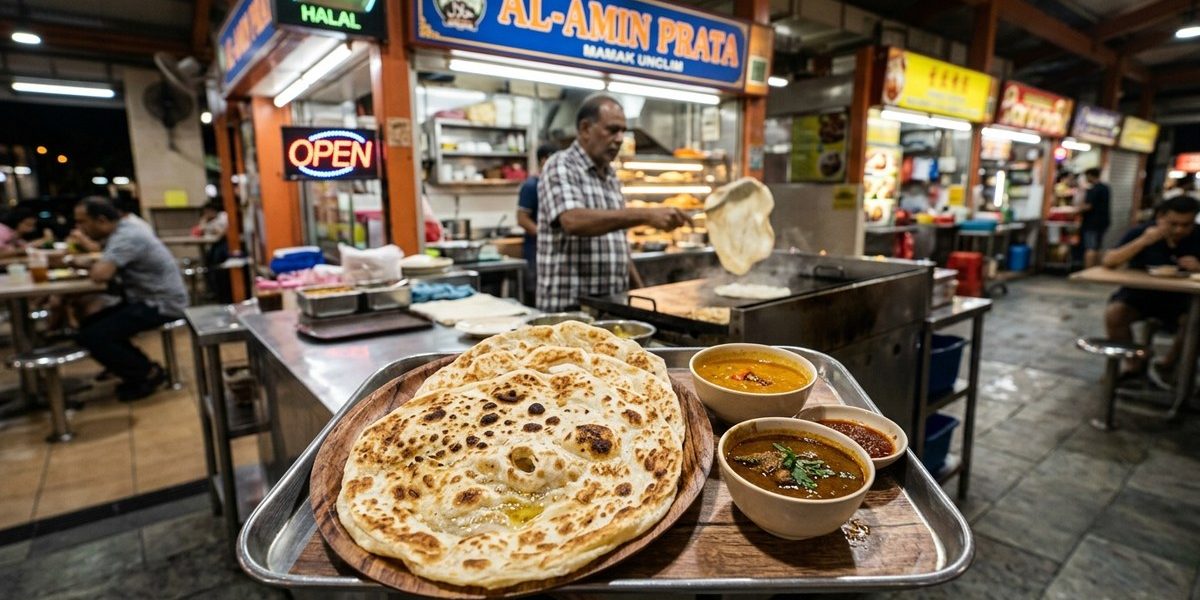
A quiet war is being fought on hot griddles across Singapore. On one side, the thick, doughy roti prata that fills you up fast. On the other, the paper-thin, crackling version that shatters with every bite. For many Singaporeans, the choice is clear: thin and crispy wins every time. The shatter, the lightness, the way it soaks up curry without turning soggy – that is the gold standard. But what exactly makes a roti prata truly thin and crispy? And where can you find the best ones in 2026?
Thin crispy roti prata is not just about rolling the dough thin. It requires high heat, the right oil temperature, a specific moisture balance, and a flicking technique that stretches the gluten. Our guide explains the hawker secrets behind this beloved mamak classic and directs you to the stalls that do it best in 2026.
Why Thin and Crispy Is a Different Art Form
Many people assume thin roti prata is just a lighter version of the standard coin prata. In reality, it demands a completely different set of skills. The goal is not to reduce dough quantity, but to create a structure that crisps up without burning.
The process starts with the dough itself. A good hawker will knead the dough for at least 15 minutes, letting the gluten develop. Then comes the resting phase. If the dough rests too little, it stays tight. If it rests too long, it becomes weak and tears easily. Experienced hawkers let it sit for about 30 minutes under a damp cloth.
Once the ball of dough is flattened, the real magic happens. The hawker lifts it with both hands and uses a flicking motion to toss it in the air. This stretches the dough into a thin, almost translucent sheet. A beginner might tear it. A master makes it look easy.
The Technique That Separates the Best from the Rest
Let’s break down what happens on the griddle.
| Aspect | Thin Crispy Prata | Thick Doughy Prata |
|---|---|---|
| Dough thickness | Less than 2 mm after stretching | 4 to 6 mm |
| Griddle temperature | Very high (around 200 °C) | Medium high |
| Oil usage | Enough to shallow fry, not drown | Moderate, often absorbed |
| Cooking time | 60 to 90 seconds per side | 2 to 3 minutes per side |
| Filling potential | Limited (one small egg is perfect) | Can hold large portions |
| Crunch factor | Shatters on first bite | Chewy, bready |
The table shows that thin crispy prata is a high-heat, high-skill game. The oil must be hot enough to crisp the outside instantly, but not so hot that it burns before the inside sets. Most stalls use a blend of butter and vegetable oil for flavour and smoke point.
4 Signs a Stall Serves Legit Thin Crispy Prata
- They stretch the dough in the air. If the uncle or aunty tosses the dough with a whip and you can see light through it, that is your cue. Stalls that press the dough flat with a palm are likely going for a denser texture.
- The prata arrives folded, not flat. After frying, thin prata is usually folded into a semicircle or a letter fold. This traps steam and keeps the inner layers soft while the outer skin stays brittle.
- You hear the crackle. A proper thin crispy prata makes an audible snap when you tear it with your hands. If it bends without breaking, it is not crispy enough.
- They serve it immediately. Thin prata loses its texture fast. A stall that makes you wait for your order is actually doing you a favour – they fry it fresh per order. Avoid places that stack pre-cooked pratas under a heat lamp.
Why Locals Keep Coming Back for Thin Crispy
- Lighter on the stomach. After a heavy roti prata with egg and onion, you can still walk around without feeling like you need a nap.
- Better dippability. The thin layers have more surface area, so they scoop up more fish curry or dal.
- Makes the toppings shine. Whether it is a classic egg prata or a modern cheese and mushroom version, the thin base lets the filling take centre stage.
- Faster cooking time. You get your order in under two minutes, which matters during peak breakfast or supper hours.
“The secret is not just thinness, but the moisture content. Too much water in the dough and it becomes chewy. You need the right balance to get that shatter effect. And the fire must be high – if not, the prata absorbs oil and becomes greasy.” – Mr. Ramesh, third-generation mamak hawker at Jalan Kayu.
Common Mistakes That Ruin Thin Crispy Prata
Even experienced hawkers sometimes slip. Here are the typical errors:
- Using too much oil. The prata should float on the griddle, not swim. Excess oil makes the layers soggy.
- Under-resting the dough. Tight dough shrinks back during stretching, resulting in a thick, rubbery prata.
- Flipping too early. The first side must develop a golden brown crust before you flip. Hurrying leads to pale, soft spots.
- Overcrowding the griddle. When multiple pratas cook at once, the temperature drops. Each prata needs its own space.
Where to Find the Best Thin Crispy Roti Prata in 2026
We have scouted hawker centres across the island to bring you a curated list of stalls that consistently deliver that perfect crackle. Our full guide, 5 Roti Prata Stalls That Prove Thin and Crispy Wins Every Time, names names and includes exact locations, operating hours, and insider tips. You will find hidden gems in Ang Mo Kio, a legendary supper spot in Geylang, and a family-run stall in Tampines that has been using the same recipe since 1985.
If you want to understand the broader story of how the Indian Muslim community shaped Singapore’s hawker scene, read our feature on How Singapore’s Indian Muslim Community Built the Mamak Stall Legacy. It traces the journey from pushcart vendors to the air-conditioned prata shops we love today.
Why Thin Crispy Matters for Hawker Heritage
Thin crispy roti prata is more than a texture preference. It represents a mastery of technique passed down through generations. The flick, the timing, the oil temperature – these are skills that take years to perfect. When a hawker serves you a perfectly shattering prata, you are tasting decades of trial and error.
As newer generations take over stalls, some traditions risk being lost. But the demand for thin crispy prata remains strong. Young hawkers are now experimenting with whole wheat flour and fillings like sambal petai, yet the core technique stays unchanged. That is the beauty of hawker culture: it evolves, but the soul remains.
So next time you are at a kopitiam or hawker centre, watch how your prata is made. If the hawker tosses it high and fries it fast, you are in for a treat. Order an extra kosong (plain) prata just to enjoy the crunch. Dip it in the fish curry, listen to the snap, and appreciate the hands that made it.
After all, in Singapore’s food scene, thin crispy roti prata is not just a dish. It is a standard.