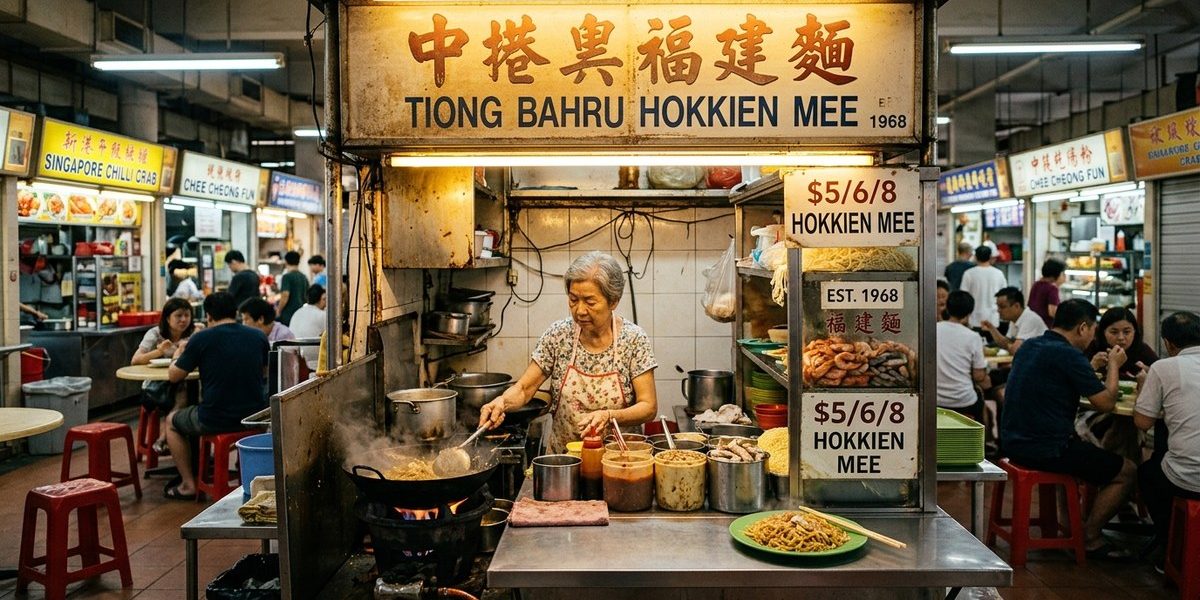
You walk past a hawker centre almost every day. Maybe it is the one near your office in Raffles Place, or the coffee shop below your HDB block in Toa Payoh. You have your usual order. You know which stall has the best kopi, and which auntie gives extra sambal without asking. But there are other stalls too. The ones with no queue. The ones where the uncle sits alone between lunch and dinner, reading a Chinese evening paper. Those are the forgotten hawker stalls Singapore has quietly left behind. And they deserve a second look.
Singapore's hawker culture is not just about Michelin stars and viral queues. Some of the most soulful bowls of laksa, Hokkien mee, and kueh are served at stalls that have been overlooked for years. This guide will help you find these hidden treasures, understand why they faded from public attention, and support the hawkers who still cook with tradition, patience, and heart. Every plate you order helps preserve a piece of Singapore's food heritage.
Why Some Stalls Fade From Memory
The food scene in Singapore moves fast. A new stall opens in a trendy hawker centre, and within weeks it has a TikTok following. Meanwhile, a Teochew porridge uncle in a quiet corner of a mature estate sees his customer base shrink year after year. It is not that his food quality dropped. It is that the neighbourhood aged, foot traffic shifted, and younger diners gravitated toward brighter, air-conditioned spaces.
For a more detailed look at how Singapore's hawkers moved from pushcarts to permanent indoor stalls, read our article on how the 1960s hawker relocation programme forever altered Singapore's food landscape. That programme created the modern hawker centre system, but it also meant some stalls got better locations than others.
There are three main reasons why excellent stalls become forgotten:
- Location disadvantage. A stall on the second floor of an older centre, or one tucked behind a staircase, simply gets less walk-by traffic. Even regulars forget to go up.
- No digital presence. The uncle has no Instagram. His daughter does not run a Facebook page. The stall relies entirely on word of mouth, which dries up when the regulars move away.
- Change in demographics. A stall that served Cantonese kway chap to a generation of factory workers may struggle when the factories close and young professionals move into the area.
None of these reasons have anything to do with taste. That is the tragedy.
What Makes a Hawker Stall Worth Revisiting
Not every quiet stall is a hidden gem. Some are quiet for good reason. But there are clear signals that a forgotten stall is actually serving something special.
| Signal | What It Looks Like | Common Mistake to Avoid |
|---|---|---|
| Consistent customer flow | A slow but steady trickle of older customers who greet the hawker by name | Assuming a long queue means better food; crowds can be driven by hype, not quality |
| Simple, focused menu | Only three or four items on the board, each perfected over decades | Judging a stall by how few dishes it offers; fewer items often means more attention to each |
| Hands-on preparation | The hawker does not just assemble; they stir, chop, grind, and taste | Equating efficiency with quality; a stall that uses pre-prepared ingredients saves time but loses soul |
| Loyal regulars | Customers who order without looking at the menu and chat with the hawker | Ignoring the conversations happening at the stall; regulars are the best food critics |
When you spot these signals, you have found a stall that deserves your lunch money.
Where to Start Your Hunt for Forgotten Hawker Stalls
Some hawker centres in Singapore have become tourist magnets. Maxwell and Lau Pa Sat are wonderful, but they are not where you will find forgotten stalls. Instead, head to the estates where time moves a little slower.
If you are looking for a systematic approach, here is how to plan your own hunt for under the radar hawker centres where you will actually find parking and great food:
- Start with mature housing estates: Ang Mo Kio, Bedok, Toa Payoh, Clementi, Jurong East, and Woodlands.
- Visit during off peak hours. A stall that is empty at 3pm might have a loyal lunch crowd that leaves by 1.30pm.
- Look for stalls that have been in the same spot for more than 20 years. Longevity is a strong signal.
- Talk to the coffee shop or kopitiam uncle. They know which stalls are run by the second or third generation.
- Check the walls for old newspaper clippings or faded award stickers. They tell a story.
"The best meal I ever had in Singapore was at a stall with no name, only a handwritten sign that said 'Laksa.' The auntie had been there since 1985. She told me she used to serve 200 bowls a day. Now she serves maybe 60. But every bowl was perfect. That is the Singapore I want people to remember."
Mr. Tan Hock Seng, 72, retired food seller and regular at a quiet Bedok coffee shop
The Generations Behind the Wok
Many forgotten stalls are run by elderly hawkers who have been cooking the same dish for 30, 40, or even 50 years. They are not trying to go viral. They are trying to pay the bills and keep a recipe alive. When they retire, the recipe often retires with them.
Understanding the three generations behind the wok: Singapore's oldest family run hawker stalls gives you a deeper appreciation for what is at stake. These are not just food stalls. They are living archives of taste.
Some of these stalls have children who have chosen not to take over. The hours are long. The margins are thin. The work is physically demanding. A younger generation may prefer air-conditioned offices over a hot wok. That is why the stall eventually becomes forgotten.
But there is hope. In 2026, more young hawkers are stepping up. Some are career switchers who left corporate jobs to learn from their parents or grandparents. We covered five such stories in from corporate jobs to coffee shops: 5 career switchers now running successful hawker stalls. The pattern is encouraging.
Dishes That Are Disappearing
Some dishes have become so rare that you can only find them at forgotten stalls. These are the trades that are slowly dying.
A good place to start is our guide on 5 dying hawker trades you need to try before they are gone. It lists specific dishes and the stalls that still make them from scratch.
Here are a few examples of what you might find:
- Chwee kueh made with hand ground rice flour rather than factory premix. The texture is softer and more delicate.
- Traditional popiah with freshly grated turnip and housemade sweet sauce. The skin is thin and slightly translucent.
- Orh luak (oyster omelette) fried in lard with fresh cockles and a starchy egg batter that crisps at the edges.
- Salted vegetable duck soup simmered for hours until the broth is milky and sour. Only a handful of stalls still serve it properly.
- Kueh kosui and other traditional Peranakan kueh made by elderly aunties who do not use artificial colouring.
For a deeper look at one specific heritage treat, read about the vanishing art of traditional kueh making: elderly hawkers keeping Peranakan sweets alive. These are the sweets your grandmother grew up with.
How to Support Forgotten Stalls Without Being Awkward
You want to help. But you also do not want to walk up to a stall and say "I am here to save you." That would be awkward for everyone. Instead, here are natural ways to show up:
- Order extra. If the food is good, buy a portion for dinner too. The hawker earns more, and you get a second meal.
- Bring a friend. Introduce someone new to the stall. Word of mouth still matters more than any app.
- Leave a review on Google Maps or Burpple. Many elderly hawkers do not manage their own online presence, but reviews help other diners find them.
- Ask questions. Hawkers love talking about their craft. Ask how long they have been cooking. Ask where they get their ingredients. It makes their day.
- Be patient. Forgotten stalls may take longer to serve because the hawker works alone. That is fine. The food will be worth it.
If you want to find more stalls that fit this description, check out our list of 10 hawker stalls only locals know about and how to find them. It is a practical starting point.
The Quiet Joy of a Forgotten Meal
There is something special about eating at a stall that has no queue. You sit down. The uncle brings your food. You take your first bite, and it tastes like something your grandmother would have made. There is no rush. No one is taking photos for their story. It is just you, the food, and decades of tradition in every spoonful.
That experience is becoming rarer. Each year, more stalls close. More recipes are lost. But you can still find them if you know where to look and what to look for.
How to Make This a Habit in 2026
Let us turn this into a practice. Here is a simple challenge:
- Pick one Saturday a month.
- Choose a hawker centre you have not visited in years or have never visited.
- Walk past the stalls with the longest queues.
- Instead, look for the stall with the oldest owner, the simplest signboard, and the smallest menu.
- Order one dish. Eat it slowly. Notice the flavours.
- If you like it, tell the hawker. If you love it, tell your friends.
Do this for the rest of 2026. You will discover bowls of comfort that most people walk past every day without a second glance. And you will help keep a small piece of Singapore's food heritage alive, one plate at a time.
For more stories and guides, start with the only stall in Singapore that still makes laksa lemak from scratch using a 1950s recipe. Then head out and find your own.