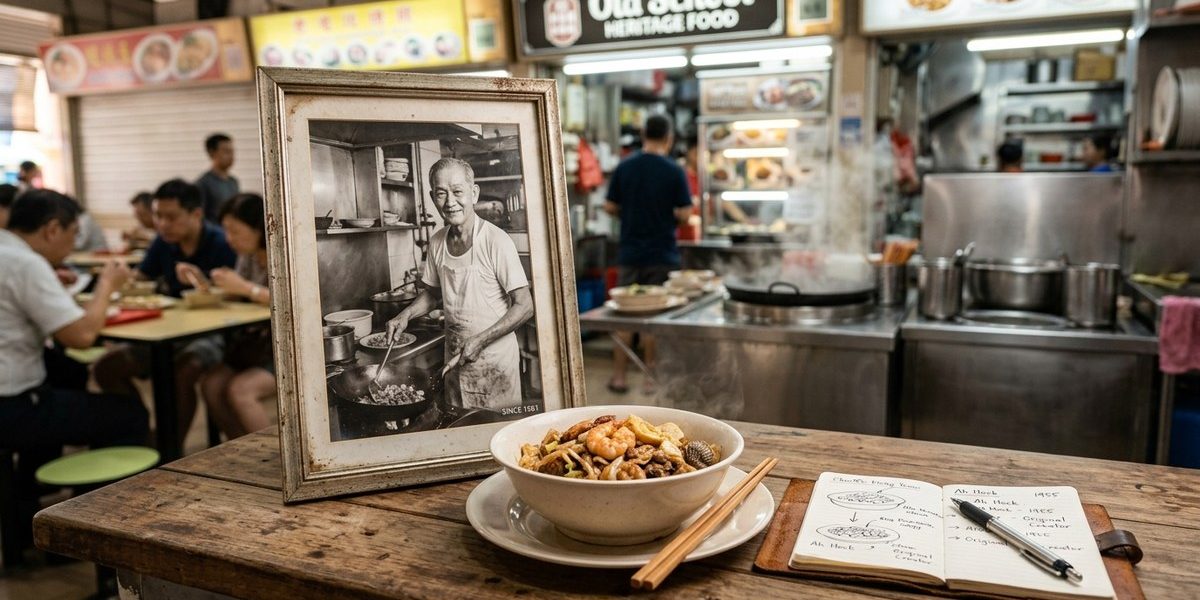
Every bowl of steaming laksa you queue for on a rainy evening carries a story that started decades ago, often with one person working over a charcoal stove in a kampung kitchen. The Hokkien mee you swear by, the bak chor mee your father queued for before you were born, the chicken rice that defines a national obsession all have a point of origin. Yet most of us can name the stall but not the person who first balanced those flavours. That gap matters because Singapore’s hawker culture was inscribed on the UNESCO Representative List of the Intangible Cultural Heritage of Humanity in 2020, and every recipe that disappears without documentation takes a piece of that heritage with it. Learning how to trace a hawker dish back to its original creator is not just a hobby for food nerds. It is a way to honour the pioneers who shaped how this city eats.
Tracing a hawker dish to its original creator requires three skills: interviewing elderly relatives and stallholders, cross-referencing old newspaper archives and oral history records, and understanding how migration patterns shaped recipe adaptation. Start with the dish’s name and key ingredients, then work backwards through family trees and stall locations. Avoid assuming the oldest known version is the first version. Document everything so the next generation can continue the search.
Why the original creator matters more than you think
Singaporeans love a good food argument. Which stall has the best char kway teow? Whose laksa is the real Katong laksa? These debates are fun, but they often miss the deeper question: who actually made this dish popular in Singapore in the first place?
Knowing the original creator does several things. It gives credit where credit is due. It helps young hawkers understand the roots of their craft. It prevents the erasure of history when stalls close or recipes change hands. And for cultural researchers and travellers, it turns a meal into a meaningful connection with the past.
Take Hainanese chicken rice. Most people know about Tian Tian and Wee Nam Kee. But the dish did not appear out of thin air. It evolved from the Wenchang chicken rice that Hainanese immigrants brought with them, and the version you eat today was shaped by cooks who adapted it for local palates in the 1930s and 1940s. Reading the story of when Hainanese cooks left the British kitchens gives you a clearer picture of how the dish took its current form.
A step by step method to trace any hawker dish
There is no single database that lists every original hawker recipe in Singapore. You have to become a detective. Here is a practical process that works whether you are researching a dish for a blog, a school project, or personal curiosity.
-
Start with the stall name and location. Write down everything you already know. What is the name of the stall? Where is it located? How long has it been there? If the stall has moved over the years, track each location. The from pushcarts to permanent stalls article explains how many hawkers started on the street before moving into hawker centres. That history can reveal clues about the original owner.
-
Interview the current stallholder. Most hawkers are happy to talk about their family history if you visit during a quiet period. Ask specific questions. Who taught them the recipe? Was it a parent, a grandparent, or an unrelated mentor? Do they know who first cooked this dish commercially? Take notes or record the conversation with permission. Even a ten minute chat can yield names and dates that are not written down anywhere else.
-
Search the National Archives of Singapore. The NAS holds oral history interviews with elderly hawkers that were recorded in the 1980s and 1990s. Many of these interviews mention the names of pioneers who have since passed away. You can search by dish name, ingredient, or location. This is one of the most underused resources for food research in Singapore.
-
Look up old newspaper articles on NewspaperSG. The National Library Board runs a free online archive of Singapore newspapers dating back to the 1800s. Search for the dish name combined with words like “hawker”, “stall”, “first”, or “invented”. You might find an article from 1958 that mentions a particular uncle who was famous for his fried noodles. That article could be the missing link.
-
Cross reference with community knowledge. Post in Singapore food groups on Facebook or Reddit. Ask older relatives. Visit the hawker centre on a weekday morning when the regulars are having coffee and chatting. The collective memory of a neighbourhood often holds details that never made it into official records. For example, the story of how a former banker built Tiong Bahru’s most talked about lor mee stall was pieced together from conversations with regulars, not from a press release.
Common mistakes when researching origins
Even experienced food writers make errors when tracing a dish’s creator. Here are the most frequent pitfalls and how to avoid them.
| Mistake | Why it happens | How to avoid it |
|---|---|---|
| Assuming the oldest stall is the original | People confuse longevity with primacy. A stall that has been around for 50 years may not be the first. | Verify the start date of each stall and compare. Look for mentions of earlier versions in old newspapers. |
| Relying on food blogs alone | Bloggers often copy each other without fact checking. Errors spread quickly. | Use blogs as leads, not evidence. Always confirm with primary sources like archives or interviews. |
| Ignoring the influence of migration | A dish like nasi lemak or roti prata has roots outside Singapore. Claiming a local creator without acknowledging the broader tradition is misleading. | Research the dish’s history in Malaysia, Indonesia, India, or China. Understand how the Singapore version differs. |
| Focusing only on Chinese dishes | Singapore’s hawker culture includes Malay, Indian, Eurasian, and Peranakan contributions. Many origin stories are overlooked. | Read about how Singapore’s Indian Muslim community built the mamak stall legacy to broaden your perspective. |
Expert advice from a heritage food researcher
“The best clue is often in the name of the dish itself. When a dish is named after a person, like Hainanese chicken rice or Ipoh hor fun, that name points you toward a specific community or place. But when the name is descriptive, like ‘fried kway teow’ or ‘bak chor mee’, you have to look at the technique. A dish that uses lard and dark soy sauce in a specific proportion usually signals a Cantonese influence, while a dish heavy on belacan and tamarind points to Peranakan or Malay roots. Follow the ingredients, and the ingredients will lead you to the cook.” * Mr. Ang Peng Hwa, volunteer researcher at the Singapore Heritage Society
This approach works especially well for dishes with murky histories. Take bak chor mee. The version you eat at Tai Hwa Pork Noodle has a distinct vinegar and chilli balance that traces back to a Teochew hawker in the 1950s. The story of five generations of bak chor mee inside Tai Hwa Pork Noodle’s Michelin success shows how a single family can carry a recipe across decades, but even they acknowledge that the dish existed in simpler forms before their grandfather refined it.
Tools and resources that make the search easier
You do not need to be a professional historian to trace a hawker dish. The following resources are free and accessible to anyone in Singapore.
- NewspaperSG by the National Library Board. Search by keyword and filter by decade. Perfect for finding advertisements, feature articles, and even letters to the forum that mention specific stalls.
- Archives Online by the National Archives of Singapore. Contains oral history recordings, photographs, and government records related to hawker licensing and relocation.
- The Hawkers’ Association publications. Some trade associations published newsletters or directories in the 1960s and 1970s. Copies are held at the Lee Kong Chian Reference Library.
- Google Books and academic journals. Researchers have published papers on Singapore’s food history. Search for terms like “Singapore hawker genealogy” or “street food origins Southeast Asia”.
- My Hawkers SG articles. Our site documents the stories behind specific dishes and stalls. Reading about the last traditional popiah stall in Katong or the Hokkien mee rivalry that divided Singaporeans can give you models for your own research.
What to do when you hit a dead end
Not every origin story can be recovered. Some dishes were created by anonymous street hawkers who never wrote anything down. Others were the result of collective trial and error across multiple stalls rather than a single inventor. That is okay.
When you cannot find a clear original creator, document what you do know. Record the earliest reliable mention you found, the people you interviewed, and the gaps that remain. Future researchers may have access to resources you did not. By leaving a clear trail, you make their job easier.
You can also contribute what you learn to community archives. The Singapore Food History Project and the My Hawkers SG platform both accept submissions from the public. A single story about a grandfather who fried the first batch of char kway teow in a particular neighbourhood could be the piece that completes the puzzle for someone else.
Putting your findings to use
Once you have traced a dish back to its original creator, do not keep that knowledge to yourself. Share it with the stallholder if they are still around. Write a review that mentions the history. Tell your friends the next time you eat together. Every time someone hears the story of how a dish came to be, that dish gains a layer of meaning.
The secret recipes that hawkers guard with their lives are not just lists of ingredients. They are memories encoded in oil and spice. By tracing those recipes back to their source, you help keep the memory alive.
Your turn to become a food detective
The next time you sit down at a hawker centre with a plate of piping hot noodles, ask yourself a simple question. Who made this dish first in Singapore? The answer may take you to a cramped stall in Geylang, a pushcart by the Singapore River, or a kampong kitchen that no longer exists. The search itself is part of the reward.
Start with one dish. Pick the one you love most. Follow the steps we outlined above. Talk to the uncle behind the stall. Look through old newspapers. Ask your grandparents what they remember. You might be surprised at how close the answer is, hiding in plain sight, waiting for someone to care enough to ask.