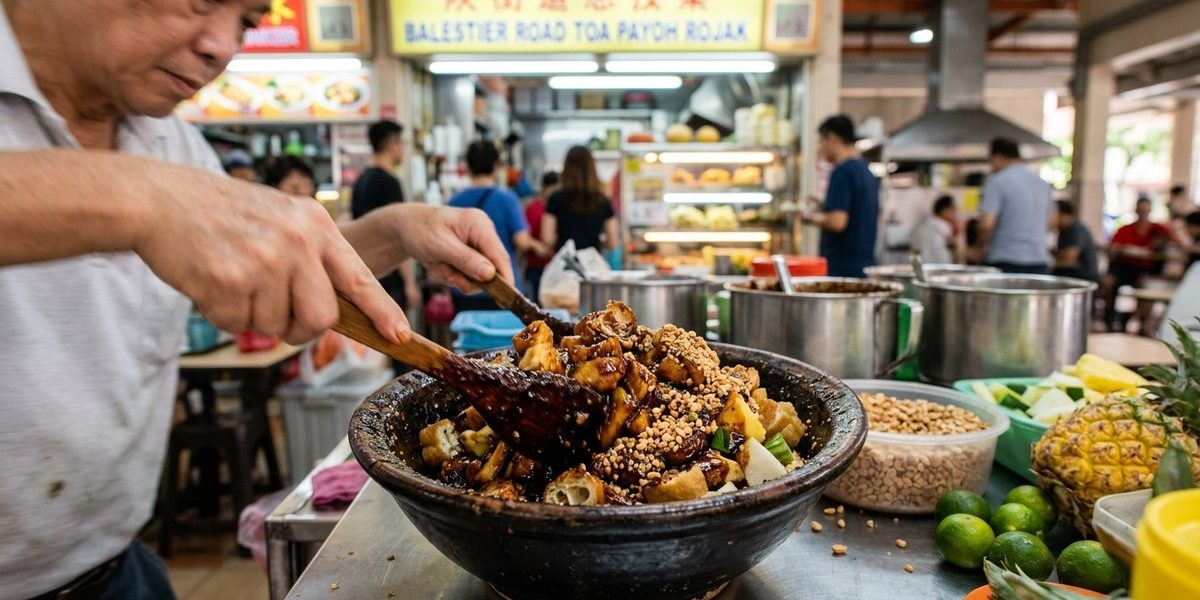
Some places in Singapore earn a reputation not through flashy marketing, but by doing one thing so well that word of mouth becomes a force of nature. That is exactly the story of this Toa Payoh rojak stall. Tucked inside a neighbourhood hawker centre that has seen generations of residents come and go, it has quietly built a following that borders on obsessive. Locals argue about its opening hours, plan their weekends around its queue, and some even travel from the east just for a single plate. What is the source of this devotion? It all comes back to one ingredient: the shrimp paste.
This Toa Payoh rojak stall’s shrimp paste is a handcrafted secret that transforms a humble plate of Chinese rojak into an unforgettable experience. Made in small batches using traditional fermentation methods, it delivers a depth of savoury, funky, and subtly sweet flavour that no commercial alternative can match. The stall’s loyal following, spanning decades, proves that when you respect the craft, people will travel across the island to taste the result.
The Secret Is in the Fermentation
Most rojak stalls buy their hae ko (shrimp paste) from a supplier. It works fine for everyday cravings, but it rarely leaves a lasting impression. This stall does things differently. The uncle behind the counter ferments his own shrimp paste, a practice that is becoming rarer with each passing year. He sources small local shrimp from the wet market, salts them, and lets them ferment in clay pots for months. The result is a paste that carries a layered umami, with a hint of sweetness and a backbone of savoury intensity.
The fermentation process is both science and art. The uncle adjusts the salt ratio based on humidity and temperature, something he learned from his father who ran a similar stall in the 1960s. He never writes down the recipe. It lives in his hands and his nose.
Why Homemade Matters
Commercial shrimp paste often uses shortcuts such as added preservatives or artificial colouring to speed up production. The texture can be gritty, and the flavour tends to be one dimensional. By contrast, this stall’s homemade version has a silky, spreadable consistency and a complex aroma that hits you before the plate even reaches your table.
Here are the key differences at a glance:
| Aspect | Homemade shrimp paste (this stall) | Commercial shrimp paste |
|---|---|---|
| Fermentation time | 4 to 6 months | 2 to 4 weeks |
| Ingredients | Fresh shrimp, sea salt only | Shrimp, salt, preservatives, colouring |
| Texture | Smooth, almost buttery | Gritty or pasty |
| Flavour profile | Deep umami with sweet and funky notes | Single note saltiness |
| Batch size | Small, limited weekly | Mass produced |
The stall goes through about 20 kilograms of paste a week. Each batch is hand stirred and checked daily. If the weather turns too humid, the uncle will adjust the salt content. If the shrimp are smaller than usual, he extends the fermentation time. This level of attention is unusual in any kitchen, let alone a bustling hawker stall.
How the Rojak Comes Together
The shrimp paste is just one part of the equation. The stall builds the entire rojak experience around it. Here is the step by step process you will witness if you stand at the queue and watch:
- Select the ingredients. You choose from a glass display of fried tofu, cuttlefish, century egg, you tiao, green mango, and cucumber. Regulars often order extra century egg and cuttlefish.
- Blanch and prep. The uncle blanches the selected items in hot water, then drains them. He does this to warm the ingredients so the sauce clings better.
- Make the sauce. In a large mixing bowl, he combines the homemade shrimp paste with a blend of chilli paste, sugar, freshly pounded peanuts, and a squeeze of calamansi. The proportions are his secret.
- Toss and coat. He adds the blanched ingredients to the bowl and tosses vigorously with a pair of wooden spatulas until every piece is glistening.
- Plate and garnish. The rojak is piled onto a plate, then sprinkled with more crushed peanuts and a handful of chilli flakes for those who want extra heat.
The sauce is the star. It strikes a perfect balance: the shrimp paste provides the savoury foundation, the chilli adds heat without overpowering, and the calamansi cuts through the richness. It is the kind of sauce that leaves you licking the plate clean.
“I have been eating here since I was in primary school. Now I bring my own kids. The sauce is unlike anything else. You can taste the effort in every bite.”
– Lim Ah Hock, a regular for 30 years
What You Need to Know Before You Go
This Toa Payoh rojak stall operates on its own schedule, which baffles first timers but adds to the allure. The stall opens around 11 am and closes when the shrimp paste runs out, which is often by 2 pm. Weekends see longer queues, but the turnover is decent.
Before you visit, keep these tips in mind:
- Bring cash. The stall does not accept digital payments, and there are no signs saying so. Be prepared.
- Visit on a weekday if you can. The queue moves faster, and the uncle is more likely to have extra sauce to give.
- Order extra sauce. Ask nicely, and the uncle will spoon a little more onto your plate. Don’t ask during rush hour.
- Pair your rojak with a cup of sugarcane juice from the drink stall two rows down. The sweetness cuts the savoury paste beautifully.
- Go before 1 pm. By 1:30 the paste is often gone, and the uncle will put up a small cardboard sign that reads “Habis” in permanent marker.
The stall’s address is well known among Toa Payoh residents, but we have covered the exact location and directions in our pillar page Why This Toa Payoh Rojak Stall’s Shrimp Paste Has a Cult Following. That page also includes a map and updated operating hours.
The Heritage Behind the Hawker
This stall is not just about great food. It represents a slice of Singapore’s hawker heritage that is slowly fading. The uncle learned the recipe from his father, who was part of the early generation of hawkers operating from pushcarts along Lorong 1 Toa Payoh. When the government relocated hawkers into permanent centres in the 1970s, the family moved indoors. The shrimp paste recipe never changed.
Stories like this remind us why preserving hawker culture matters. We wrote about the broader history in From Pushcarts to Permanent Stalls: How Singapore’s Hawkers Moved Indoors, and it gives context to places like this stall.
Keeping the Craft Alive
The uncle is now in his seventies. He still wakes up at 4 am to start the fermentation for the next batch. He has no successor in sight. His children have corporate jobs and no interest in the hawker life. That reality hangs over every plate he serves. Each visit might be one of the last times you taste a shrimp paste made this way.
What does it take to preserve such a craft? The answer involves more than just customers showing up. It requires a community that values tradition enough to support it. And in Singapore, that community is still strong. As long as people queue, the uncle will keep stirring his clay pots.
A Plate Worth the Pilgrimage
If you have not yet tried this Toa Payoh rojak stall, make a plan. Clear your Saturday morning, bring cash, and prepare to wait. The shrimp paste is not just an ingredient. It is a story of patience, skill, and a man who refuses to cut corners. One taste, and you will understand why people call it a cult favourite.
The next time you find yourself in Toa Payoh, skip the bubble tea and queue for this stall instead. Your taste buds will thank you. And if you want to explore more hidden gems like this, browse our collection of stories about Singapore’s most dedicated hawkers. There are many more waiting to be discovered.