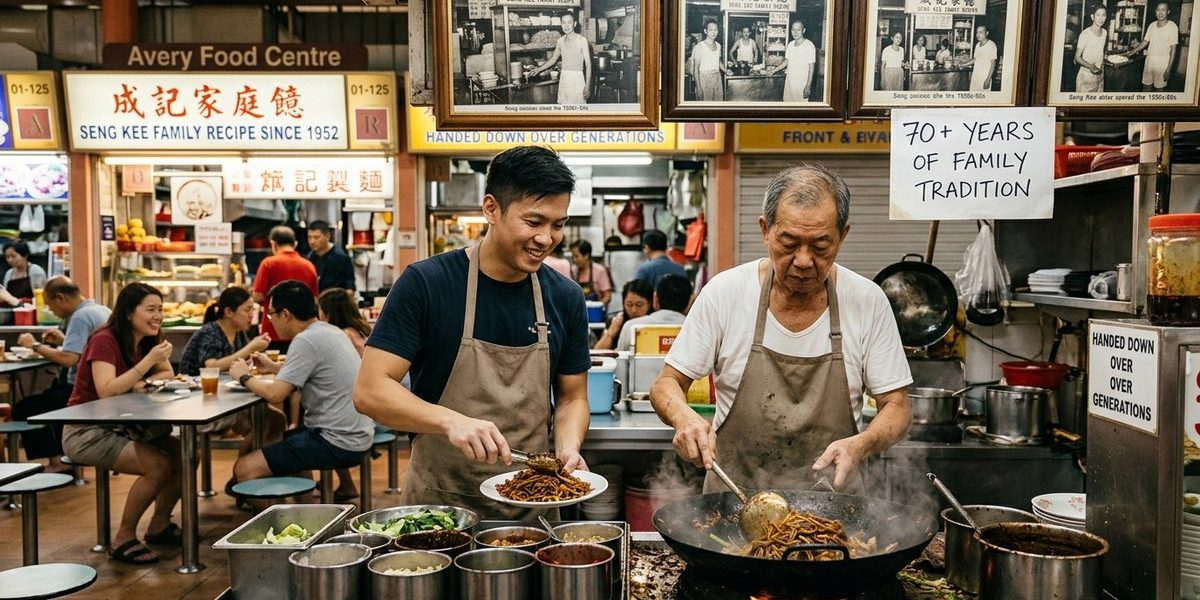
A bowl of steaming laksa arrives at your table. The gravy is thick, fragrant with coconut milk and belacan. You take a spoonful and taste something you cannot quite place. It is not just rempah or spice. It is memory. At certain stalls across Singapore, that memory stretches back more than seven decades. The recipe has never changed. The same handwritten notes, the same proportions, the same fire. These are not just hawker stalls. They are living archives of taste.
Singapore’s oldest family recipe hawker stalls have survived war, relocation, and changing palates by guarding their recipes like state secrets. This article uncovers five stalls that have served the same dish for over 70 years, explains how they preserve authenticity, and gives you a practical guide to tasting living heritage without falling for tourist traps.
What Makes a Family Recipe Last 70 Years
A recipe is just a list of ingredients until someone pours their life into it. The stalls we feature here have outlasted governments, hawker centre relocations, and the rise of food delivery apps. Their secret is not complicated.
They refuse to compromise.
Every one of these stalls uses the same core method their founder used. Some still insist on charcoal fire. Others grind their own spices by hand. A few have never written their recipe down at all. The knowledge passes from parent to child through observation and repetition. No cookbook. No video tutorial. Just hours spent watching and learning.
Here is what these heritage stalls have in common:
- The founder or a direct descendant still works the wok every day
- Core ingredients are sourced from the same suppliers, sometimes for decades
- No shortcuts on preparation time, even during lunch rush
- The recipe has never been altered for cost or convenience
- Customers span three or four generations of the same families
The Five Stalls That Define Heritage Hawker Food
1. Sungei Road Laksa (Since 1956)
This stall began as a pushcart along Sungei Road, serving workers from the nearby textile shops. The laksa gravy takes four hours to cook. The owner’s grandmother developed the spice paste in the 1950s, and the ratio of coconut milk to stock has not changed since.
What sets this laksa apart is the use of thick, hand-cut rice noodles and a broth that balances lemak (richness) with a sharp chilli kick. You will not find any shortcut coconut cream here. Only freshly grated coconut milk.
2. Original Alhambra Satay (Since 1952)
Named after the old Alhambra Cinema at Beach Road, this satay stall started when the founder sold skewers outside the theatre. The marinade contains a blend of spices that the family has kept locked in a safe for over 70 years. Only two people know the full recipe: the current owner and his eldest son.
The satay is grilled over charcoal, not gas. The owner insists this is non-negotiable. Charcoal gives the meat a smoky depth that gas cannot replicate. Each skewer is turned by hand, basted with the same oil mixture from the 1950s.
3. Bukit Merah View Carrot Cake (Since 1954)
Do not let the name confuse you. This is not the sweet carrot cake you find in bakeries. This is chai tow kway, the savoury radish cake fried with eggs, chilli, and preserved radish. The founder learned the recipe from his father in China before bringing it to Singapore.
The white version uses a simple mix of rice flour and water, fermented for exactly 18 hours. The black version adds a house-made sweet soy sauce that has been aged in clay pots. The stall still uses a traditional stone grinder for the radish paste.
4. Wah Kee Big Prawn Noodles (Since 1958)
Wah Kee began as a small coffee shop stall in Upper Thomson. The broth is the star here. It simmers for at least eight hours using pork bones, dried shrimp, and a secret blend of soy sauce. The owner’s grandfather developed the recipe when prawn noodles were a luxury dish.
The prawns are still peeled by hand. The yellow noodles are sourced from the same supplier since 1960. The chilli padi is chopped fresh each morning. Nothing comes from a packet.
5. Che Rose Nasi Padang (Since 1951)
Che Rose started as a home kitchen in Geylang Serai, serving the Malay and Indian Muslim community. The recipes date back to the owner’s grandmother in Java. Every spice paste is ground from whole spices. No pre-mixed curry powders are allowed.
The beef rendang takes three hours to cook. The sambal goreng uses a chilli paste that ferments for two days. The owner says the secret is patience. You cannot rush rendang.
How These Stalls Preserve Their Recipes Across Generations
Passing a recipe down is harder than it sounds. The younger generation often has different ideas. Some want to modernise. Others want to reduce costs. At these stalls, the family has found ways to keep the recipe intact while still making a living.
| Challenge | How They Handle It |
|---|---|
| Rising ingredient costs | They absorb the margin or raise prices slightly, never swap ingredients |
| Younger generation not interested | They start training children early, often from age 12 |
| Health regulations | They adapt cooking methods (e.g., using stainless steel) but keep the recipe itself unchanged |
| Tourist expectations | They refuse to dilute flavours for foreign palates |
| Competition from newer stalls | They rely on loyal regulars and word of mouth |
One owner told us: “If people want a cheaper version, they can go elsewhere. My grandfather’s name is on this stall. I will not be the one who ruined it.”
A Practical Guide to Visiting Heritage Hawker Stalls
You want to experience these stalls. But you also want to avoid the crowds and the tourist traps. Here is a simple process that works.
- Go on a weekday morning between 9am and 11am. The lunch crowd has not arrived yet. The owners have time to chat.
- Order the signature dish first. Do not ask for modifications. Eat it exactly as the recipe intends.
- Observe the cooking process. Watch how the owner handles the wok or the grill. You will learn more in two minutes than from any food blog.
- Ask one question only: “How long have you been making this?” If the owner smiles and says “Since I was a boy,” you are in the right place.
- Pay in cash if possible. Many heritage stalls still prefer it. It also shows respect.
“When you eat at a stall that has been around for 70 years, you are eating the same meal your grandfather ate. That is a connection you cannot get anywhere else.” — Third-generation hawker at Original Alhambra Satay
What Not to Do at These Stalls
Some behaviours can offend the owners. Avoid these mistakes.
- Do not ask for the full recipe. It is a family secret. Asking is rude.
- Do not complain about the queue. The queue is proof the food is good.
- Do not request less oil, less salt, or less chilli. You are asking them to change a 70-year-old recipe.
- Do not take photos of the cooking area without asking. Some owners are private.
- Do not compare their food to a chain restaurant version. It insults their craft.
Why These Recipes Matter Beyond the Food
Singapore changes fast. Old buildings make way for new malls. Traditional trades disappear. But a bowl of laksa or a plate of satay can carry a story across time. These stalls are not just selling food. They are selling continuity.
When you sit down at Sungei Road Laksa, you are sharing a meal with everyone who has eaten there since 1956. The same spoon. The same broth. The same taste. That is rare in any city. In Singapore, it is precious.
The owners know this. They feel the weight of responsibility. One told us he wakes up at 4am every day because his grandmother did the same. He does not question it. He just keeps stirring.
How to Spot a Truly Old Family Recipe Stall
Not every stall that claims to be old actually is. Some rebrand themselves with heritage stories. Here is how to tell the real ones.
- Look for the founder’s photo on the wall. Real heritage stalls display their history proudly.
- Check if the stall has a second generation working there. If the owner is under 50, ask who taught them. If they say “my father” or “my uncle,” it is likely genuine.
- Taste the broth. Real long-cooked broth has depth. It coats your tongue. Fake broth is thin and salty.
- Observe the queue. Heritage stalls have regulars who come every week. They do not need Instagram hype.
- Ask the owner about the ingredients. If they can name their supplier and how long they have used them, it is real.
The Future of These Family Recipes
The biggest threat to these stalls is not competition. It is succession. Many young Singaporeans do not want the hawker life. The hours are long. The work is physical. The profit margins are thin.
But there is hope. Some of the stalls we featured have already trained the next generation. The grandson of the Sungei Road Laksa founder now runs the stall full time. The daughter of the Wah Kee owner left her corporate job to take over the broth.
These younger hawkers are not changing the recipes. They are learning them exactly as they were taught. That is the only way the recipe survives.
If you want to support them, the best thing you can do is simple. Eat at their stall. Tell your friends. Bring your children. Let them taste what real heritage food tastes like.
Your Heritage Hawker Checklist
Before you head out, here is a summary of what to look for and what to avoid.
- Real heritage stalls: family run, unchanged recipe, long cooking time, loyal regulars
- Fake heritage stalls: recent rebranding, no family connection, short cuts in preparation, heavy social media presence
- Best time to visit: weekday mornings, before 11am
- Best attitude: respectful, curious, patient
- Best order: the signature dish, no modifications
Keep the Tradition Alive by Eating Well
You now know where to find the oldest family recipe hawker stalls in Singapore. You know how to spot them, how to order, and how to show respect. The rest is up to you. Go to the hawker centre. Queue patiently. Eat slowly. Taste the history. And when you finish that last spoonful of laksa or that final skewer of satay, remember that you just took part in a tradition that has lasted longer than most countries. That is worth the trip.